 comparison
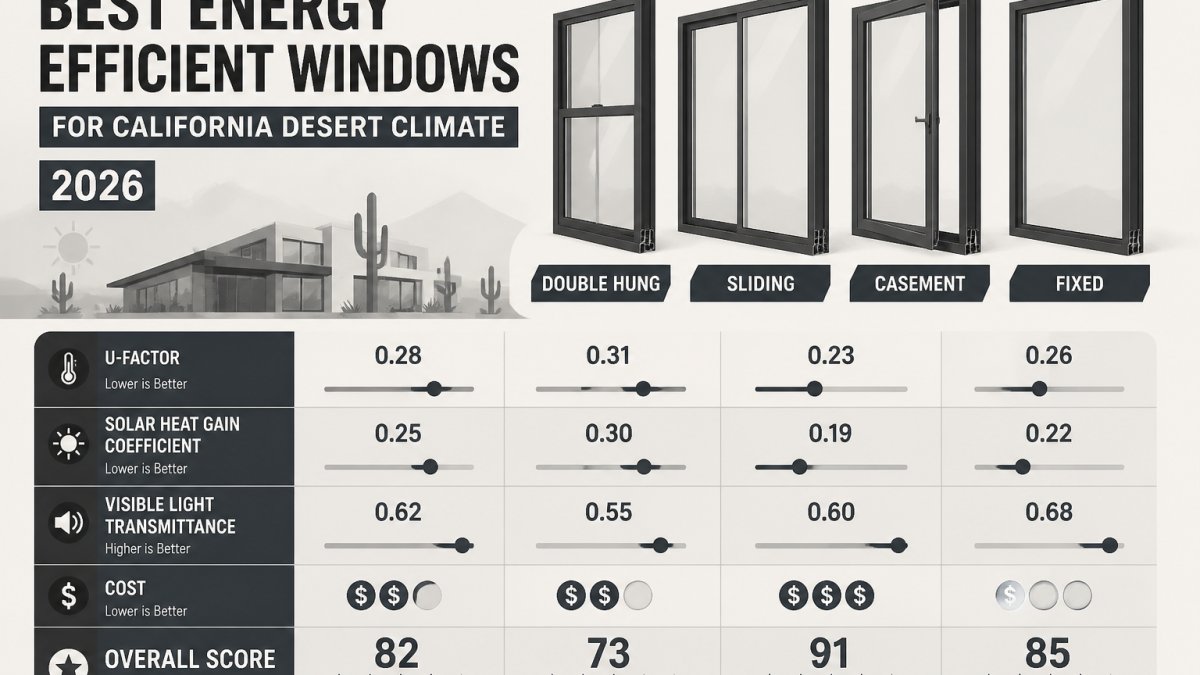
Best Energy Efficient Windows for California Desert Climate 2026
Last Updated: October 23, 2026
Quick Summary
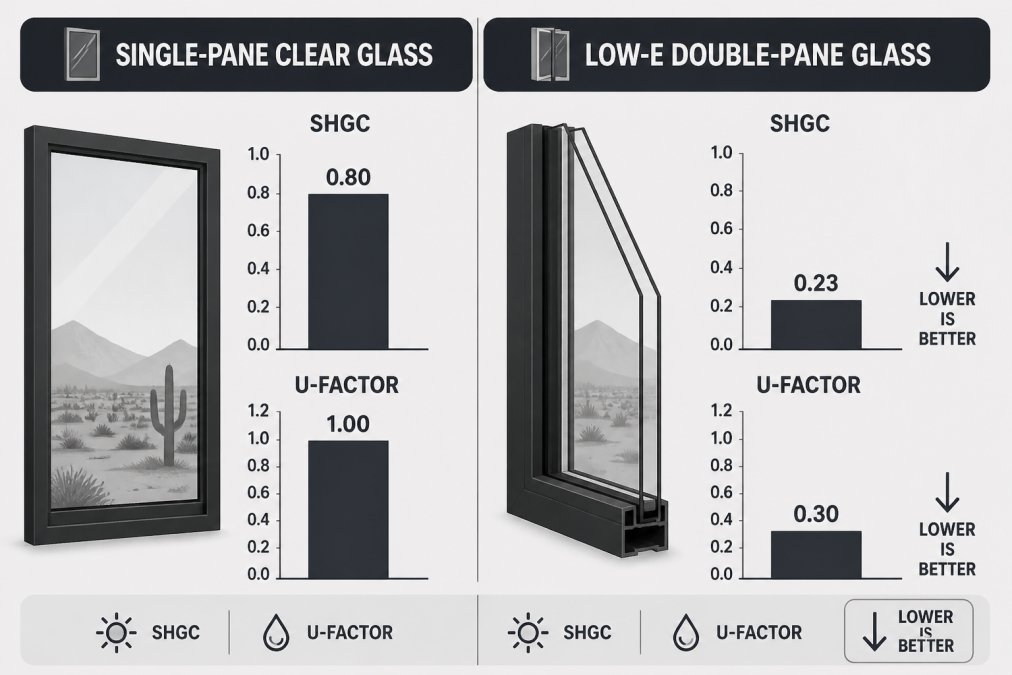
The best energy efficient windows for California desert climate in 2026 pair low-E double-pane glass with argon fill and a thermally efficient frame, targeting an SHGC of 0.23 or lower and a U-factor of 0.30 or lower. Ratings come first, then frames, then style, and installation quality decides whether the window performs as rated.
- Read the NFRC label on the specific unit you buy, not the product line brochure.
- Soft-coat low-E sealed inside an insulated glass unit is the usual desert recommendation.
- Triple-pane pays off mainly on very exposed west-facing walls and for noise reduction.
- Vinyl frames outperform aluminum in desert heat for most homes.
- Specify glass by elevation, since west-facing glass takes the harshest afternoon sun.
Table of Contents
- Why California Desert Homes Need Different Windows
- Window SHGC and U-Factor Explained
- Low-E Windows for Desert Heat: Coatings That Block Sun
- Double-Pane vs. Triple-Pane Windows: What Pays Off in the Desert
- Vinyl vs. Aluminum Window Frames for Hot, Dry Conditions
- Comparing the Best Energy Efficient Windows for 2026
- Orientation, Shading, and Installation Quality
- Frequently Asked Questions
Why California Desert Homes Need Different Windows
A window that performs well in a coastal climate can fail badly 60 miles inland. The best energy efficient windows for California desert climate in 2026 are not the ones with the thickest glass or the highest price tag, they are the ones matched to intense solar gain, wide day-night temperature swings, and long cooling seasons. At Times Square Remodeling Inc., we have spent more than 15 years transforming homes through expert craftsmanship, and the pattern is consistent: desert-facing homes live or die by glass performance and installation quality, not brand names.
What Desert Heat Does to Ordinary Glass
Ordinary clear glass is nearly transparent to solar radiation. Sunlight passes through, strikes floors and furniture, and converts to heat that stays trapped inside. In a desert climate, that trapped heat arrives in the middle of the afternoon, exactly when cooling demand peaks.
Ultraviolet rays cause a second, slower problem. They fade flooring, upholstery, and artwork over time. Heat blocking coatings address both issues at once, which is why low-emissivity glass has become the default specification for new and replacement windows in hot, sunny regions.
How to Read the Ratings Before You Buy
Every window sold in the United States carries a label from the National Fenestration Rating Council (NFRC). That label is the single most useful comparison tool a homeowner has, because it reports measured performance rather than marketing claims.
Three numbers matter most:
- U-factor measures how quickly heat moves through the whole window assembly. Lower is better.
- Solar Heat Gain Coefficient (SHGC) measures how much solar heat the window admits. Lower means less heat gain.
- Visible transmittance (VT) measures how much daylight passes through. Higher means a brighter room.
The mistake most buyers make is shopping by appearance and asking about ratings afterward. Reverse that order. Ratings first, then frames, then style.
NFRC certified product directory and rating explanations
Window SHGC and U-Factor Explained
Window SHGC and U-factor are the two performance ratings that decide how a window behaves in desert heat. SHGC controls how much sun heat enters; U-factor controls how fast heat leaks through the glass and frame. A window can score well on one and poorly on the other, so compare both together before choosing.
Solar Heat Gain Coefficient (SHGC)
Solar Heat Gain Coefficient (SHGC) is the fraction of incoming solar radiation that enters a building as heat, expressed as a number between 0 and 1.
For desert conditions, a low SHGC is the priority. West- and south-facing glass absorbs the most direct sun, so those elevations benefit most from aggressive heat blocking. Guidance from Fusion Windows on hot-climate window performance cites an SHGC of 0.23 or lower as a reasonable hot-climate target.
U-Factor and Visible Transmittance
U-factor measures heat flow through the entire window, including frame and spacers. Lower values indicate better insulation. The same hot-climate guidance cites a U-factor of 0.30 or lower as a cited California Title 24 target.
Visible transmittance is the trade-off. Coatings that block solar heat also reduce daylight, so a very low SHGC can leave a room dim. The goal is balance: strong heat rejection without turning the living room into a cave.
Low-E Windows for Desert Heat: Coatings That Block Sun
Low-E windows for desert heat use a microscopically thin metallic coating that reflects infrared radiation while letting visible light pass.
Two families of coating exist. Soft-coat low-E delivers the strongest heat rejection and is typically sealed inside an insulated glass unit. Hard-coat low-E is more durable and slightly less effective.
What most guides miss is that coating position matters as much as coating type.
Double-Pane vs. Triple-Pane Windows: What Pays Off in the Desert
Double-pane windows are the practical choice for most desert homes, but the decision is not as simple as counting panes.
Here is the honest comparison for desert conditions:
| Feature | Double-Pane | Triple-Pane |
|---|---|---|
| Typical SHGC range with low-E | 0.23-0.40 | 0.20-0.35 |
| Typical U-factor range | 0.30-0.40 | 0.20-0.30 |
| Heat blocking in peak summer | Strong with low-E | Strongest |
| Weight and frame stress | Moderate | Higher |
| Daylight | Good balance | Slightly reduced |
| Repair complexity | Simpler | More complex |
| Best for | Most desert homes | Extreme exposure, noise reduction |
Triple-pane earns its place on very exposed west-facing walls and on homes where outside noise is a concern. For the typical desert house, the better investment is upgrading the glass coating and the frame rather than adding a third pane.
How Title 24 and NFRC Ratings Guide Pane Selection
California's Title 24 energy code sets prescriptive requirements for window performance that vary by climate zone. In the desert zones, the code typically demands a maximum U-factor and a maximum SHGC that push builders toward double-pane low-E glass as a baseline. Triple-pane can help meet stricter targets, but it is not automatically required, and the code allows trade-offs between envelope measures.
Inert Gas Fills and Insulated Glass Units
An insulated glass unit (IGU) is a sealed assembly of two or more panes separated by a spacer, with a trapped air or gas layer between them.
The seal is the weak point. When an IGU fails, moisture fogs the glass and the insulating gas escapes.
If you are weighing window upgrades against other efficiency work, it helps to know whether adding insulation reduces HVAC energy bills before you commit your budget to one measure.
Vinyl vs. Aluminum Window Frames for Hot, Dry Conditions
Vinyl frames outperform aluminum in desert heat for most homes. Vinyl conducts very little heat, resists moisture, and does not need a thermal break to perform well. Aluminum is strong and slim, but it conducts heat readily and requires a thermal break to avoid becoming a hot bridge through the wall.
Thermal Breaks and Frame Durability
A thermal break is an insulating barrier set between the inner and outer sections of a metal frame to stop heat transfer. Without one, an aluminum frame can radiate heat inward on a summer afternoon and condense moisture in winter.
Durability is the counterargument. Vinyl can warp or crack under sustained extreme heat if the profile is thin, which is why frame wall thickness matters. Aluminum holds its shape but needs the thermal break to be effective.
Comparing the Best Energy Efficient Windows for 2026
The best energy efficient windows for California desert climate in 2026 come from three places: certified product lines, verified ratings, and a contractor who installs them properly. Here is how the main options compare.
| Option | What It Offers | Watch Out For |
|---|---|---|
| ENERGY STAR certified windows | Recognized efficiency benchmark | Certification alone does not fit the home |
| Low-E double-pane with argon | Strong heat blocking, good daylight | Seal quality varies by maker |
| Thermally broken aluminum | Slim sightlines, strength | Must verify the thermal break |
| Quality vinyl double-pane | Low conductivity, moisture resistance | Check profile thickness |
ENERGY STAR Certified Residential Windows
ENERGY STAR residential windows program sets a recognized efficiency benchmark for residential windows, doors, and skylights. The program reports that certified products can reduce heating and cooling costs by an average of up to 13%. That figure is an average across climates, not a promise for a specific desert home, but it gives buyers a credible floor for comparison.
The ENERGY STAR Climate Zone Finder
The ENERGY STAR climate zone finder lets you select your state and county to identify products suited to your local climate. This matters because a window certified for a mild coastal zone is not automatically the right specification inland. Use the finder before you shortlist models.
Orientation, Shading, and Installation Quality
Installation quality decides whether a good window performs as rated.
Orientation comes first. West-facing glass takes the harshest afternoon sun and benefits most from low SHGC. South-facing glass can be shaded with overhangs. East-facing glass gains heat in the morning.
Shading helps but does not replace ratings.
Sealing is the last and most overlooked step. If you want practical steps to tighten up after a window upgrade, a guide on how to seal air leaks around windows and doors covers common materials and methods.
If cooling load is your main concern, it is worth comparing heat pump vs central air efficiency and reviewing roofing materials for California climate, since the roof and windows together drive most of the heat gain in a desert home. Homeowners also ask whether a smart thermostat is worth it for energy savings once the envelope is tightened.
Desert heat punishes weak specifications, and windows are where that shows up first.
Frequently Asked Questions
What type of windows are best for a hot, dry desert climate?
Look for dual-pane or triple-pane units with a low-E coating and an inert gas fill such as argon. In desert conditions the glass package matters more than the brand: a low solar heat gain coefficient keeps intense sun from cooking the room, and a low U-factor slows heat transfer. Pair that glass with a frame that resists warping and cracking, and have it installed with proper air sealing. ENERGY STAR's climate zone finder lets you check which products are rated for your county.
What U-factor and SHGC should I look for in desert-climate windows?
Hot-climate guidance from window manufacturers cites a solar heat gain coefficient of 0.23 or lower and a U-factor of 0.30 or lower as targets, with the U-factor figure tied to California Title 24 considerations. Treat those as a starting point, not a rule for every wall. A west-facing window with full afternoon sun benefits from the lowest SHGC you can get, while a shaded north window can trade some solar control for more visible transmittance and daylight.
Are double-pane or triple-pane windows better for desert homes?
Double-pane windows with a good low-E coating and argon fill handle desert heat well and cost less than triple-pane. Triple-pane adds a third pane and another insulating gap, which raises performance but also weight and price. In a climate where cooling dominates, the coating and gas fill usually do more work than the extra pane. Spend the difference on better glass on sun-facing walls and on careful installation instead.
Do energy-efficient replacement windows qualify for a federal tax credit in 2026?
Federal incentives change from year to year, so confirm current eligibility with a tax professional or the IRS before you buy. What you can control is documentation: keep the manufacturer's NFRC label and certification statement for every unit installed. Those records show the U-factor and solar heat gain coefficient of the exact product, which is what any incentive program or rebate asks for. Your contractor should hand them over at project close.
Are vinyl or aluminum frames more energy efficient in hot climates?
Vinyl frames insulate better because the material itself resists thermal transfer, and they hold up well against moisture. Aluminum is stronger and thinner, but it conducts heat, so an aluminum frame needs a thermal break to perform in desert sun. For most residential replacements in hot, dry conditions, vinyl is the simpler choice. Aluminum with a proper thermal break works when you want slim sightlines or a specific architectural look.