 comparison
Heat Pump vs Central Air: Efficiency Comparison
Table of Contents
- Heat Pump vs Central Air: Key Differences
- Heat Pump vs Air Conditioner Efficiency: Cooling Performance
- Heat Pump Heating Efficiency and Year-Round Capability
- Heat Pump Energy Consumption vs Central AC Operating Costs
- Heat Pump Maintenance Requirements and Lifespan
- Upfront Costs and Long-Term Value
- Which System Is Right for Your Home?
- Frequently Asked Questions
Last Updated: October 10, 2026
Heat Pump vs Central Air: Key Differences
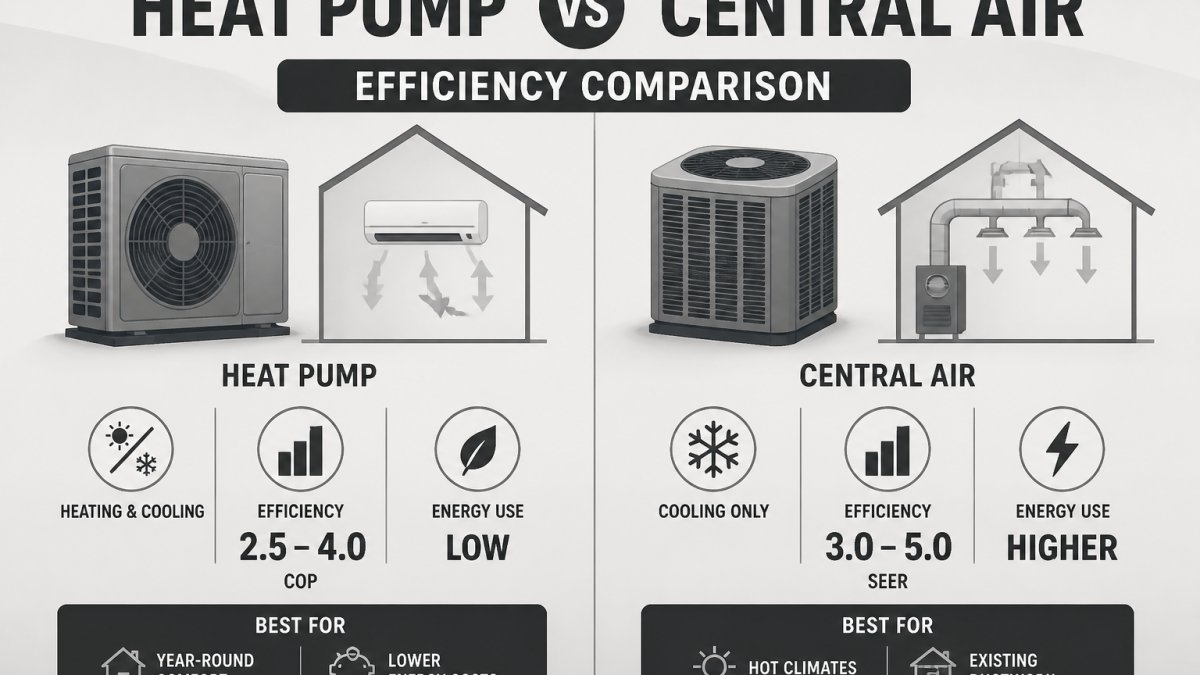
A heat pump vs central air comparison reveals two fundamentally different approaches to home climate control. At Times Square Remodeling Inc., we help homeowners understand that a heat pump provides both heating and cooling from a single system, while a central air conditioner delivers cooling only and typically pairs with a separate furnace for heating. This distinction shapes everything from upfront installation costs to your monthly energy bills and long-term home comfort.
The core difference lies in how each system moves or generates heat. A heat pump transfers heat between your home and the outdoors using a refrigeration cycle. In cooling mode, it works like a traditional air conditioner. In heating mode, it reverses direction to pull heat from outside air and move it indoors, even in cold weather. A central air conditioner only moves heat out of your home; it cannot provide heating.
Understanding this fundamental split is essential for making the right choice for your climate and lifestyle.
Heat Pump vs Air Conditioner Efficiency: Cooling Performance
When comparing cooling performance, a heat pump vs central air reveals an important truth: both systems use identical refrigeration cycles in cooling mode, and their cooling efficiency ratings are directly comparable.
Understanding SEER2 and Real-World Cooling Efficiency
Both systems are rated using SEER2 (Seasonal Energy Efficiency Ratio 2), a metric that reflects average cooling efficiency across a range of outdoor temperatures and operating conditions.
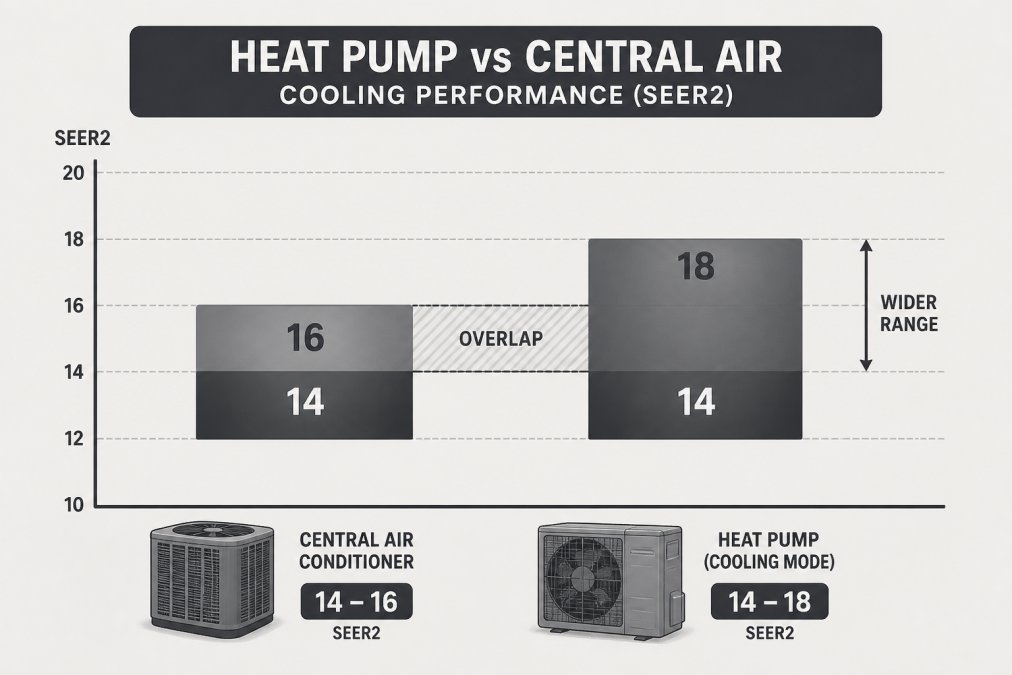
- Central air conditioners typically achieve 14-16 SEER2 in standard installations
- Heat pumps in cooling mode typically achieve 14-18 SEER2 in standard installations
The overlap is significant.
What SEER2 Means in Dollars and Kilowatt-Hours
SEER2 is a ratio: higher numbers mean lower energy consumption. A system rated 15 SEER2 uses roughly 20% less electricity for cooling than a system rated 12 SEER2.
The practical advantage of a heat pump in cooling mode lies not in superior cooling efficiency, but in year-round utility.
Capacity and Sizing Matter More Than System Type
A properly sized central air conditioner will outperform an oversized heat pump, and vice versa. Both systems must be matched to your home's cooling load through a professional Manual J calculation.
Heat Pump Heating Efficiency and Year-Round Capability
This section separates the two systems most dramatically. A central air conditioner provides zero heating; you must rely on a furnace or other heat source. A heat pump heating efficiency advantage comes from moving heat rather than generating it through combustion.
A heat pump can operate at up to 300% efficiency in heating mode without burning fuel, meaning it moves three units of heat for every unit of electricity consumed. This is fundamentally different from a furnace, which converts fuel into heat at 80-95% efficiency. A heat pump's efficiency drops in extremely cold climates, which is why many cold-weather installations include auxiliary electric heating as backup.
Heat pumps excel in moderate climates where outdoor temperatures rarely drop below freezing. In California's diverse climate zones, from coastal regions to inland valleys, heat pumps provide reliable heating for most of the year.
Central air conditioners offer no heating whatsoever. If your furnace fails or you need replacement heating, a central air conditioner leaves you dependent on a separate system.
Heat Pump Energy Consumption vs Central AC Operating Costs
Energy consumption differs between the two systems because they serve different purposes. A central air conditioner cools only; a heat pump energy consumption covers both heating and cooling.
For cooling alone, both systems draw similar power. The advantage of a heat pump emerges when you combine heating and cooling costs. Because a heat pump moves heat instead of generating it through combustion, your total annual electricity use often drops compared to running a furnace plus a central air conditioner.
The practical impact depends on your current heating system. If you're replacing an old furnace and air conditioner with a heat pump, you may see lower combined utility costs. If you already have an efficient furnace and only need to replace your air conditioner, adding a heat pump won't save money, it will simply add complexity.
Heat Pump Maintenance Requirements and Lifespan
Maintenance and lifespan are where the operational differences between heat pumps and central air conditioners become concrete. While both systems can last 15-20 years with proper care, the maintenance burden and failure modes differ significantly.
Seasonal vs. Year-Round Operation and Component Wear
A central air conditioner operates only during cooling season (typically 4-6 months per year in most climates). A heat pump runs in both heating and cooling modes year-round, cycling between seasons. This continuous operation means:
- Compressor wear: The compressor is the most expensive component in either system. Year-round cycling in a heat pump subjects it to more on-off cycles than a seasonal air conditioner, increasing stress over time.
- Refrigerant circulation: Heat pumps circulate refrigerant through both heating and cooling cycles; central AC circulates only during cooling season. More circulation means more wear on seals and connections.
- Reversing valve: Heat pumps include a reversing valve that switches the refrigeration cycle between heating and cooling modes. This valve has no equivalent in a central air conditioner. Reversing valves can fail, requiring replacement ($300-$600 in labor and parts), and they add a potential failure point that central AC units simply do not have.
Annual Maintenance Requirements
Both systems require professional inspection before the heating or cooling season:
- Refrigerant charge verification: Undercharged systems lose efficiency; overcharged systems can damage the compressor. Heat pumps require more frequent checks because they operate year-round.
- Coil cleaning: Outdoor and indoor coils accumulate dust and debris. Central AC coils need cleaning once per year; heat pump coils may need cleaning twice per year depending on climate and usage.
- Electrical connections and capacitors: Both systems use capacitors to start the compressor and fan motors. Heat pump capacitors experience more cycling and may fail sooner.
- Filter replacement: Both systems use air filters (typically 1-3 months). Heat pump filters may need more frequent replacement due to year-round operation.
- Ductwork inspection: Both systems rely on ducts; leaky ducts reduce efficiency in both cases. Heat pump ductwork should be sealed and insulated to minimize heating losses in winter.
Lifespan and Component Replacement
With proper maintenance, both systems typically last 15-20 years. However:
- Central air conditioners often reach the upper end of this range (18-20 years) because seasonal operation reduces cumulative stress.
- Heat pumps more commonly require major component replacement (compressor, reversing valve, or fan motor) around year 12-15 due to year-round cycling. A compressor replacement may occur before the system reaches end of life.
Refrigerant Considerations
Both systems use refrigerant, but heat pumps require more careful handling. If a heat pump develops a refrigerant leak, it loses heating capability in winter immediately, a critical failure. Central air conditioners lose cooling capability, also serious but typically not an emergency in cold months.
Maintenance Cost Comparison
A typical annual maintenance visit for either system involves routine service. Heat pump owners should budget for potential reversing valve or capacitor replacement, whereas central air owners rarely face these specific costs. If a compressor fails in either system, expect a major expense that can occur in year 10-15 for a heat pump or year 15-20 for a central AC unit.
Upfront Costs and Long-Term Value
Comparing upfront installation costs reveals why many homeowners hesitate to choose a heat pump. A ducted heat pump system installed after incentives is comparable to a full heating-and-cooling replacement but delivers both functions in one system.
The long-term value calculation depends on what you're replacing. If you need both a new furnace and a new air conditioner, a heat pump consolidates both into one installation, potentially simplifying the process and reducing labor costs. If you only need to replace your air conditioner and your furnace is relatively new, a central air conditioner is the lower-cost option.
Energy savings over 10-15 years can offset the upfront premium, but the timeline varies by climate, local utility rates, and your current heating system efficiency. At Times Square Remodeling Inc., we help homeowners model these scenarios to understand true cost of ownership.
Which System Is Right for Your Home?
Choosing between a heat pump vs central air depends on three factors: your climate, your current heating system, and your timeline for equipment replacement.
Choose a heat pump if:
- You need to replace both heating and cooling equipment
- You live in a moderate climate where winter temperatures rarely drop below 20°F
- You want a single, integrated system to manage year-round comfort
- You're interested in electrification and reducing fossil fuel dependence
Choose central air conditioning if:
- You have a functioning furnace you plan to keep
- You only need cooling replacement
- You live in a very cold climate where heat pump efficiency drops significantly
- You want the lowest upfront installation cost
Times Square Remodeling Inc. specializes in energy-efficient home upgrades, including both heat pump and central air conditioning installations tailored to California's climate zones. We evaluate your existing systems, model long-term costs, and recommend the solution that maximizes comfort and efficiency for your specific home.
Choosing the right cooling and heating system is one of the most significant decisions in home comfort and energy management. If you're ready to upgrade your HVAC system with professional installation and expert guidance, Times Square Remodeling Inc. brings 15+ years of experience in energy-efficient home upgrades. We handle everything from system selection through installation, ensuring your new system operates at peak efficiency and integrates seamlessly with your home. Contact us for a comprehensive evaluation and personalized recommendation based on your climate, home layout, and budget.
Frequently Asked Questions
What is the main difference between a heat pump and central air conditioning?
A central air conditioner cools your home only and requires a separate heating system like a furnace. A heat pump provides both heating and cooling in one unit by moving heat between indoors and outdoors. In winter, a heat pump extracts heat from outside air and moves it inside; in summer, it reverses to cool. This dual function makes a heat pump a complete heating and cooling solution, while central AC handles cooling alone.
Is a heat pump more efficient than central air conditioning for cooling?
Heat pumps and central air conditioners deliver similar cooling efficiency in moderate climates. Both can achieve SEER2 ratings of 14-18, which measures cooling performance. The real efficiency advantage of a heat pump appears in heating mode, where it can reach 300% efficiency by moving heat rather than generating it. For cooling alone, a modern central AC unit performs comparably to a heat pump's cooling cycle.
How much energy does a heat pump use compared with central AC and a furnace?
A heat pump typically uses 30-50% less energy than a central AC paired with a furnace because it provides heating by moving existing heat instead of burning fuel. However, actual energy consumption depends on your climate, insulation, and how often you run each system. In cold climates, a heat pump may use backup electric heating on extremely cold days, which increases consumption. A professional energy audit can estimate your home's specific savings.
How often should a heat pump be serviced compared with central air conditioning?
Heat pumps typically require annual maintenance, similar to central AC units. Both systems need refrigerant checks, filter changes, and coil cleaning. Heat pumps may need slightly more frequent service because they operate year-round in both heating and cooling modes, while a central AC runs seasonally for cooling only. Regular maintenance keeps both systems running efficiently and extends their lifespan to 15-20 years.