 comparison
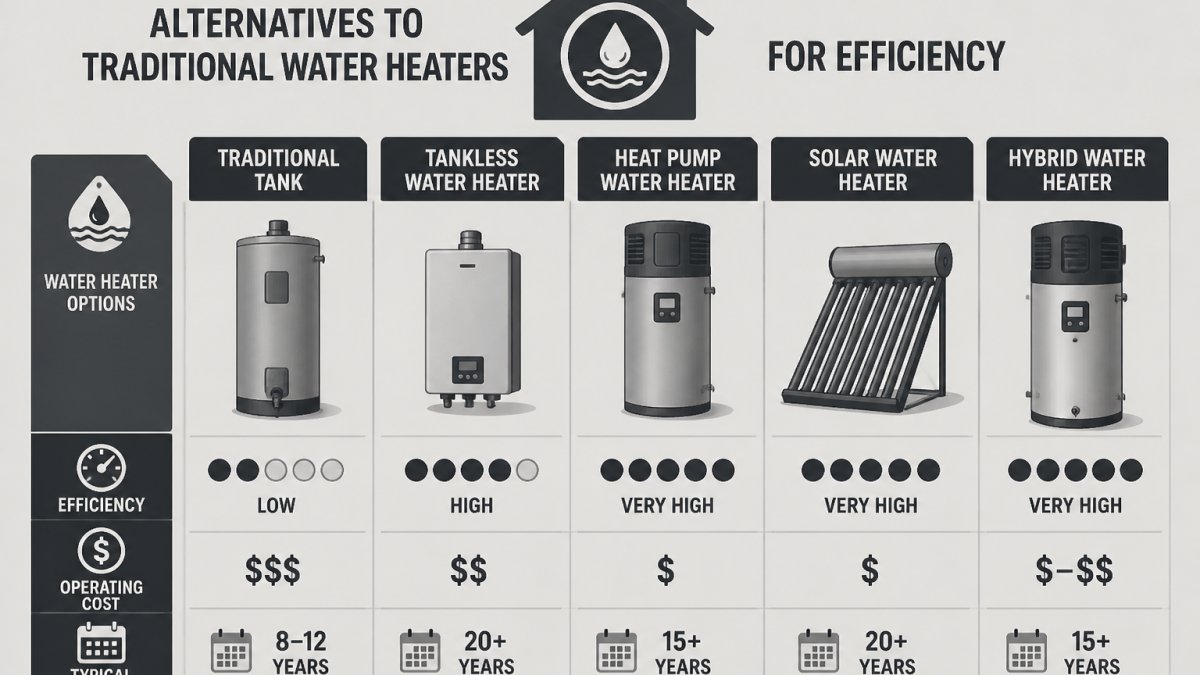
Alternatives to Traditional Water Heaters for Efficiency
Table of Contents
- Why Traditional Water Heaters Waste Energy
- Heat Pump Water Heater: How It Works and Who It Suits
- Tankless Water Heater Efficiency: On-Demand Hot Water
- Solar Water Heater for Home: Using the Sun to Cut Energy Use
- Water Heater Sizing for Household Demand
- Comparing Lifecycle Costs and Efficiency Metrics
- Installation Constraints, Maintenance, and Lifespan
- Choosing the Right Water Heater Efficiency Upgrade
- Frequently Asked Questions
Last Updated: October 12, 2026
Why Traditional Water Heaters Waste Energy
A storage-tank water heater keeps a full cylinder of hot water ready around the clock, whether anyone is using it or not. According to the U.S. Department of Energy guide to water heating, water heating is typically the second-largest energy expense in a home, which is why so many homeowners now ask us at Times Square Remodeling Inc. about alternatives to traditional water heaters for efficiency.
A conventional tank heats water with a gas burner or electric element, stores it, and reheats it as it cools.
Alternatives to traditional water heaters for efficiency attack that waste differently. Heat pumps move heat instead of making it, tankless units skip storage entirely, and solar preheats with free sunlight. None is universally best, the right pick depends on your hot-water demand, climate, and home construction.
Heat Pump Water Heater: How It Works and Who It Suits
A heat pump water heater (often called a hybrid) pulls warmth from the surrounding air and transfers it into the tank instead of generating heat directly with a burner or element. Because it moves heat rather than creating it, it can be far more efficient than a standard electric tank. Rheem's comparison of heat pump and tankless systems notes that heat pump water heaters are typically two to four times more efficient than traditional systems.
That efficiency comes with conditions. A heat pump needs ambient air, so it works best in a garage, basement, or utility room that stays reasonably warm; in a cold, cramped closet it struggles. It also produces cool, dry exhaust air, a bonus in a warm climate, a drawback in a chilly one.
Best for: households with a warm, roomy installation spot and steady hot-water needs.
Tankless Water Heater Efficiency: On-Demand Hot Water
A tankless water heater heats water only when a tap or appliance calls for it, eliminating standby loss from a stored tank. That core efficiency advantage is why on-demand units are among the most popular alternatives to traditional water heaters for efficiency.
The trade-off is flow rate. Brands like Navien, Rinnai, and Eccotemp build condensing and non-condensing models aimed at different demand levels, and the U.S. Department of Energy overview of tankless water heaters explains how on-demand operation differs from storage.
| Factor | Storage Tank | Tankless |
|---|---|---|
| Standby heat loss | Yes, continuous | None |
| Hot water supply | Limited by tank size | Continuous if sized right |
| Recovery | Refill and reheat | Instant on demand |
| Best for | Low, steady demand | High or variable demand |
Best for: homes with moderate-to-high demand and space to vent or power a unit correctly.
Solar Water Heater for Home: Using the Sun to Cut Energy Use
A solar water heater for home uses rooftop collectors to preheat water before it reaches a backup tank or heater. In a sunny climate, that preheating can carry much of the load, cutting the energy needed to reach temperature.
Solar systems come in two types: active systems pump a fluid through collectors, while passive systems rely on natural circulation.
The catch is siting. Collectors need sun exposure, roof space, and a piping path to the tank; shade, roof orientation, and structural limits all affect performance.
Best for: sun-exposed homes willing to pair collectors with a backup system.
Water Heater Sizing for Household Demand
Sizing decides whether an efficient unit actually performs. An undersized tankless or heat pump unit will disappoint no matter how good its UEF looks on the box. Match the unit to peak demand, not average demand.
Start by counting demand sources:
- Count occupants and bathrooms. Two full baths and four residents is a different load than one bath and two residents.
- List hot-water fixtures and appliances. Showers, tubs, dishwashers, clothes washers, and kitchen sinks all draw. Note which can run at once.
- Identify the peak window. Morning is the usual crunch, overlapping showers plus laundry plus dishes. That window, not the daily average, is what the unit must serve.
- Estimate peak flow. A standard showerhead runs roughly 2.0-2.5 gallons per minute (gpm); a tub fill can demand 4-6 gpm; a dishwasher or washing machine adds a few gpm. Add fixtures likely to run together for a rough peak gpm.
- Account for incoming water temperature. Cold-month groundwater enters far colder than in summer, raising the temperature rise the unit must deliver and reducing effective tankless flow.
Now match the number to the metric:
- Storage and heat pump tanks: compare against first-hour rating (FHR), the gallons delivered in a busy hour. A household peaking at 60 gallons in an hour needs an FHR at or above that, not a tank labeled 50 gallons.
- Tankless: compare against flow rate at the expected temperature rise. A unit rated for 8 gpm at a 35°F rise may only deliver 5 gpm at a 60°F rise. Cold-climate households should size to the winter rise, not summer.
- Solar: size collector area and storage tank to local sun hours and household usage, with the backup sized to carry cloudy-day and peak-window loads.
A worked example: two showers (about 4-5 gpm combined), a dishwasher (about 2 gpm), and a washing machine (about 2 gpm) running in the same morning hour is roughly 8-9 gpm of simultaneous demand. A small tankless unit rated at 6 gpm at the winter rise will fall behind; a larger condensing unit or a high-FHR storage tank will not.
Get sizing right and the efficiency rating translates into real performance; get it wrong and you either run out of hot water at the worst moment or pay for unused capacity.
Comparing Lifecycle Costs and Efficiency Metrics
Most comparisons stop at the sticker price, the wrong number. A water heater is a 10-to-20-year decision, and purchase price is often the smallest slice of what you pay.
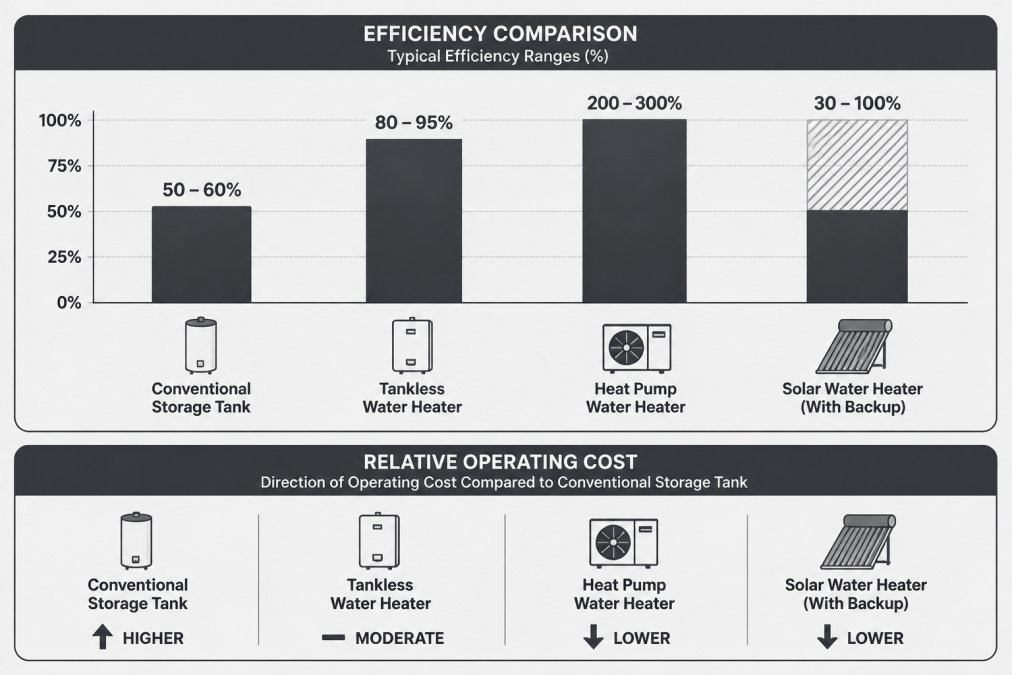
Start with the metrics that make the cost math comparable.
- Uniform Energy Factor (UEF) is the DOE's overall efficiency rating, folding standby loss, recovery, and cycling into one number. Higher is better: a conventional gas tank lands around 0.60-0.70, a condensing tankless unit can reach the 0.90s, and a heat pump often exceeds 3.0 because it moves heat rather than creating it.
- Coefficient of Performance (COP) applies to heat pumps. A COP of 3.0 means three units of heat per unit of electricity, why heat pumps beat resistance electric tanks on operating cost by a wide margin.
- Standby loss is the heat a tank sheds between draws, baked into UEF but worth understanding since tankless and heat pump designs are built to reduce it.
- Recovery rate is how fast a unit reheats after a draw, mattering most for storage tanks and clustered morning demand.
- First-hour rating (FHR) is the gallons a storage or heat pump tank delivers in a busy hour, the number to compare against peak demand, not tank capacity.
With metrics in hand, build the lifecycle picture:
| Cost bucket | Storage tank | Tankless | Heat pump | Solar + backup |
|---|---|---|---|---|
| Purchase | Lowest | Moderate | Higher | Highest |
| Installation | Lowest | Higher (venting, gas line, electrical) | Moderate to higher (space, condensate, electrical) | Highest (roof, plumbing, backup) |
| Energy (10-15 yr) | Highest | Moderate | Lower | Lowest |
| Maintenance/replacement | Anode rods, eventual tank replacement | Annual descaling | Filter and coil service | Collector cleaning, pump service, backup replacement |
| Typical service life | ~8-12 years | ~15-20 years | ~13-15 years | Collectors 20+ years; backup shorter |
Two mechanics drive the energy bucket more than any label claim:
- Utility rates and fuel type. A heat pump's operating advantage scales with the local electricity rate versus gas. Low electricity and high gas narrows the gap; high gas and moderate electricity widens it. Time-of-use rates shift the math further, since heat pumps can run off-peak.
- Climate and incoming water temperature. Cold-region groundwater enters much colder than in warm regions, raising the temperature rise every unit must deliver, penalizing tankless flow rates and raising energy use across the board.
A common pattern: a low-purchase tank wins on year-one outlay and loses on 15-year total cost once energy and a mid-life replacement are included. A heat pump flips that.
Installation Constraints, Maintenance, and Lifespan
Installation constraints decide which options are even possible.
Maintenance needs differ too. Tankless units benefit from periodic descaling, especially in hard-water areas; heat pumps need clean air filters and coils; solar collectors need occasional cleaning and a working pump on active systems.
Lifespan varies by type and water quality. Tankless and heat pump units generally outlast conventional tanks when maintained, while solar collectors can last decades with the backup replaced as needed.
Skipping tankless descaling in a hard-water area shortens the unit's life and cuts its efficiency. It is the single most neglected maintenance task we see.
Choosing the Right Water Heater Efficiency Upgrade
Choosing comes down to matching the technology to your home, not chasing the highest rating.
- Warm, roomy space, steady demand: heat pump water heater
- High or variable demand, limited space: properly sized tankless
- Sunny roof, willing to add a backup: solar with a storage or tankless backup
- Tight budget, low demand: a modern high-UEF storage tank still beats an old one
At Times Square Remodeling Inc., we handle energy-efficient upgrades as part of full home improvement work, from assessing hot-water demand to coordinating installation with the rest of a remodel.
Every alternative to a traditional water heater trades one set of constraints for another.
Most homeowners stall on this decision because the options pull in different directions, and a wrong pick means either cold showers or wasted money.
Frequently Asked Questions
What is the most energy-efficient alternative to a traditional water heater?
Heat pump water heaters typically deliver the highest efficiency for most homes. Rheem's comparison notes they are often 2 to 4 times more efficient than traditional systems. Solar water heaters can also cut energy use significantly, especially in sunny climates, but they depend on roof space and backup heating. Tankless units avoid standby heat loss, which helps efficiency, though their real-world performance depends on proper sizing and your household's daily hot-water demand.
Are tankless water heaters more efficient than traditional tank water heaters?
Tankless water heater efficiency comes from heating water on demand rather than keeping a tank hot around the clock. That eliminates standby heat loss, which is a major source of waste in storage-tank models. However, efficiency gains depend on proper sizing for your household. An undersized unit may struggle to keep up, while an oversized one cycles inefficiently. For homes with high simultaneous demand, a tankless system can still be a strong fit when sized correctly.
How do I choose the right water heater for my household?
Start with water heater sizing for household demand. Count how many people live in the home and how many hot-water tasks happen at the same time, such as showers, laundry, and dishwashing. Then match that demand to a system's capacity and recovery rate. Other factors include available space, venting requirements, utility rates, and climate. A heat pump water heater works well in mild climates, while solar performs best with good sun exposure and adequate roof space.
What are the disadvantages of a tankless water heater?
Tankless systems have higher upfront costs than conventional storage tanks, and installation may require upgraded gas lines, electrical work, or venting changes. They also have minimum flow rates, so low-flow fixtures may not trigger heating. In hard-water areas, scale buildup can reduce performance without regular maintenance. Finally, tankless units may struggle to supply multiple showers at once if undersized. Proper sizing and professional installation address most of these issues.
Is a 40-gallon water heater more efficient than a 50-gallon water heater?
A smaller tank loses less heat through standby losses, so a 40-gallon unit can be slightly more efficient than a 50-gallon model of the same type. But efficiency also depends on the tank's insulation, the Uniform Energy Factor rating, and how well the size matches your household's daily hot-water use. An undersized tank that runs out of hot water forces the heating element to work harder during recovery, which can offset any standby savings.