 how-to
How to Seal Air Leaks Around Windows and Doors Fast
Table of Contents
- Why Sealing Air Leaks Around Windows and Doors Matters
- How to Find Air Leaks Around Windows
- Best Caulk for Windows and Doors: Matching Material to Gap
- How to Weatherstrip a Door for a Tight Seal
- Sealing Window Frames and Stationary Gaps
- Temporary Window Draft Seal Options for Renters and Winter
- Common Mistakes and Moisture Management
- Frequently Asked Questions
Last Updated: October 15, 2026
Why Sealing Air Leaks Around Windows and Doors Matters
Small gaps around windows and doors let cold air in all winter, making rooms drafty and forcing your heating system to work harder until you seal air leaks.
Learning how to seal air leaks around windows and doors is one of the cheapest comfort upgrades you can make.
Here is what we will cover:
- How to hunt down the leaks you cannot see
- Which material fits which gap
- How to seal window frames, door sides, and door sweeps
Most guides skip the hard part: matching the material to the gap. We start there.
How to Find Air Leaks Around Windows
Finding air leaks is simple once you know where to look: air sneaks in at the edges, not the middle. Focus on frames, sashes, and hardware first.
The Four-Step Leak Detection Process
Start with the easiest method and work your way up.
**1.
2. The tissue test. Tape a single ply of tissue paper to a pencil or wire hanger and hold it near suspect gaps.
3. The incense or smoke pencil test. Light an incense stick or smoke pencil and hold it near the gap.
4. The flashlight test at night. Shine a bright flashlight along the frame from outside while a helper watches from inside.
Distinguishing Window and Door Leaks from Other Drafts
Not every draft comes from a window or door. Before sealing, make sure you are fixing the right problem:
- Window leaks tend to be localized to the frame, sash, or where the frame meets the wall. You will often see cracked caulk, peeling paint, or gaps where wood has shrunk.
- Door leaks are usually at the sides, top, or bottom. The bottom is the most common because door sweeps wear out. Check for daylight under the door and around the edges.
- Other drafts can come from electrical outlets, light fixtures, attic hatches, and plumbing penetrations. If you feel air near a window but the smoke test does not react at the frame, check nearby outlets and switches. Air travels through wall cavities and exits at the nearest opening, so the leak you feel at a window might originate at an outlet on the same wall.
Check These Spots First
- The bottom corners of window frames
- Where the sash meets the frame
- Around door hinges and strike plates
Checking Frames, Sashes, and Hardware
Run your hand along each frame. You can often feel cold air before you see it. Look for cracked caulk, peeling paint, and gaps where wood has shrunk.
For wooden windows, open the sash and check the sides. Older wood moves with the seasons, so gaps grow over time, and locks or handles that no longer line up signal a shifted sash.
If you find a leak at the trim-to-wall joint, that is a stationary gap and should be caulked.
Best Caulk for Windows and Doors: Matching Material to Gap
The best caulk for windows and doors depends on the gap size, the surface, and whether the joint moves. Pick wrong and the seal fails within a season.
Material Selection by Gap Size and Location
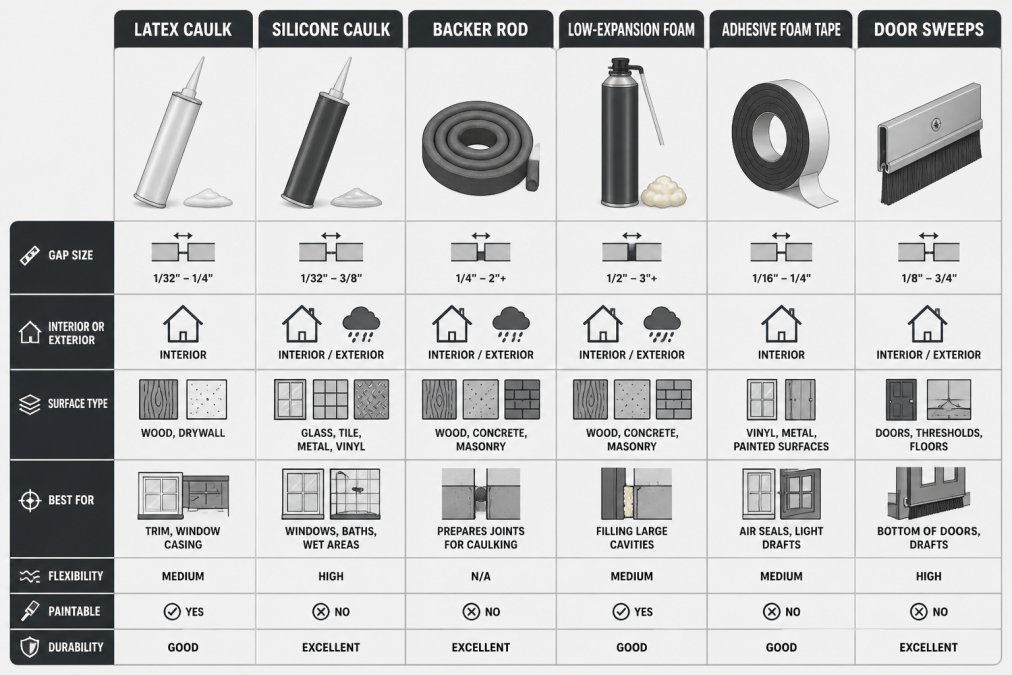
Use this matrix to narrow your options before buying.
| Material | Best For | Gap Size | Interior or Exterior | Notes |
|---|---|---|---|---|
| Latex caulk | Painted wood frames, trim-to-wall joints | Up to 1/4 inch | Interior | Paintable, easy cleanup, not for wet areas |
| Silicone caulk | Metal, glass, wet areas, exterior joints | Up to 1/4 inch | Exterior | Flexible in cold, not paintable, messy to tool |
| Backer rod | Deep gaps before caulking | 1/4 inch to 1 inch | Both | Closed-cell foam rope, saves caulk, improves seal |
| Low-expansion foam | Large hidden gaps around frames | 1/4 inch to 3 inches | Both | Expands to fill, use low-expansion to avoid bowing frames |
| Adhesive foam tape | Moving parts like door sides and tops | 1/8 inch to 1/2 inch | Both | Easy to apply, good for irregular gaps |
| Door sweep | Bottom of exterior doors | 1/4 inch to 1 inch | Exterior | Screws or slides onto door bottom, adjustable |
How to Choose by Gap Size
Small cracks (less than 1/4 inch): Use caulk, latex for interior painted surfaces, silicone for exterior or wet areas.
Medium gaps (1/4 inch to 1 inch): Use backer rod plus caulk, or adhesive foam tape for moving parts.
Large gaps (over 1 inch): Use low-expansion foam. Standard expanding foam can bow window frames and make windows hard to open; low-expansion foam is designed for window and door frames and expands less forcefully.
How to Choose by Location
Interior trim-to-wall joints: Latex caulk, paintable, water cleanup, flexible enough for indoor temperature swings.
Exterior frame-to-siding joints: Silicone caulk or a high-quality exterior sealant. These joints take the most weather.
Window sash and door edges (moving parts): Weatherstripping, not caulk.
Bottom of exterior doors: Door sweep. This is a separate product from weatherstripping and is the single biggest comfort win for most doors.
Latex vs. Silicone: Which Holds Up Where
Latex caulk is easy to work with, takes paint well, and cleans up with water. Use it indoors on wood frames you plan to paint.
Silicone caulk sticks to glass, metal, and damp surfaces and stays flexible in cold weather, making it the better pick for exterior joints.
A common mistake is using latex outside. It cracks when temperatures swing. Save it for interior work.
Safety and Moisture Management
Do not seal every gap you find, some need to stay open for drainage or ventilation:
- Weep holes: Windows and doors often have small drainage holes at the bottom of the frame. Never caulk or foam over these. They let water escape that gets behind the frame. If you block them, water can rot the frame.
- Combustion appliances: If you have a gas water heater, furnace, or fireplace, sealing too much can affect how they draft. The U.S. Environmental Protection Agency indoor air quality resources at EPA indoor air quality resources explain when to call a professional.
- Rot and water damage: If you find soft wood or dark stains, stop and fix the source first. Sealing over damage traps water and makes it worse.
How to Weatherstrip a Door for a Tight Seal
Weatherstripping a door is the single biggest comfort win in most homes. Doors take more abuse than windows, so seals wear out faster.
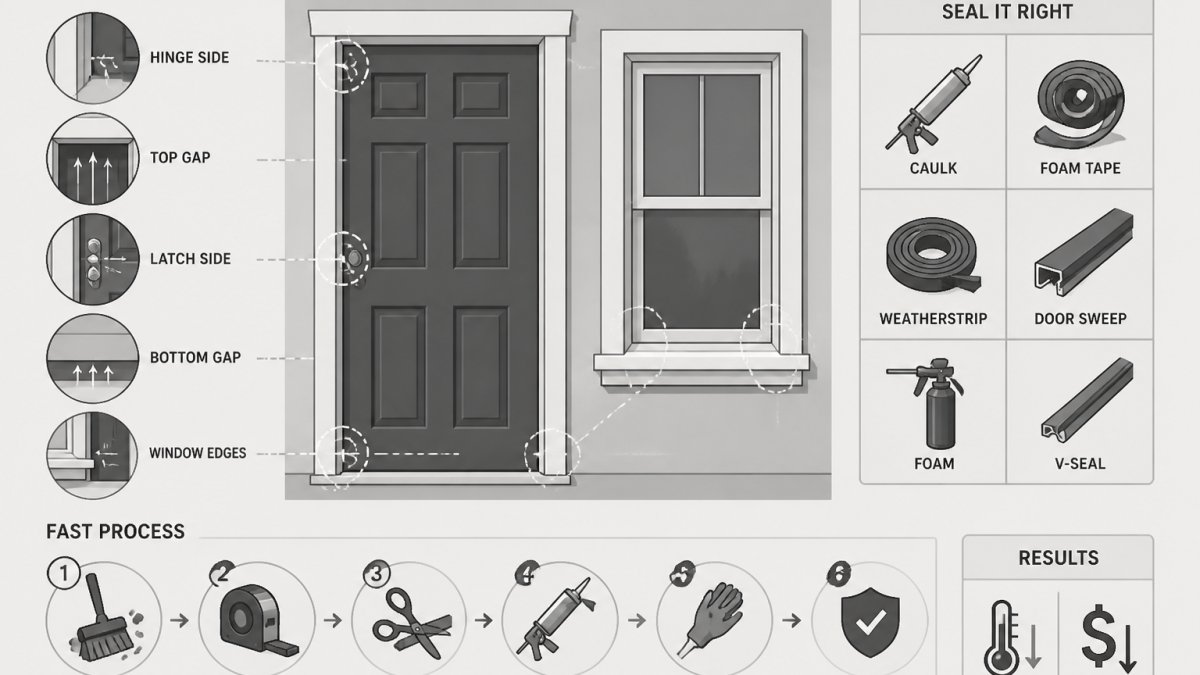
Start by cleaning the frame. Dirt and old adhesive stop new strips from sticking. Then measure each side before you cut.
Sides, Top, and the Door Sweep
Each part of the door needs a different product:
- Sides and top: use foam or felt weatherstripping for narrow gaps, or a metal tension strip for heavy doors
- Bottom: use a door sweep to close the gap between the door and the floor
- Corners: overlap the strips slightly so no gap is left behind
Press the strip along the top of the door first, work down each side, and trim the ends with scissors for a clean fit.
For the door sweep, unscrew the old one and slide the new sweep onto the bottom edge. Adjust it so it just touches the floor.
Close the door and check for daylight. Any light means you missed a spot.
Sealing Window Frames and Stationary Gaps
Stationary gaps need caulk, not weatherstripping. Weatherstripping is for parts that move. Caulk is for parts that stay put.
Here is the order we follow:
- Remove old caulk with a putty knife
- Clean the surface and let it dry
- Apply a bead of caulk along the gap
- Smooth it with a finger or tool
- Let it cure before you paint
Focus on the outside edge of the frame where it meets the siding. That joint takes the most weather. Inside, check where the frame meets the wall. For wooden windows, check the sash channels too.
Temporary Window Draft Seal Options for Renters and Winter
Renters cannot caulk or weatherstrip without permission, but that does not mean living with the cold.
Try these temporary window draft seal options:
- Shrink film kits: tape the film over the frame, then shrink it tight with a hair dryer
- Peel-and-stick rope caulk: press it into gaps, then pull it out in spring
- Draft snakes: roll a fabric tube along the bottom of the door
These fixes cost little, come off clean, and work for a single cold snap or a full winter. If you own the home and the drafts keep coming back, the frames may need more than a patch.
Common Mistakes and Moisture Management
The biggest mistake is sealing a gap that needs to breathe. Homes need some airflow. Seal too much and moisture gets trapped inside.
Watch for these problems:
- Caulking over wet or dirty surfaces, which stops the seal from sticking
- Using the wrong caulk for the surface
- Sealing a gap that hides a bigger problem, like rot or water damage
If you find soft wood or dark stains, stop and fix the source first.
The U.S. Department of Energy guide to air sealing explains how air sealing fits into a whole-home efficiency plan. For safety guidance on materials and ventilation, the U.S. Environmental Protection Agency indoor air quality resources is a solid reference.
When a draft keeps returning after every patch, the window or door itself may be past saving. Our team at Times Square Remodeling Inc. handles energy-efficient upgrades as part of a full remodel, so you get a fix that lasts.
Frequently Asked Questions
How do you air seal a window?
Start by finding the leak with an incense stick or flashlight test. For stationary gaps around the frame, apply a bead of latex or silicone caulk and smooth it with a finger or tool. For moving parts like the sash, use foam or felt weatherstripping. Press it firmly into the channel so the window still opens and closes. Seal both interior and exterior gaps for the best result.
Which is better for sealing windows, caulk or silicone?
It depends on the gap. Latex caulk works well for painted interior frames because it cleans up with water and accepts paint. Silicone caulk is better for exterior gaps because it stays flexible in temperature swings and resists moisture. For gaps wider than a quarter inch, use backer rod or foam before caulking. Matching the product to the location prevents premature failure.
What is the best way to seal a drafty door?
Check the sides, top, and bottom separately. Install weatherstripping along the sides and top of the door frame, choosing a type that compresses when the door closes. Add a door sweep at the bottom to block the gap between the door and threshold. If the frame itself has gaps, caulk those first. Test the seal by closing the door on a piece of paper and pulling it out.
Can expanding foam be used around window and door frames?
Yes, but use a low-expansion foam made for windows and doors. Standard expanding foam can bow frames as it cures. Apply it in small amounts to gaps between the frame and rough opening, then trim excess after it sets. Never use foam on moving parts like sashes or door edges. Foam is best for deep, irregular gaps that caulk cannot bridge.
Drafts that keep coming back usually mean the window or door is worn out, not just loose. Times Square Remodeling Inc. is a California-licensed general contractor (Lic. #953868) with more than 15 years of experience in energy-efficient home upgrades. We handle the whole job, from sealing and insulation to full window and door replacement, so you are not managing several crews yourself. Get started with Times Square Remodeling Inc. and make your home comfortable again.