 comparison
ADU Contractor Santa Clarita Valley CA: 2026 Review Guide
Table of Contents
- What to Expect From an ADU Contractor in Santa Clarita Valley, CA
- ADU Contractor License California: How to Verify Credentials Before You Sign
- ADU Contractor Questions to Ask Before Hiring
- California ADU Permit Process: What the Contractor Should Handle
- ADU Construction Timeline California: Realistic Schedules and Causes of Delay
- Comparing ADU Contractors: Design-Build Firms vs. Matching Services
- Contract Terms, Change Orders, and Payment Schedules
- Conclusion
- Frequently Asked Questions
Last Updated: October 18, 2026
What to Expect From an ADU Contractor in Santa Clarita Valley, CA
Hiring an adu contractor santa clarita valley ca homeowners trust means handing over a project that touches design, permitting, and construction at once. An ADU contractor is a licensed building professional who manages an accessory dwelling unit from feasibility through final inspection. At Times Square Remodeling Inc., we have spent more than 15 years guiding California homeowners through exactly this process, and we know where projects stall.
The first thing to understand is scope. A good contractor runs a feasibility assessment before anyone draws a floor plan. That means checking your lot's setbacks, utility connections, and site conditions against local regulations. Skipping this step is the most common reason a project loses months later.
Below, we break down what a real ADU engagement looks like, from license checks to the final walkthrough, so you can judge any bid with clear eyes.
ADU Contractor License California: How to Verify Credentials Before You Sign
Verifying an ADU contractor license in California takes about ten minutes and protects you from the costliest mistake in the process. The Contractors State License Board (CSLB) maintains a public database where you can confirm a license number, its status, and whether it covers the work being quoted.
Here is how we would check any contractor, including us:
- Look up the license number on the CSLB license lookup tool and confirm active status
- Match the license classification to residential construction work
- Confirm the business name and address match the contract you are signing
- Ask for a certificate of general liability insurance and verify it with the insurer
- Confirm workers' compensation coverage or a valid exemption
- Request the warranty terms in writing before work begins
Ask for the license number in writing. Ours is #953868, and we expect every homeowner to check it. A contractor who hesitates on this question is telling you something important.
ADU Contractor Questions to Ask Before Hiring
The right ADU contractor questions separate a firm that builds ADUs regularly from one that treats them as a side job. Ask these before any deposit changes hands:
- Who handles the permit application, and do you pull it in your name or mine?
- What is included in your scope, and what is billed as an extra?
- How do you price change orders, and what triggers one?
- Who supervises the crew on site, and how often?
- What is your realistic schedule, and what has delayed your past projects?
- What warranty do you provide, and for how long?
- Can you show completed ADU projects nearby?
The answers matter more than the sales pitch. A contractor who explains delays honestly is usually the one who finishes on time.
California ADU Permit Process: What the Contractor Should Handle
The California ADU permit process runs through your local planning and building department, and your contractor should carry most of it. State law limits how cities can restrict ADUs, but each jurisdiction still runs its own plan check, so the California Department of Housing and Community Development ADU guidance is worth reading before you interview anyone.
A competent contractor manages this sequence:
- Feasibility review against zoning, setbacks, and lot coverage
- Design and floor plans prepared for plan check
- Permit application submission and response to reviewer comments
- Coordination of inspections at each construction phase
- Final inspection and closeout documentation
What most guides miss is how much of the timeline sits with the city, not the builder. Your contractor controls the quality of the submittal, and a clean submittal moves faster.
ADU Construction Timeline California: Realistic Schedules and Causes of Delay
A realistic ADU construction timeline in California is best understood as four overlapping phases, not one number. Anyone quoting a single fixed completion date before feasibility is finished is guessing, and the guess usually favors the sales conversation rather than the build.
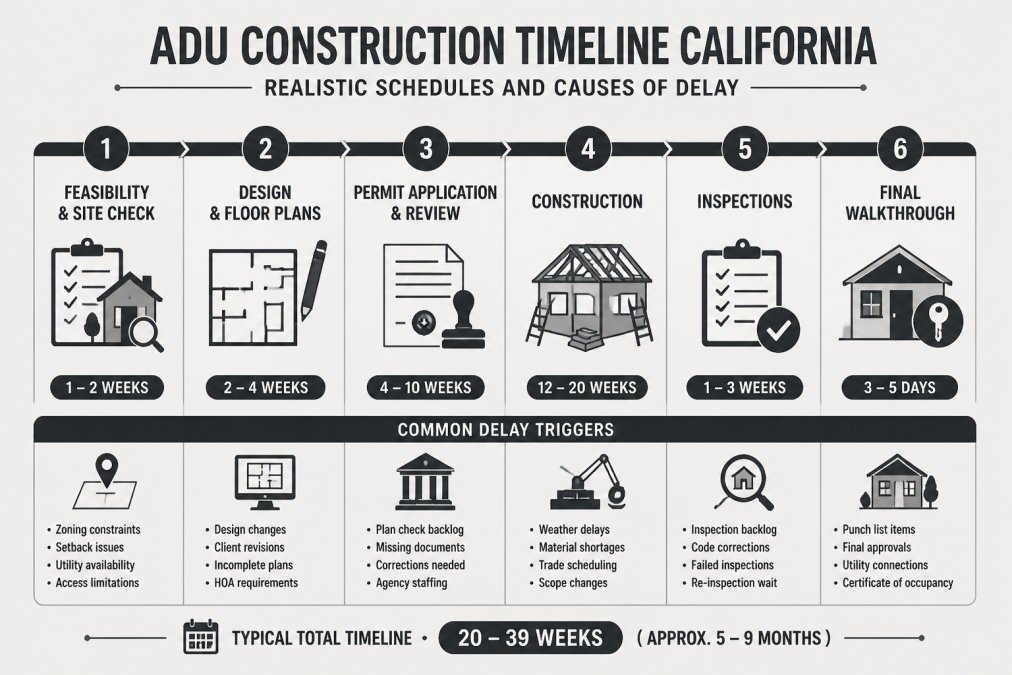
Here is how the phases actually break down, and where the calendar time goes:
Phase 1, Feasibility and site check. Before design, the contractor confirms setbacks, lot coverage, utility connections, access for equipment, and any easements or slope issues. This is the cheapest phase and the one that most often gets skipped. A thorough feasibility review typically takes days to a couple of weeks, and it is where a project is either set up to move or set up to stall.
Phase 2, Design and floor plans. Architectural drawings, structural calcs where needed, and a plan set formatted for the local plan check. Revisions between the homeowner and designer are the biggest variable here.
Phase 3, Permit application and plan review. The contractor submits to the local planning and building department and responds to reviewer comments. This is the phase homeowners most underestimate, because the time sits with the city, not the builder.
Phase 4, Construction and inspections. Foundation, framing, rough-in, insulation, drywall, finishes, and the inspection sequence that runs alongside each. Utility connection upgrades are a common hidden delay because the utility company, not the contractor, schedules the work.
Delays cluster in predictable places, and a contractor who plans for them handles them:
- Incomplete plan submittals stall in review and lose their queue position
- Utility connection upgrades wait on the utility company's schedule, not the builder's
- Site conditions such as slope, older infrastructure, or undocumented improvements surface mid-build
- Weather slows exterior work and concrete pours
- Homeowner decisions on finishes and layout changes restart portions of design or review
- Hidden damage discovered during demolition requires a documented change order before work continues
We build float time into every schedule for exactly these reasons. A contractor who plans for delay absorbs it; one who ignores it passes the stress to you.
Comparing ADU Contractors: Design-Build Firms vs. Matching Services
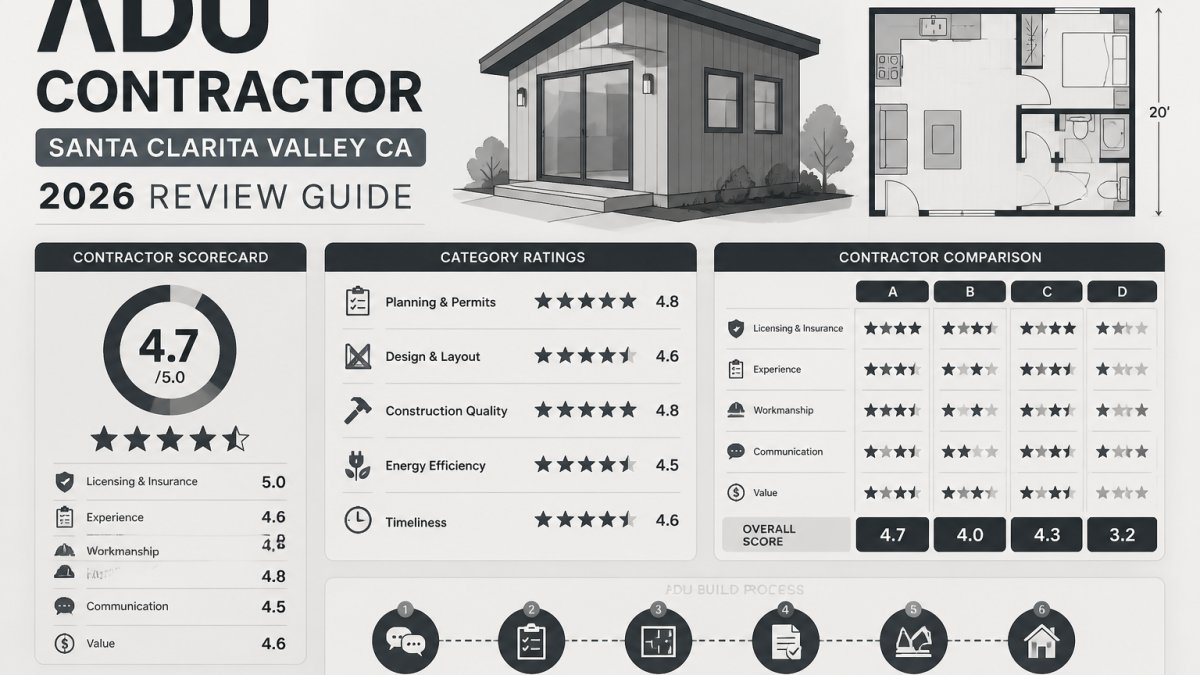
Comparing ADU contractors starts with one question: do you want one firm accountable for design and construction, or a service that introduces you to separate parties? Most guides stop there. The more useful comparison is a consistent set of criteria you apply to every provider, whether it is a design-build firm, a matching service, or a separate architect and builder.
| Option | Who Holds the Contract | Accountability | Best For |
|---|---|---|---|
| Design-build firm | One firm for design and build | Single point of responsibility | Homeowners who want end-to-end service |
| Matching service | You and the matched contractor | Split across parties | Homeowners comparing multiple bids |
| Separate architect and builder | You hold two contracts | Coordination falls to you | Owners with construction experience |
Our view is simple. If you are managing a renovation for the first time, a design-build firm removes the coordination burden. Matching services are useful for gathering bids, but the screening criteria are often unclear. Ask what "pre-screened" actually means, and ask for the specific criteria in writing.
What most comparisons miss is a neutral, criteria-based scorecard. Apply the same five criteria to every provider you interview:
- Licensing and insurance. Confirm the license number on the CSLB lookup tool, match the classification to residential work, and verify general liability and workers' compensation coverage with the insurer. A provider that cannot produce these in writing is out.
- Service area and local review experience. Ask which jurisdictions the firm regularly pulls permits in and how many ADU submittals it has handled in your city. Local review experience shortens plan check because the firm already knows the reviewer's hot buttons.
- Project types. Detached ADUs, garage conversions, and prefab or modular installs each have different design, structural, and inspection demands. Ask for completed examples of the specific type you want, not just any ADU.
- Customer feedback and references. Ask for references from projects completed in the last year and call them. Ask specifically about change-order frequency, schedule accuracy, and how the firm handled a problem. A firm that only offers references from five years ago is telling you something.
- Warranty and closeout. Get the warranty terms in writing before signing, including what is covered, for how long, and who performs the work. Ask what closeout documentation you receive at final inspection.
A matching service can be a reasonable way to gather bids, but the accountability is split and the screening criteria are often opaque. A design-build firm concentrates responsibility, which matters most when something goes wrong mid-build. Neither model is automatically better; the criteria are what separate a good provider from a good sales pitch.
Contract Terms, Change Orders, and Payment Schedules
Contract terms decide whether a project stays on budget, and the payment schedule is where homeowners get hurt. A fair contract ties payments to completed milestones, not to calendar dates. Never pay a large deposit before work starts, and never pay ahead of progress.
We structure agreements around three protections:
- Milestone payments: each draw follows a completed, inspectable phase
- Written change orders: no extra work proceeds without your signed approval and a stated amount
- Defined scope: exclusions are listed, so surprises are rare
Hidden damage is the honest wildcard in any remodel. A good contractor documents it, prices the fix in writing, and lets you approve before proceeding. If a builder resists putting change-order terms in the contract, that is your answer.
Conclusion
An ADU is a major investment, and the contractor you choose decides whether it feels like progress or a second job. Verify the license, ask the hard questions, and insist on milestone payments and written change orders. At Times Square Remodeling Inc., we bring a California general contractor license (#953868), more than 15 years of remodeling experience, and full ADU construction service from feasibility through final inspection. Get started with Times Square Remodeling Inc. and build your ADU with one accountable team.
Frequently Asked Questions
How do I choose an ADU contractor in the Santa Clarita Valley?
Start by confirming the contractor holds an active California license and carries insurance, then ask whether design, permitting, and construction are handled in-house or subcontracted. Request a written scope with an itemized budget, a payment schedule tied to milestones, and a change-order procedure. Ask for local project references and a walkthrough of a completed ADU. A contractor who answers these questions in writing, before you sign, is usually the safer choice for a Santa Clarita Valley property.
What should I ask an ADU contractor before hiring?
Ask who pulls the building permits, who draws the floor plans, and whether a licensed architect or engineer stamps them. Confirm how change orders are priced and approved, what the payment schedule looks like, and what warranty covers workmanship after completion. Ask how the contractor handles hidden site conditions, such as utility conflicts or grading issues, and who pays for re-inspection fees. Get every answer in the contract, not just in conversation.
Does an ADU contractor handle design and permits?
Some do, some don't. Design-build firms manage architectural design, floor plans, permitting, and construction under one contract, which usually means fewer handoffs and one point of accountability. Others build only from plans you supply. Ask directly which stages are included and which are billed separately. If permitting is excluded, you will be coordinating with the city yourself, and that adds time to the schedule.
How long does it take to build an ADU in California?
Timelines vary by scope, site conditions, and city review queues. A garage conversion generally moves faster than a detached ADU because it uses existing utility connections and a standing structure. Detached units and prefab or modular builds add design, fabrication, and delivery time. Permit review is often the biggest variable. Ask your contractor for a phase-by-phase schedule in writing, with the review period listed separately so you can see what is inside their control.
How can I check whether an ADU contractor is licensed in California?
Look up the license number on the Contractors State License Board (CSLB) website. Confirm the license is active, the classification matches residential construction, and the business name and address match what appears on your contract. Ask for a certificate of insurance for general liability and workers' compensation, and verify it with the insurer if you can. A legitimate contractor will give you the license number without hesitation.