 listicle
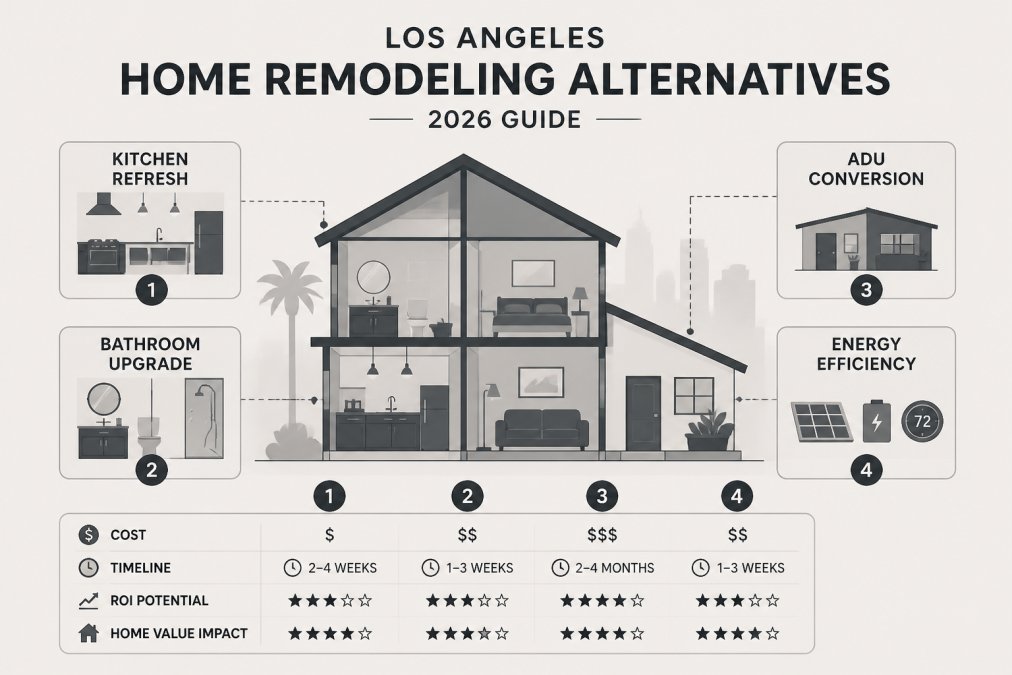
Los Angeles Home Remodeling Alternatives: 2026 Guide
Table of Contents
- Why Homeowners Are Choosing Remodeling Alternatives in 2026
- Quick Comparison: Remodeling Alternatives at a Glance
- Cosmetic Home Upgrades for Property Value That Cost Less Than a Full Remodel
- How to Prevent Unexpected Remodeling Costs Before You Start
- ADU Construction Benefits: Adding Space Without Moving
- Energy-Efficient Upgrades as a Remodeling Alternative
- DIY vs. Professional Trade-Offs: What Makes Sense for Your Project
- How to Choose the Right Remodeling Alternatives Provider
- Frequently Asked Questions
Last Updated: September 17, 2026
Why Homeowners Are Choosing Remodeling Alternatives in 2026
Los Angeles home remodeling alternatives have moved from niche to main event. A full gut renovation is no longer the default for homeowners who want a better kitchen, more space, or lower energy bills, many now weigh smaller, targeted projects against the cost and disruption of a complete rebuild.
Quick Comparison: Remodeling Alternatives at a Glance
The best remodeling alternative depends on your goal. For visual impact without moving walls, cosmetic upgrades win. For more livable space, an ADU or room addition does more. For lower utility bills, energy upgrades pay you back monthly.
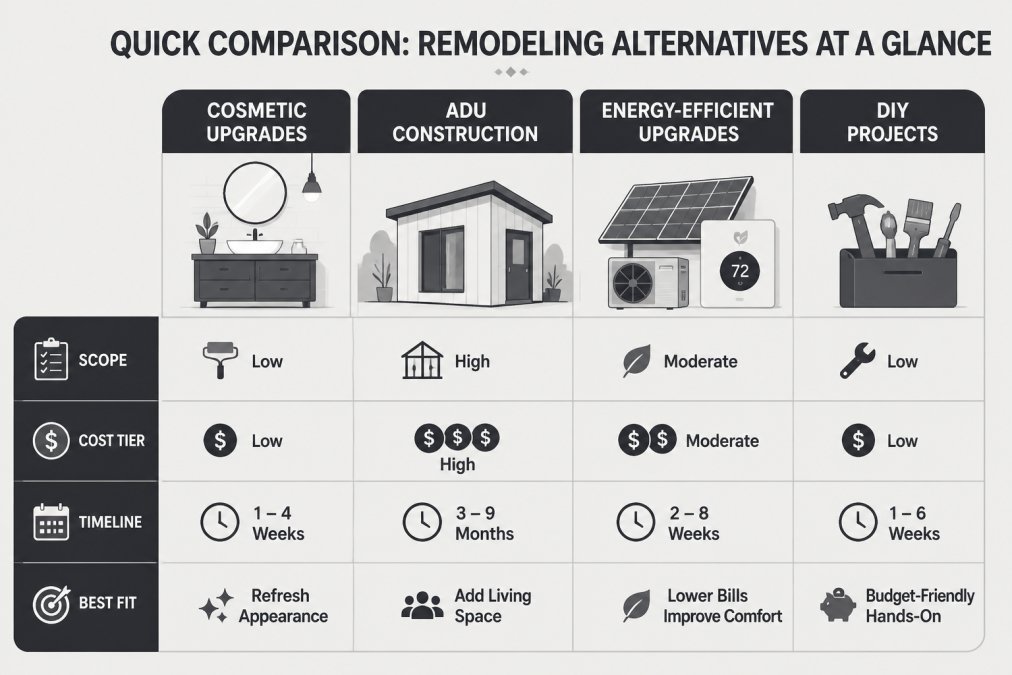
| Alternative | Typical Scope | Relative Cost Tier | Timeline Range | Best Fit |
|---|---|---|---|---|
| Cosmetic upgrades | Paint, fixtures, flooring | Lowest | Days to weeks | Fast visual refresh |
| Energy-efficient upgrades | Insulation, HVAC, solar | Low to moderate | Weeks | Lower utility bills |
| ADU construction | New detached or attached unit | Highest | Months | Rental income or family space |
| DIY projects | Owner-managed tasks | Lowest | Varies widely | Simple, low-risk work |
Cosmetic Home Upgrades for Property Value That Cost Less Than a Full Remodel
Cosmetic home upgrades for property value are the fastest route to visible change without touching structure. They target surfaces and finishes, not framing, plumbing runs, or load-bearing walls.
High-Impact Cosmetic Changes: Paint, Fixtures, and Flooring
Paint is the cheapest transformation available, a fresh, neutral palette makes rooms read larger and cleaner in listing photos. Swapping dated fixtures like faucets, cabinet hardware, and light fittings updates a kitchen or bath without moving a pipe. Flooring sits between the two: refinishing hardwood or laying new luxury vinyl changes how a room feels underfoot.
When Cosmetic Upgrades Beat Structural Renovation on ROI
Cosmetic work wins when the layout already functions. If your kitchen has a workable triangle and your bathroom has adequate space, you don't need to move walls. Structural renovation only pays off when the layout itself is the problem.
How to Prevent Unexpected Remodeling Costs Before You Start
Learning how to prevent unexpected remodeling costs starts before a contractor is called. Homeowners who stay on budget define scope tightly, price the unknowns in writing, and know where hidden costs hide.
Where Budget Overruns Actually Come From
Most overruns aren't caused by contractor greed. They come from four predictable sources:
- Hidden conditions behind walls. Water damage, knob-and-tube wiring, undersized framing, or an unlevel slab, none visible until demolition begins.
- Scope creep. Adding a pot filler, moving an outlet, upgrading tile mid-project. Each change feels small; together they add weeks and a meaningful percentage to the original figure.
- Permit and inspection delays. Plan check comments, corrections, and re-inspections add calendar time, and time is money.
- Material lead times. Cabinets, windows, and specialty tile can run weeks behind, forcing labor to idle or resequence.
Contingency Budgets and Fixed-Price Contracts Explained
A contingency budget is a reserve for discovered conditions, a percentage of the project total, with older homes warranting a larger reserve than newer ones. Fixed-price contracts lock the agreed scope to a set figure, protecting you from labor and material creep on defined work. The two work together: the contract covers what's known, the contingency covers what isn't.
The Permit and Inspection Cost Layer
Permits aren't a single line item. Depending on scope, you may pay for building, electrical, plumbing, and mechanical permits plus separate plan-check fees. Inspections happen in phases, foundation, framing, rough electrical, rough plumbing, insulation, and final, and each must pass before the next trade proceeds. A failed inspection means a correction, a re-inspection fee, and lost days.
Financing Options That Change the Math
- Cash reserves, no interest, no application, but ties up liquid savings.
- Home equity loans or HELOCs, secured against your home, typically lower rates than unsecured borrowing, but the home is collateral.
- Cash-out refinance, replaces your mortgage with a larger one and gives you the difference in cash; best when rates are favorable.
- FHA 203(k) or Fannie Mae HomeStyle, renovation loans that roll the purchase or refinance and the renovation into one mortgage; these require lender-approved contractors and specific draw schedules.
- Unsecured personal loans, faster to obtain, higher rates, no home collateral.
ADU Construction Benefits: Adding Space Without Moving
ADU construction benefits center on one idea: you add living space without buying a new house or relocating. An accessory dwelling unit is a secondary residence on the same lot, either detached, attached, or converted from existing space like a garage.
Energy-Efficient Upgrades as a Remodeling Alternative
Energy-efficient upgrades are the alternative that pays you back every month. Instead of changing how a room looks, they change how much it costs to run, and the federal and utility incentive layer is what makes them pencil out.
Start With an Energy Audit, Not a Purchase
The most common mistake is buying equipment before diagnosing the house. A professional home energy audit uses a blower door test to measure air leakage, a thermal camera to find missing or compressed insulation, and a combustion safety test on gas appliances. It produces a prioritized list: what to fix first, what to fix later, and what isn't worth doing.
The Highest-Impact Upgrades, Ranked by Payback
- Air sealing and insulation. Attic and rim-joist air sealing plus added attic insulation is usually the fastest-payback upgrade in an older home, reducing heating and cooling load before any equipment is replaced.
- HVAC replacement with a proper load calculation. A Manual J calculation sizes the system to the house; an oversized unit short-cycles, wears out faster, and never dehumidifies properly.
- Heat pump water heater. Replaces a gas or electric tank unit and qualifies for federal incentives in many cases.
- High-efficiency windows and doors. Best done when other exterior work is already happening, since labor overlaps.
- Solar with or without battery storage. Payback depends on roof orientation, shading, utility rate structure, and net metering availability.
Federal Tax Credits and Utility Rebates
The federal government offers tax credits for qualifying residential energy improvements through the Inflation Reduction Act. The two main programs are the Energy Efficient Home Improvement Credit (insulation, windows, doors, HVAC, water heaters, electrical panel upgrades) and the Residential Clean Energy Credit (solar, battery storage, geothermal, fuel cells). Credit percentages and annual caps vary by category and year, so confirm current terms before you buy.
Financing Energy Upgrades
Energy upgrades can be financed through the same paths as other renovations, home equity loans, HELOCs, cash-out refinances, and unsecured personal loans. Some utilities and state programs offer on-bill financing, repaid through the monthly utility bill. Property Assessed Clean Energy (PACE) financing is available in many areas and repaid through a property tax assessment, but it attaches to the property and should be evaluated carefully before signing.
What This Means for the Remodeling Decision
If your goal is lower monthly costs, energy upgrades are the only remodeling alternative that produces a recurring return. Pair them with cosmetic work, paint and fixtures, and you get a visible refresh plus a lower utility bill without touching structure. That combination is often the highest-value package for a homeowner not ready for a full remodel.
ENERGY STAR residential energy efficiency guidance
DIY vs. Professional Trade-Offs: What Makes Sense for Your Project
DIY makes sense for low-risk cosmetic tasks: painting, swapping hardware, installing shelving, or replacing a light fixture on an existing circuit. It stops making sense the moment work touches structure, gas, major electrical, plumbing rough-in, or anything requiring a permit.
| Task | DIY-Friendly? | Why |
|---|---|---|
| Interior painting | Yes | Fully reversible, low risk |
| Fixture and hardware swaps | Yes | Simple, no permit needed |
| Flooring installation | Sometimes | Depends on substrate and material |
| Electrical panel work | No | Permitted, hazardous |
| Structural wall removal | No | Requires engineering and permits |
| Plumbing rough-in | No | Permitted, high water damage risk |
How to Choose the Right Remodeling Alternatives Provider
Choosing a provider comes down to verifying three things: license, insurance, and project management. In California, general contractors are licensed through the state licensing board, and you can verify a license number directly on the official site before signing anything.
Frequently Asked Questions
What are the most cost-effective ways to update a home without a full remodel?
Cosmetic upgrades deliver the highest return for the lowest spend. Painting cabinets and walls, replacing dated light fixtures, swapping hardware, and refinishing floors can transform a kitchen or bathroom for a fraction of a structural renovation. Energy-efficient additions like insulation and HVAC upgrades also cut utility bills while adding value. These remodeling alternatives let you modernize your home without the disruption, permits, or timeline of a full gut renovation, and they often recoup a larger percentage of their cost at resale.
How do cosmetic home upgrades for property value compare to structural remodeling?
Cosmetic home upgrades for property value typically cost far less and finish faster, but they address surface appearance rather than layout or function. Structural remodeling changes square footage, reconfigures rooms, or fixes underlying issues, which can raise appraised value more substantially. The right choice depends on your goal: if you plan to sell soon, cosmetic work often returns more per dollar spent. If you plan to stay long-term or need more space, structural changes or ADU construction may justify the higher investment.
What are the benefits of choosing an ADU over a home addition?
ADU construction benefits include added rental income potential, space for multigenerational family members, and increased property value without altering your main living area. An ADU is a separate structure or converted space with its own entrance, so you avoid the disruption of living inside a construction zone. In California, state laws have eased ADU permitting, making approval more predictable than in past years. For homeowners who need space but want to keep their primary home intact, an ADU is often the smarter alternative.
How can I prevent unexpected remodeling costs during my project?
To prevent unexpected remodeling costs, insist on a detailed written scope before work begins, hold a contingency fund of 10 to 20 percent of the project total, and choose a licensed general contractor who provides fixed-price contracts with clear change-order procedures. Ask what happens if hidden damage is discovered, and get that process in writing. Regular progress meetings and a payment schedule tied to completed milestones also keep budgets on track and reduce the chance of surprise invoices mid-project.
Are there energy-efficient alternatives to full-scale home renovations?
Yes. Adding attic and wall insulation, sealing air leaks, upgrading to a high-efficiency HVAC system, and installing solar panels are energy-efficient alternatives that improve comfort and lower utility bills without a full remodel. Many of these upgrades qualify for federal tax credits and utility rebates, which reduces net cost. They also increase property value because buyers increasingly prioritize efficiency. A licensed contractor can assess which upgrades deliver the best return for your specific home and climate zone.