 listicle
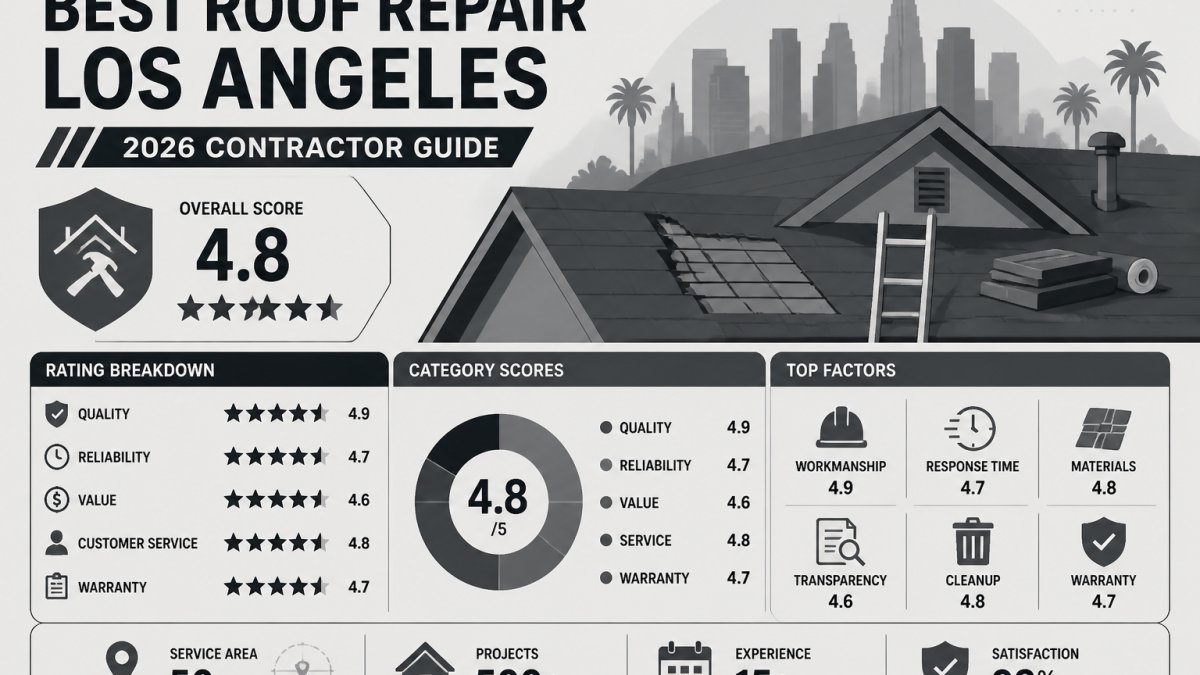
Best Roof Repair Los Angeles: 2026 Contractor Guide
Table of Contents
- How We Evaluated the Best Roof Repair Los Angeles Contractors
- Top Roof Repair Contractors in Los Angeles: Quick Comparison
- Signs of Roof Water Damage Every Homeowner Should Know
- Your Roof Inspection Checklist: What to Look For
- Hiring a Licensed General Contractor for Roofing in Los Angeles
- Roof Repair vs. Replacement: How to Decide
- Conclusion
- Frequently Asked Questions
Last Updated: September 29, 2026
How We Evaluated the Best Roof Repair Los Angeles Contractors
Finding the best roof repair Los Angeles homeowners can trust starts with verification, not advertising. Every contractor here is scored on licensing, insurance, warranty terms, and inspection transparency, a clean license and written warranty are non-negotiable.
Licensing and Insurance Verification
A valid license is the first filter. The California State License Board license lookup lets any homeowner verify a contractor's license number, status, and complaint history in minutes.
Warranty Coverage and Workmanship Guarantees
A workmanship warranty separates a professional roof repair from a handshake. Manufacturer warranties cover materials; the contractor's warranty covers installation errors, which cause most premature leaks.
| Warranty Type | Covers | Typical Provider |
|---|---|---|
| Manufacturer material warranty | Defective shingles, tiles, membranes | Product maker |
| Workmanship warranty | Installation and flashing errors | Roofing contractor |
| Full-system warranty | Materials plus labor, bundled | Manufacturer-certified installer |
Top Roof Repair Contractors in Los Angeles: Quick Comparison
Six licensed contractors dominate local roof repair searches. All handle leak detection, shingle replacement, and flashing repair, but differ on inspection terms, warranty strength, and review depth.
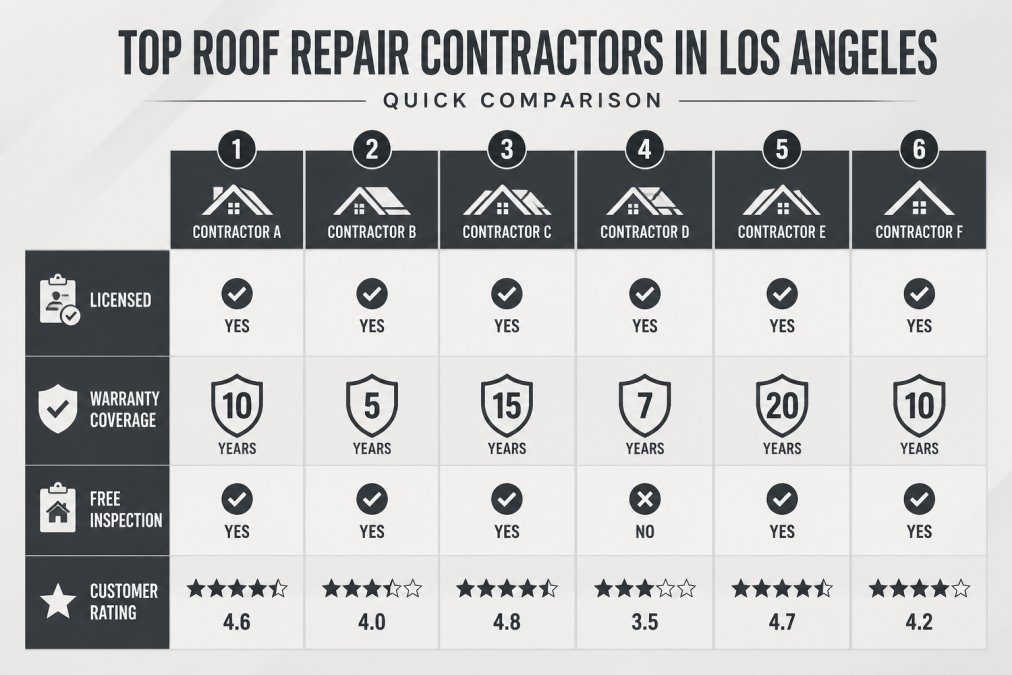
| Contractor | License Status | Free Inspection | Warranty | Customer Rating |
|---|---|---|---|---|
| Times Square Remodeling Inc. | CA licensed general contractor (#953868) | Yes, written estimate | Workmanship warranty included | 15+ years in business |
| Roof Repair SCA | CSLB licensed (#1144009) | Contact for details | Workmanship warranty | 4.9/5 |
| Roof Replacement Inc | Licensed | Yes, no obligation | Written warranty | Operating since 2019 |
| Best LA Roofing | Licensed | Yes | Workmanship warranty | 5-star rated |
| Golden Eagle Roofing | Licensed and insured | Yes | Comprehensive warranty | Highly rated |
| California Smart Roofing | Licensed | Contact for details | Workmanship warranty | 4.9/5, 199+ reviews |
Times Square Remodeling Inc.
Times Square Remodeling Inc. is our top pick for roof repair in Los Angeles: a California-licensed general contractor (#953868) with 15+ years of experience, offering roofing alongside remodeling, ADU construction, and energy-efficient upgrades under one license.
Roof Repair SCA
Roof Repair SCA specializes in leak detection and storm damage across shingle and flat roof systems, holds CSLB license #1144009, and earns a 4.9/5 rating.
Roof Replacement Inc
Roof Replacement Inc leans on transparency: free no-obligation inspections, written estimates, and client-accessible work inspections.
Best LA Roofing
Best LA Roofing offers full roof inspection services plus residential repair and replacement, backed by a 5-star rating and a licensed crew.
Pros: strong reputation, licensed. Cons: quotes by phone only.
Golden Eagle Roofing
Golden Eagle Roofing, based in Granada Hills, is known for honest assessments and a no-pressure sales approach, with comprehensive warranties and full licensing and insurance.
California Smart Roofing
California Smart Roofing carries a 4.9/5 rating across 199+ reviews, one of the deepest review bases among local repair specialists.
Signs of Roof Water Damage Every Homeowner Should Know
Most roof damage announces itself indoors before it shows outside. Catching these signs early is the difference between a targeted repair and a full replacement.
Interior Warning Signs
Brown ceiling stains, peeling paint, and a musty attic smell point to water already inside the assembly. Sagging drywall and bubbling paint mean moisture has reached the substrate.
Exterior Warning Signs
Missing, cracked, or curling asphalt shingles are the clearest exterior signal. Granule loss in gutters, rusted flashing, and cracked pipe boots matter too.
Your Roof Inspection Checklist: What to Look For
A roof inspection checklist turns a vague worry into a documented problem. Run this walkthrough twice a year, before the winter rain window and in spring after the heat has done its work. If you are not comfortable on a ladder, inspect from the ground with binoculars and let a professional handle the roof surface.
What Each Finding Actually Means
A checklist is only useful if you understand what you are looking at. How to read the most common findings:
- Ceiling stains or attic dampness, water is already inside the assembly. The stain is the end of the path, not the start; the entry point is usually uphill and offset.
- Daylight through roof boards, a failed flashing detail or worn underlayment, not a shingle problem. Shingle replacement alone will not fix it.
- Missing, cracked, or curling shingles, thermal cycling and UV exposure. Curling edges mean the shingle lost its seal; cracked shingles mean the mat is failing.
- Granule buildup in gutters, the shingle is shedding its protective surface. Heavy granule loss across a slope usually signals the roof is near end of life, not a spot-repair candidate.
- Rusted or loose metal flashing, the sealant has failed, not the metal. Re-sealing is short-term; re-flashing is durable.
- Cracked pipe boots, the rubber collar around plumbing vents dries out and splits. This is one of the most common and cheapest leak sources to fix.
- Sagging roofline or soft spots, a structural signal, not a surface one. Stop and call a professional before walking the roof.
How to Inspect Safely From the Ground
You do not need to climb. Stand back to see the full slope, then work in sections:
- Scan the roofline for dips or waves.
- Check the valleys and any place two roof planes meet.
- Look at every penetration, vents, chimneys, skylights, satellite mounts.
- Check the gutters and downspouts for granules, shingle pieces, or standing water.
- Photograph anything that looks off, with a date.
When to Stop and Call a Professional
Some findings are safe to note and monitor; others are not. Call a licensed contractor immediately if you see:
- Sagging or a visibly soft roof deck
- Water actively entering during a rain event
- Daylight visible through the roof structure from the attic
- Damage that spans more than one roof plane
- Any damage after a fire, high wind, or hail event
Hiring a Licensed General Contractor for Roofing in Los Angeles
Hiring a licensed general contractor for roofing gives you one point of accountability for the whole repair: coordinating trades, pulling the roofing permit, and staying responsible for the finished result.
Questions to Ask Before You Sign
- What is your license number, and is it active?
- Will you provide a written estimate with a scope of work?
- Who pulls the roofing permit?
- What does your workmanship warranty cover, and for how long?
- What happens if you find hidden dry rot or structural damage?
- How do you handle change orders and additional costs?
- Can you provide references from similar roof repairs nearby?
Roof Repair vs. Replacement: How to Decide
Repair wins when damage is localized and the roof is young; replacement wins when the roof is near end of life or damage covers a large area. The hard part is the middle, where most homeowners get talked into the wrong call.
A Decision Framework, Not a Rule of Thumb
Work through these questions in order. The first clear answer usually settles it:
- How old is the roof? Past roughly three-quarters of its expected service life, a repair is money spent on a surface already near the end.
- How many separate leak points are there? One is a repair. Three or more on different slopes usually means the system is failing, not a spot.
- Is the damage surface-level or structural? Shingles, flashing, and pipe boots are surface. Sagging, soft decking, and rafter rot are structural, and structural work changes the math entirely.
- Is the underlayment intact? If water has been getting under the shingles for a season or more, the underlayment is likely compromised, and re-shingling over it just hides the problem.
- Will a repair void or preserve the existing warranty? Some manufacturer warranties require certified installers for any roof work. A repair by a non-certified crew can void coverage on the rest of the roof.
The Cost of Waiting
A small leak that gets ignored rarely stays small. Water travels along the deck, finds a low point, and shows up as a ceiling stain far from the actual entry. By the time it is visible indoors, the decking and insulation are often already wet, and wet decking is where rot starts.
The Insurance Angle Most Guides Skip
A few things worth knowing before you file:
- Document before you repair. Photograph the damage and keep damaged materials until the claim is resolved. Repairing first can complicate the claim.
- Understand your deductible and your policy's roof provisions. Many policies have separate roof deductibles or actual-cash-value provisions for older roofs, which changes what you receive.
- Get the scope in writing. The adjuster's scope and the contractor's scope should match. If they do not, ask the contractor to document the difference in writing before work starts.
- Ask about code upgrades. If local code requires upgrades during a covered repair, some policies include an allowance. Ask specifically.
A professional roof inspection resolves the question in one visit. Ask for the inspector's reasoning, not just a verdict, and get it in writing.
Conclusion
Roof damage rarely waits for a convenient moment, and the contractor you choose determines whether the fix holds. Verify the license, demand a written scope and warranty, and confirm who pulls the permit before anyone climbs your roof. Times Square Remodeling Inc. brings a California general contractor license (#953868), 15+ years of experience, and full-service capability covering roofing, structural repair, and energy-efficient upgrades in one project.
Frequently Asked Questions
What is the average cost of roof repair in Los Angeles?
Roof repair costs in Los Angeles vary widely based on damage extent, roof material, pitch, and accessibility. Minor repairs like shingle replacement or flashing repair cost less than extensive structural work. Flat roof repair and clay tile repair often require specialized labor. Request written estimates from at least three licensed contractors and compare line items, not just totals. For an accurate quote specific to your roof, contact a licensed general contractor directly.
What should I look for when hiring a roof repair contractor?
Verify the contractor holds a valid California license through the CSLB, carries liability insurance and workers' compensation, and provides a written workmanship warranty. Ask for local references and check review platforms. A licensed general contractor for roofing should offer a detailed written estimate, explain the scope clearly, and never demand large upfront payments. Avoid contractors who pressure you to sign immediately or offer deals only available that day.
How do I know if my roof needs repair or full replacement?
Age matters: asphalt shingles typically last 20-25 years, while clay tile can exceed 50. If your roof is near the end of its lifespan and shows widespread damage, replacement makes more sense than repeated repairs. Localized issues like flashing repair, a few cracked tiles, or isolated leaks are usually repairable. A professional roof inspection will assess structural integrity, underlayment condition, and the extent of damage to give you a clear recommendation.
What are the most common roofing issues in this climate?
Los Angeles roofs face intense UV exposure, temperature swings between day and night, and seasonal rain. Common problems include sun-damaged shingles, deteriorated flashing, dry rot in underlayment, and clogged gutters that cause roof drainage issues. Flat roofs are prone to ponding water and membrane deterioration. Regular preventative maintenance, including annual inspections and gutter maintenance, extends roof lifespan and catches small problems before they become expensive repairs.
Are there specific licensing requirements for roof repair contractors?
Yes. Roofing contractors in California must hold a valid license from the Contractors State License Board (CSLB). You can verify any contractor's license number, bond status, and complaint history on the CSLB website. A licensed general contractor for roofing carries insurance and is bound by state regulations. Always confirm the license is active and covers roofing work before hiring. Unlicensed contractors leave you without legal recourse if problems arise.