 ultimate-guide
Energy Efficient Insulation Upgrades for Homes
Table of Contents
- Why Energy Efficient Insulation Upgrades Matter for Your Home
- Understanding Insulation Materials and R-Value Performance
- Attic Insulation R-Value Requirements and Installation
- Cost of Spray Foam vs. Fiberglass Insulation: What Affects Price
- Insulation Tax Credit 2025 and Federal Incentives
- Prioritizing Your Insulation Upgrades: Attic, Basement, and Crawl Space
- DIY vs. Professional Installation: When to Call an Expert
- Measuring ROI and Annual Energy Savings
- Frequently Asked Questions
Last Updated: September 1, 2026
Why Energy Efficient Insulation Upgrades Matter for Your Home
Heating and cooling account for nearly half of home energy consumption, your biggest opportunity to cut utility bills and reduce your carbon footprint. Energy efficient insulation upgrades work by creating a thermal envelope: a continuous barrier that stops heat transfer before it happens. When this envelope has gaps or poor insulation, your HVAC system works overtime, wasting energy and driving up monthly costs.
Federal tax credits for energy efficient insulation upgrades have been expanded and simplified, and combined with rising heating and cooling costs, the ROI has improved dramatically. Most homeowners see payback within 5-10 years, with energy savings continuing for decades.
This guide covers which materials perform best, how to prioritize upgrades, available federal incentives in 2026, and when to hire professionals versus attempting DIY work. By the end, you'll have a clear strategy for upgrading your home's thermal resistance and reducing annual energy costs.
Understanding Insulation Materials and R-Value Performance
R-value measures thermal resistance, how well a material resists heat flow. Higher R-value means better performance, but installation quality, material type, and how insulation fits into your overall thermal envelope matter equally.
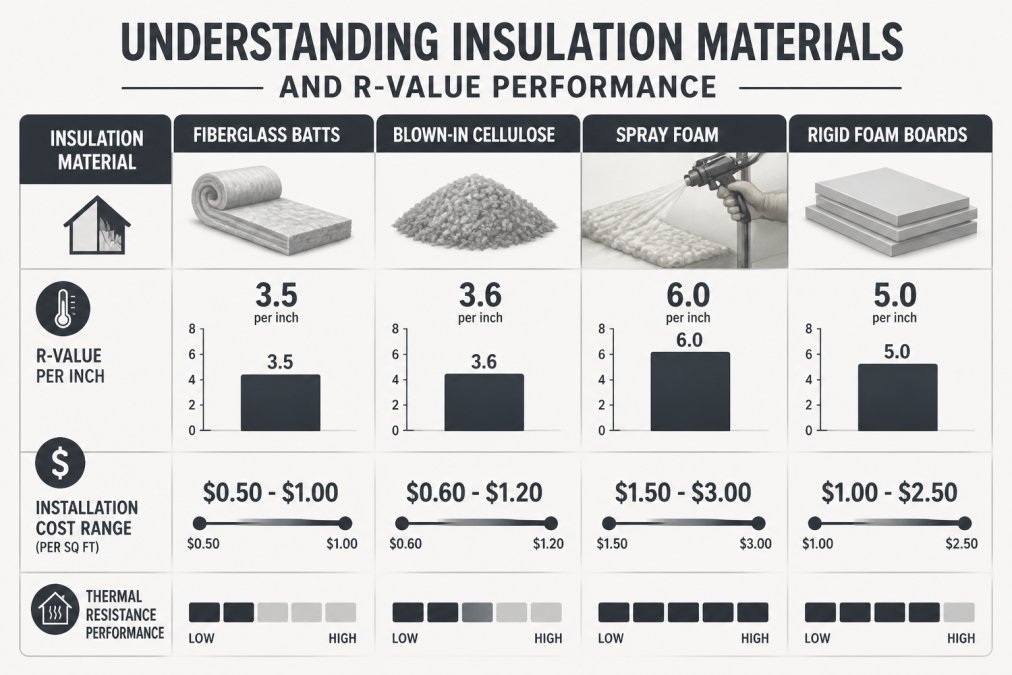
Fiberglass Batts vs. Blown-In Cellulose
Fiberglass batts are affordable and widely available but have real limitations. They require precise installation to avoid air gaps and settle over time, reducing effective R-value. They also absorb moisture, which degrades performance and encourages mold growth in humid climates.
Blown-in cellulose, made from recycled paper, performs better in practice. It fills cavities more completely, reducing air leakage, and resists settling better than fiberglass. Installation requires specialized equipment and professional application. Density matters enormously, properly installed cellulose should be compressed to 1.5-2.0 pounds per cubic foot. Under-compressed cellulose settles and loses R-value; over-compressed cellulose can trap moisture and damage the building envelope.
Spray Foam and Rigid Foam Boards
Spray foam polyurethane delivers the highest R-value per inch and creates an air seal simultaneously. This dual benefit makes it exceptionally efficient for reducing heat transfer and air infiltration, though it costs 2-3 times more than fiberglass batts.
Closed-cell spray foam has an R-value around 6 per inch and provides a vapor barrier, making it suitable for basements and crawl spaces. Open-cell spray foam has an R-value around 3.5 per inch, costs less, and allows vapor transmission.
Rigid foam boards offer a middle ground at R-5 to R-6 per inch, install more simply than spray foam, and cost less. They work well for basement walls, crawl space ceilings, and exterior applications. The challenge is ensuring proper air sealing at joints and edges with caulk or foam tape.
Attic Insulation R-Value Requirements and Installation
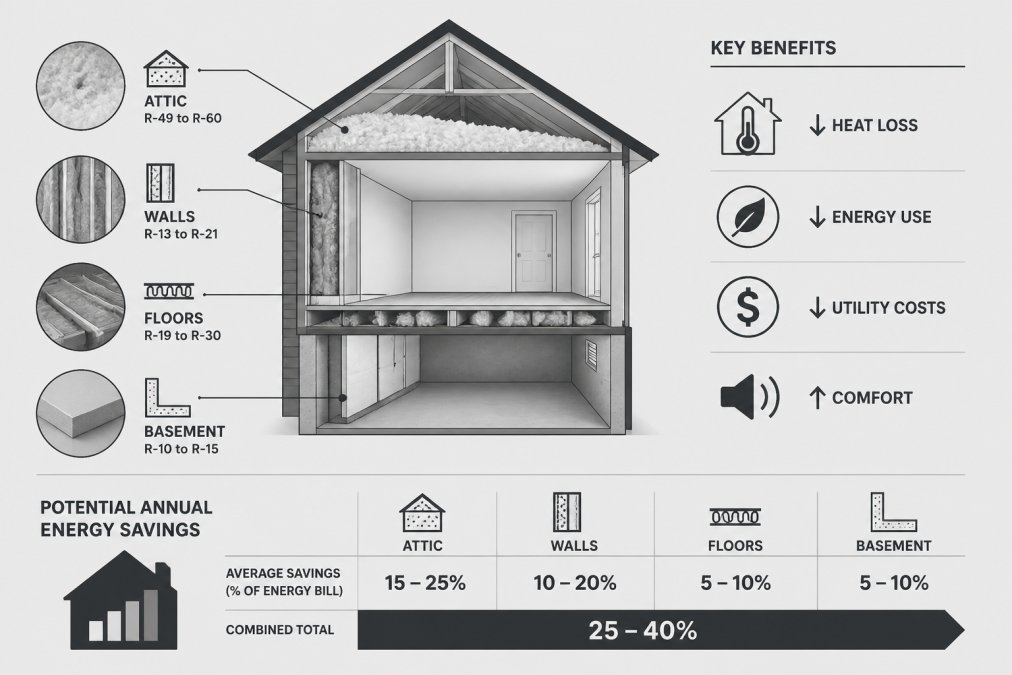
Your attic is where most heat loss happens in winter and most heat gain occurs in summer. Most homes benefit from R-38 to R-60 in the attic floor (energy.gov). If your attic currently has R-19 or less, upgrading is one of the highest-ROI improvements available.
Before installing new insulation, identify and seal air leaks around electrical outlets, recessed light fixtures, gaps where walls meet the roof line, HVAC ducts, attic access points, and improperly baffled soffit vents. Air sealing typically costs $500-$1,500 and can reduce heating and cooling costs by 10-15% on its own.
Attic ventilation also matters. Improper ventilation traps moisture, which degrades insulation and encourages rot. Your attic should have continuous soffit vents and ridge vents or an equivalent passive ventilation system.
Cost of Spray Foam vs. Fiberglass Insulation: What Affects Price
Spray foam costs more upfront because it requires specialized equipment, certified applicators, and more labor hours. Fiberglass batts are cheap to purchase but labor-intensive to install properly, which can offset material savings.
Several factors affect pricing for energy efficient insulation upgrades:
- Accessibility: Hard-to-reach attics or crawl spaces cost more
- Existing insulation: Removing old insulation adds cost; leaving it in place is cheaper
- Air sealing scope: Extensive air sealing increases project cost but improves results
- Material type: Spray foam costs 2-3x more than fiberglass; blown-in cellulose falls in the middle
- Climate zone: Colder climates require higher R-values, increasing material and cost
- Seasonal timing: Summer projects often cost more due to higher contractor demand
The real question isn't which material is cheapest, but which delivers the best ROI for your home. A $3,000 spray foam project saving $500 per year breaks even in 6 years. A $1,200 blown-in cellulose project saving $250 per year breaks even in 4.8 years. Lower-cost options often pay back faster.
Insulation Tax Credit 2025 and Federal Incentives
The federal government expanded tax credits for energy efficient insulation upgrades through 2032. The Inflation Reduction Act allows homeowners to claim up to $3,200 per year in energy efficiency tax credits, with an aggregate lifetime limit of $10,000.
To qualify, your upgrade must be installed in your primary residence, meet ENERGY STAR or equivalent performance standards, include a Certificate of Energy Efficiency from your contractor, and improve your home's thermal envelope. The credit covers blown-in cellulose, fiberglass batts, spray foam, and rigid foam boards.
Many states offer additional rebates on top of federal credits, and utilities often provide rebates covering 20-30% of material costs. Homeowners can stack federal tax credits with state rebates and utility incentives, significantly reducing out-of-pocket costs.
According to the Energy.gov guide to home energy rebates, the process is straightforward: hire a contractor familiar with credit requirements, complete the work, collect the Certificate of Energy Efficiency, and claim the credit on your tax return. Times Square Remodeling Inc. can provide documentation to help ensure your upgrade qualifies for available incentives.
Prioritizing Your Insulation Upgrades: Attic, Basement, and Crawl Space
Most homes have multiple areas needing insulation work. Prioritizing correctly focuses first on upgrades delivering the biggest energy savings for your climate and home type.
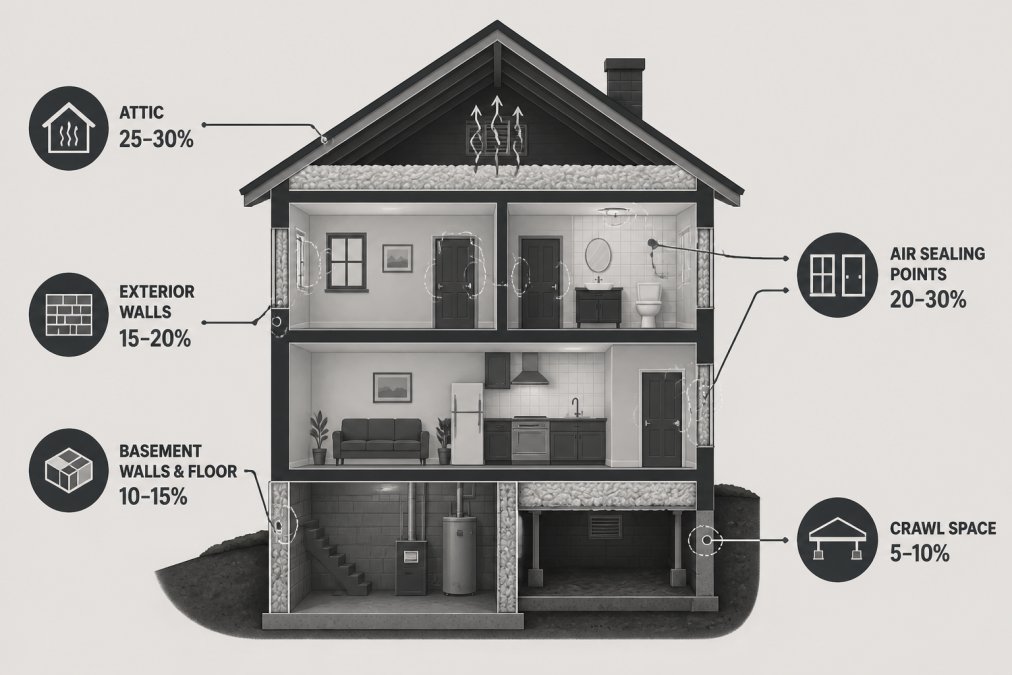
Attic first. Heat rises, so attic insulation delivers the fastest payback. Upgrading from less than R-30 to R-38 or higher often reduces heating and cooling costs by 10-15%.
Air sealing second. Seal air leaks throughout your home before adding more insulation. Air sealing is cheap relative to its impact and works in any climate. Seal gaps around electrical outlets, windows, doors, and ductwork.
Basement walls third. Insulating basement walls improves comfort and reduces heating costs. Rigid foam boards or closed-cell spray foam work best because they resist moisture. Open-cell spray foam or fiberglass batts can trap moisture, leading to mold.
Crawl space encapsulation fourth. Encapsulation involves sealing the crawl space, insulating perimeter walls, and controlling moisture. This complex upgrade should be handled by professionals familiar with crawl space building science.
Exterior walls last. Insulating exterior walls is expensive and disruptive. Unless you're already doing siding replacement, exterior wall insulation should be a lower priority.
DIY vs. Professional Installation: When to Call an Expert
Fiberglass batts are the most DIY-accessible insulation material. You can purchase them at any home improvement store and install them yourself in an attic or between wall studs. The challenge is achieving consistent coverage without gaps. Even small gaps significantly reduce R-value.
Blown-in cellulose and blown-in fiberglass require rental equipment and create significant dust. DIY installation often results in uneven density and rarely achieves professional performance. Professional installation is usually the better choice.
Spray foam requires certified applicators. Improper application results in poor coverage, inadequate air sealing, or off-gassing issues. Only hire contractors certified by the spray foam manufacturer.
Rigid foam boards fall in the middle. Cutting and fitting is manageable for experienced DIYers, but air sealing joints requires precision. Professional installation ensures proper air sealing and moisture management.
The real cost of DIY mistakes is high. Improper installation reduces thermal resistance, traps moisture, creates air leaks, or voids warranties. Times Square Remodeling Inc. recommends professional installation for spray foam, blown-in cellulose, and crawl space work. For fiberglass batts in accessible attics, DIY is reasonable if you're detail-oriented.
Measuring ROI and Annual Energy Savings
ROI for energy efficient insulation upgrades depends on your climate, current insulation levels, energy costs, and specific upgrades. Most homeowners see payback within 5-10 years, with savings continuing for decades.
Start with your current energy bill. Heating and cooling typically account for 40-50% of residential energy use. A well-executed insulation upgrade can reduce this by 15-30%.
If heating and cooling costs are $2,000 per year and an upgrade reduces them by 20%, you save $400 annually. A $4,000 project breaks even in 10 years; a $2,000 project breaks even in 5 years. Lower-cost upgrades typically deliver faster payback.
Federal tax credits and utility rebates improve ROI significantly. A $3,200 tax credit on a $5,000 project drops net cost to $1,800. That same $400 annual savings now breaks even in 4.5 years instead of 12.5 years.
According to the Department of Energy's guidance on insulation payback periods, homeowners in moderate climates typically see 15-20% energy savings from comprehensive insulation upgrades, with payback periods of 6-8 years before accounting for tax credits.
Energy savings compound over time. As energy rates increase, your savings increase. A project saving $400 in year one may save $450 in year five if rates rise 2-3% annually. Over 30 years, a $2,000 attic insulation upgrade could save $15,000+ in today's dollars.
Better insulation also improves comfort by reducing drafts and temperature swings, increases home value through improved energy efficiency ratings, and reduces outside noise transmission.
Energy efficient insulation upgrades are one of the highest-ROI home improvements available. The combination of federal tax credits, utility rebates, and long-term energy savings makes these projects worth prioritizing. Times Square Remodeling Inc. specializes in comprehensive insulation upgrades that improve your home's thermal envelope, reduce utility costs, and maximize your return on investment. Contact us for a free energy audit and upgrade recommendations tailored to your home's specific needs.
Frequently Asked Questions
What type of home insulation is the most energy-efficient?
Spray foam and rigid foam boards deliver the highest R-value per inch, making them most efficient for small spaces. Blown-in cellulose offers excellent thermal performance and environmental benefits at lower cost. The best choice depends on your climate, existing structure, and budget. Fiberglass batts remain effective for new construction or accessible areas. An energy audit can identify which material delivers the best return for your specific home.
Is there a tax credit for adding insulation to your house in 2025?
Yes. The Inflation Reduction Act provides a 30% federal tax credit (up to $1,200 per year) for qualifying insulation improvements, including attic, basement, and crawl space upgrades. Credits also apply to air sealing and weatherstripping work. To qualify, insulation must meet performance standards and be installed in your primary residence. Consult a tax professional or your contractor to verify eligibility and claim the insulation tax credit 2025.
How does attic insulation impact overall home energy efficiency?
The attic is responsible for 25-30% of heat loss in winter and heat gain in summer, making it the highest-priority upgrade. Proper attic insulation R-value requirements typically range from R-38 to R-60 depending on climate zone. Combined with air sealing around penetrations and proper ventilation, attic upgrades reduce HVAC load, lower utility bills, and improve thermal comfort. Most homeowners see measurable savings within the first heating or cooling season.
What factors affect the cost of spray foam vs fiberglass insulation?
The cost of spray foam vs fiberglass insulation varies by material type, application area, labor rates, and accessibility. Spray foam typically costs more per square foot but requires fewer square feet due to higher R-value density. Fiberglass batts cost less upfront but may need thicker installation. Open-cell spray foam suits interior walls; closed-cell suits basements and crawl spaces. Local contractor rates, equipment requirements, and site complexity all influence final pricing. Request quotes from licensed contractors for accurate comparison.
This article was written using GrandRanker