 listicle
Emergency Home Restoration Services Los Angeles: 2026 Guide
Table of Contents
- Emergency Home Restoration Services in Los Angeles: Quick Comparison
- What to Do in the First Hour After Property Damage
- Water Damage Restoration Timeline: What to Expect Day by Day
- Hiring a Licensed General Contractor for Restoration in California
- Property Damage Insurance Claim Process: A Homeowner's Walkthrough
- Cost Transparency and Estimating for Emergency Home Restoration
- Frequently Asked Questions
Last Updated: September 25, 2026
Emergency Home Restoration Services in Los Angeles: Quick Comparison
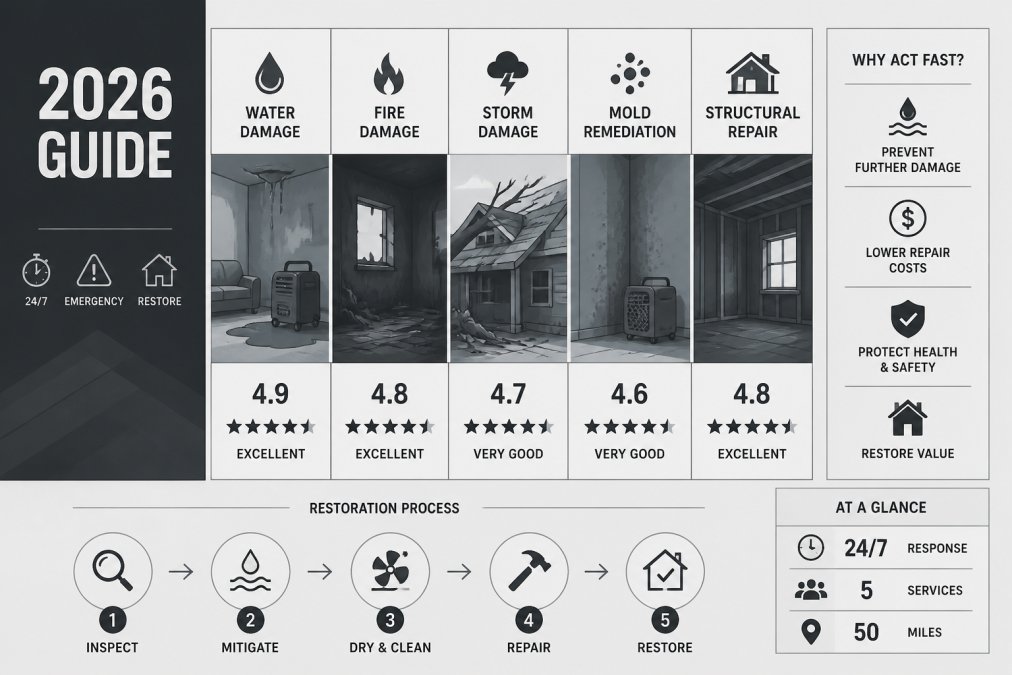
Emergency home restoration is the process of stabilizing, cleaning, and repairing a property after water, fire, storm, or mold damage, usually starting within hours of the incident. This guide from Times Square Remodeling Inc. covers what to do in the first hour, how long drying takes, and how to keep an insurance claim on track.
| Provider | Primary Strength | Emergency Availability | Best For |
|---|---|---|---|
| Times Square Remodeling Inc. | Mitigation through rebuild | Contact for scheduling | Full restoration projects |
| 911 Restoration | Water damage response | 24/7 | Urgent water emergencies |
| PuroClean | Flood and pipe bursts | 24/7 | Structural water damage |
| Paul Davis Restoration | Fire and storm recovery | 24/7 | Large-scale losses |
| SERVPRO | National network | 24/7 | Rapid franchise response |
| Guardian Restoration | Local water cleanup | 24/7 | Fast local dispatch |
| ServiceMaster Restore | Flood mitigation | 24/7 | Free quote assessments |
| West Coast Restoration | Residential and commercial | 24 hours | Immediate water intervention |
| Guardians Mold Removal | Mold remediation | Contact for scheduling | Post-water mold growth |
| Damage Restoration Network | Rapid problem resolution | 24/7 | Quick water damage repair |
What to Do in the First Hour After Property Damage
Your first hour sets the ceiling on your total loss. Shut off the water main or gas supply, cut power to flooded rooms at the breaker, and photograph everything before you move a single item. The steps below are organized by damage type so you can act on the right sequence instead of guessing.
Step-by-Step Emergency Mitigation Guide
- Make sure everyone is safe. Leave the structure if you smell gas, see sagging ceilings, or find standing water near outlets. Do not re-enter until a professional clears the structure.
- Stop the source. Close the main water valve for plumbing failures; call the utility for gas leaks. If the leak is from a fixture, close the angle stop under the sink or behind the toilet.
- Kill power to affected areas. Never stand in water while touching the electrical panel. If the panel is in a flooded area, call the utility and wait.
- Document before you clean. Take wide photos, then close-ups, then video walkthroughs. Include serial numbers on appliances and a timestamp if your phone supports it.
- Call your insurer. Most policies require prompt notice; ask what they need before you discard anything. Get a claim number and the adjuster's direct line.
- Call a restoration contractor. Water extraction and structural drying should begin within hours to limit secondary damage. Ask for an arrival window in writing.
- Move valuables to a dry room. Lift furniture onto blocks and pull wet rugs to prevent dye transfer. Separate wet books and papers and freeze them if you can, freeze-drying is a standard document recovery method.
- Do not run your HVAC. Circulating air spreads soot and mold spores through the ductwork. Tape plastic over supply registers in affected rooms.
Damage-Type Playbooks
Burst pipe or supply line. Shut the main valve first, then open the lowest faucet in the house to drain the lines. Water in a slab leak can travel under flooring for days before it surfaces, so mark the visible wet zone with tape and photograph it before extraction begins.
Keep a running log with times: when you shut off the water, when you called the insurer, when the contractor arrived. Adjusters use this timeline to reconstruct the loss, and a clean log speeds up the payout.
Water Damage Restoration Timeline: What to Expect Day by Day
Most water damage restoration follows a predictable arc: emergency extraction in the first 24 hours, structural drying over the next three to five days, then repairs. Timelines stretch when water sat unnoticed or reached a second story.
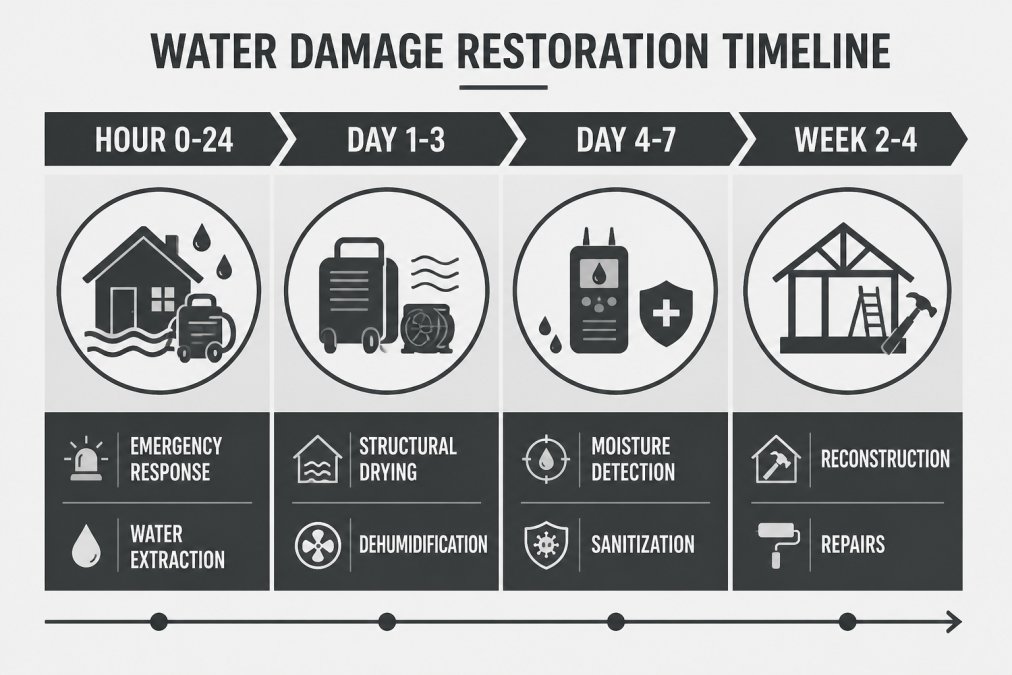
Here is the standard sequence:
- Hour 0-24: Emergency response, hazard assessment, water extraction, and debris removal.
- Day 1-3: Structural drying with air movers and dehumidification; thermal imaging and moisture detection track hidden pockets.
- Day 4-7: Air quality testing, sanitization, decontamination, and odor neutralization.
- Week 2-4: Reconstruction, from drywall and paint to flooring and cabinetry.
Ask for daily moisture readings in writing. A floor that reads dry on the surface can still hold water in the pad and subfloor, and that is where mold remediation starts.
Hiring a Licensed General Contractor for Restoration in California
Hiring a licensed general contractor for restoration protects you from unpermitted work, liability gaps, and insurance disputes. In California, the Contractors State License Board maintains the official license lookup, and any contractor you hire for work over the state's threshold must hold an active license.
Contractors State License Board license lookup
Ask three questions before signing anything:
- What is your license number? Verify it directly, not from a business card.
- Do you carry general liability and workers' compensation? Request certificates, not verbal assurances.
- Will you handle permits and inspections? Structural repairs almost always require them.
Property Damage Insurance Claim Process: A Homeowner's Walkthrough
The property damage insurance claim process moves faster when documentation is complete before the adjuster arrives. Report the loss, photograph everything, keep receipts for emergency spending, and request a written scope of work. California's Department of Insurance publishes a residential claims guide that explains timelines and your right to a written explanation if a claim is denied.
California Department of Insurance residential claims guide
The Claim Sequence, Step by Step
- File the claim. Provide the date, cause, and a general description of the damage. Ask for the claim number and the name of the assigned adjuster in the same call.
- Document the loss. Photos, video, and an itemized list of damaged contents. Photograph each room from all four corners, then close-ups of every damaged item. Keep a copy of the video off-site, cloud storage or a family member's phone.
- Mitigate further damage. Your policy requires you to prevent additional loss. That means calling a restoration contractor, not waiting for the adjuster. Save every receipt for tarps, fans, hotel stays, and emergency repairs.
- Meet the adjuster. Walk the property together and note anything they miss. Ask them to photograph the same areas you did so the record matches.
- Review the scope of work. This document drives the payout; compare it against your contractor's estimate line by line. Missing line items are the most common reason payouts come in low.
- Negotiate supplements. Hidden damage discovered during demolition is common and usually covered. Submit supplement requests in writing with photos of the newly exposed damage.
- Keep every receipt. Hotel stays, meals, and emergency repairs may fall under loss-of-use coverage. Most policies cap loss-of-use at a daily rate and a total number of days, check your declarations page.
Documentation That Survives Scrutiny
Adjusters deny or reduce claims for three recurring reasons: no proof the damage predated the loss, no proof of the item's value, and no proof the homeowner mitigated further damage. Close those gaps before the adjuster arrives.
- Pre-loss photos. A phone walkthrough from six months ago is worth more than a perfect photo taken after the flood.
- Receipts and appraisals. For high-value items, jewelry, electronics, art, a receipt or appraisal establishes replacement cost. Without one, the adjuster defaults to actual cash value, which is replacement cost minus depreciation.
- A written mitigation log. Note the date, time, and action for every step you took. This is the single most effective document for defeating a "failure to mitigate" reduction.
California-Specific Rules That Affect Your Claim
California's Fair Claims Settlement Practices Regulations require insurers to acknowledge a claim within 15 calendar days of receiving notice and to accept or deny a claim within 40 calendar days of receiving proof of loss. If the insurer needs more time, it must give you written notice every 30 days explaining why. If your claim is denied, you are entitled to a written explanation citing the policy provision relied on.
California Fair Claims Settlement Practices Regulations overview
Direct Billing and the Contractor-Insurer Handoff
Direct billing arrangements let the contractor invoice your insurer rather than you. Ask upfront whether the company you hire offers that, and get it in writing. Even with direct billing, you remain the policyholder of record, the insurer's obligation runs to you, not the contractor. Review every scope of work before the contractor signs it on your behalf.
The claim is won or lost on documentation, not on the size of the loss. Photograph before you clean, log every action with a timestamp, and never discard damaged materials until the adjuster has seen them.
Cost Transparency and Estimating for Emergency Home Restoration
Emergency restoration pricing depends on the category of water, the square footage affected, and whether reconstruction is required. That is why reputable contractors assess on site before quoting.
What drives the number:
- Category of contamination.
- Affected area.
- Hidden damage.
- Reconstruction level.
| Damage Scenario | Typical Sequence | What to Ask |
|---|---|---|
| Burst pipe, single room | Extraction, drying, minor repair | Is drying equipment included? |
| Appliance leak, two rooms | Extraction, drying, flooring replacement | Are subfloor moisture readings included? |
| Sewage backup | Decontamination, drying, sanitization | Is Category 3 handling certified? |
| Fire and smoke | Board-up, soot removal, odor neutralization | Is HVAC cleaning included? |
| Storm intrusion | Water extraction, roof repair, rebuild | Are permits handled by you? |
Frequently Asked Questions
What steps should I take immediately after home water or fire damage?
First, make sure everyone is safe and call 911 if there is an active fire or electrical hazard. Shut off the water supply or gas line if you can reach it safely. Then call a 24/7 emergency restoration hotline. Document the damage with photos before moving anything, and contact your insurance company to start a claim. Avoid entering rooms with standing water or visible mold, and do not run HVAC systems, which can spread soot or contaminants through the house.
How long does water damage restoration take?
Most water damage restoration projects follow a timeline of 3 to 7 days for mitigation and drying, depending on how much water entered and what materials were affected. Water extraction typically happens within the first 24 hours, followed by structural drying and dehumidification for 3 to 5 days. Moisture detection and sanitization come next. If reconstruction is needed, such as replacing drywall or flooring, the full project can extend several weeks.
How do I verify if a restoration company is licensed in California?
Ask for the contractor's license number and verify it through the California Contractors State License Board (CSLB) website. A legitimate restoration contractor should also carry general liability insurance and workers' compensation coverage. Request a written estimate and confirm the company's address and references. Times Square Remodeling Inc., for example, holds California license #953868, which you can look up directly on the CSLB database.
Does homeowners insurance cover emergency restoration services?
Most standard homeowners insurance policies cover sudden and accidental damage from burst pipes, fires, storms, and similar events. Coverage typically includes water extraction, structural drying, mold remediation, and reconstruction up to your policy limits. However, damage from neglected maintenance or gradual leaks is usually excluded. Review your policy's dwelling coverage and personal property limits, and ask your adjuster whether the restoration company can bill directly to streamline the property damage insurance claim process.
What is the difference between mitigation and restoration?
Mitigation refers to the immediate steps taken to stop further damage, such as water extraction, board-up, tarping, and structural drying. Restoration is the process of returning the property to its pre-damage condition, which includes repairs, reconstruction, and finishing work. Mitigation happens first and is time-sensitive; restoration follows once the property is stabilized. A licensed general contractor for restoration can often handle both phases, which reduces handoffs and keeps the project on schedule.
A burst pipe at 2 a.m. or a kitchen fire does not wait for business hours, and neither should your contractor. Times Square Remodeling Inc. brings over 15 years of experience, California general contractor license #953868, and full-scope capability from emergency mitigation through final reconstruction, so you are not coordinating three separate companies while your home sits damaged. Get started with Times Square Remodeling Inc. and move from emergency response to a finished, restored home.