 listicle
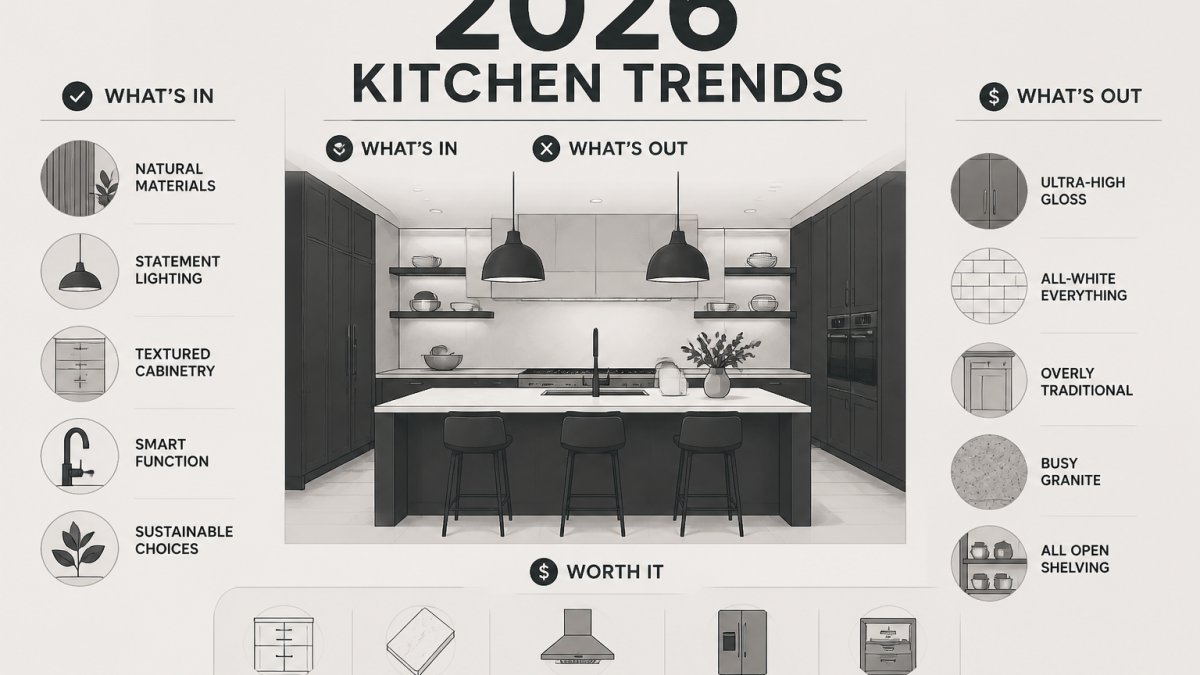
2026 Kitchen Trends: What's In, Out, and Worth It
Table of Contents
- Warm Neutrals Replace the All-White Kitchen
- Statement Stone and Natural Textures Take Center Stage
- 2026 Kitchen Trends in Cabinetry: Bespoke and Built-In
- Smart Kitchen Technology Integration That Actually Helps
- Durable Countertop Materials for High-Traffic Kitchens
- Budget-Friendly 2026 Kitchen Updates and Small Space Solutions
- Kitchen Remodeling Cost Estimates: What Drives Your Budget
- Frequently Asked Questions
Last Updated: September 27, 2026
Warm Neutrals Replace the All-White Kitchen
The 2026 trend for kitchens is a decisive move away from the cold, all-white palette that dominated the past decade. Warm neutrals are now the foundation of the modern kitchen, and this guide from Times Square Remodeling Inc. breaks down what's actually changing on job sites.
Cream, oatmeal, taupe, and soft greige are replacing stark white cabinetry and icy gray walls. The shift isn't just aesthetic. Homeowners want rooms that feel lived-in rather than showroom-sterile, and warmer tones photograph better for resale listings.
Designers at the National Kitchen & Bath Association have tracked this movement toward warmer, layered palettes in their annual trend research. The practical takeaway: if you're planning a remodel, pick a warm neutral base and build texture on top of it rather than chasing a single trendy color.
What most guides miss is that warm neutrals only work when you commit to them across surfaces. A cream cabinet paired with a cool gray backsplash fights itself. Pick a direction and stay in it.
Statement Stone and Natural Textures Take Center Stage
Statement stone is the single biggest visual change in 2026 kitchen trends. Instead of quiet, uniform slabs, homeowners are choosing dramatic veining, book-matched islands, and full-height backsplashes that read as art.
Natural textures support that stone. Handmade zellige tile, with its irregular glazed surface, has become a common backsplash choice for people replacing flat white subway tile.
Texture layering is where most projects succeed or fail. Stone, wood, tile, and metal can all coexist in one kitchen, but they need a rhythm. Repeating one texture three times across a space usually looks more intentional than scattering five different ones.
2026 Kitchen Trends in Cabinetry: Bespoke and Built-In
Bespoke cabinetry is the defining storage story of the year. Open shelving, once a staple of design blogs, is losing ground to floor-to-ceiling built-in storage that hides clutter behind doors.
Custom built-in cabinetry scales based on linear footage, finish, and internal organization. The trade-off is lead time. Custom fabrication can take several weeks longer than stock or semi-custom boxes, so it needs to be ordered early in the schedule.
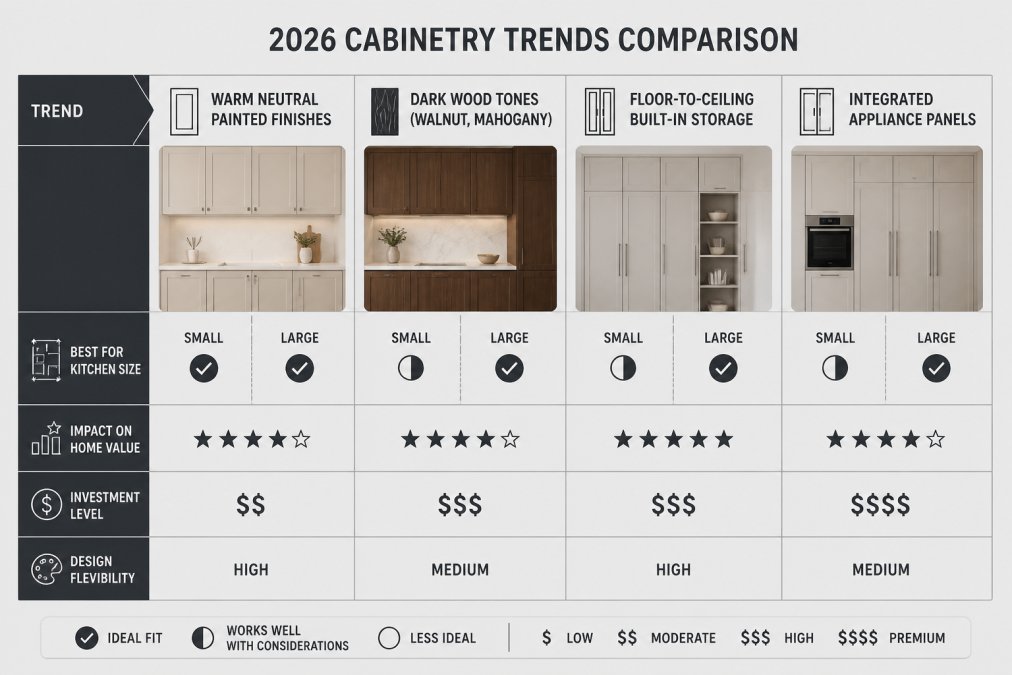
Dark wood tones are back, but selectively.
Smart Kitchen Technology Integration That Actually Helps
Smart kitchen technology integration has matured past the novelty stage. The features that stick are the ones that solve a real annoyance, not the ones that need an app to operate a light switch. The 2026 shift is away from app-first gadgets and toward systems that run quietly in the background and only surface when something needs attention.
What's earning its place in 2026:
- Induction cooktops with precise temperature hold and pan-detection zones
- Under-cabinet lighting on motion or daylight sensors
- Smart leak detection under the sink, behind the fridge, and at the dishwasher supply line
- Panel-ready refrigerators with internal cameras for remote inventory checks
- Ventilation hoods that ramp automatically with cooktop load
How these systems actually work
Induction holds temperature by cycling the magnetic field on and off many times per second, which is why it responds faster than gas and why a precise hold setting is possible at all. Leak sensors use a small conductivity probe; when water bridges the contacts, a solenoid valve closes the supply and the hub pushes an alert. Motion and daylight sensors on under-cabinet lighting are simple photocell-plus-PIR combinations, and they are the single easiest smart upgrade to retrofit because they don't require a hub.
Where smart kitchens fail
The failure mode is almost always the same: too many apps, too many hubs, and no single point of control. A kitchen with four different manufacturer apps is a kitchen nobody enjoys using. Pick one ecosystem for lighting and sensors, and keep appliances on their own native controls. Also confirm your Wi-Fi reaches the kitchen, a mesh node in an adjacent room is usually enough, but a metal-backed cabinet can kill a signal.
Durability and maintenance of smart components
Smart hardware has a shorter service life than the cabinetry around it. Sensors, hubs, and LED drivers typically need replacement before the cabinets do, so plan for accessible junctions rather than burying them behind a finished panel. Keep a simple record of model numbers and install dates; when a driver fails in year six, matching it is far easier than guessing.
Durable Countertop Materials for High-Traffic Kitchens
Durable countertop materials for high-traffic kitchens come down to a simple question: how hard will this surface be used, and how much maintenance will you actually do? Most trend coverage stops at the look. The part that determines whether you still love the counter in year ten is care, and that is where the real differences show up.
Quartzite
Quartzite has become the 2026 favorite for high-end projects. It's a natural stone with the veined look of marble but significantly more scratch and heat resistance. The advantage is longevity and resale appeal.
Engineered quartz
Engineered quartz is more forgiving than natural stone and does not need sealing, which makes it the practical pick for busy households. It looks more uniform, which some homeowners now find less interesting, but the trade-off is real: fewer surprises, easier cleanup, and consistent color across seams. It is not heat-proof, though, a hot pan set directly on the surface can leave a scorch mark, so trivets are non-negotiable.
Granite
Granite remains the workhorse. It is hard, heat-tolerant, and widely available, and it takes a polish that hides everyday wear well. It does need sealing, and darker granites tend to show fewer stains than lighter ones. For a high-traffic kitchen where the counter will take abuse, granite is still a defensible choice.
Butcher block and laminate
For rental properties or budget-driven projects, a quality laminate or butcher block remains a reasonable choice. Neither lasts as long as stone, but both can be replaced later without a full tear-out. Butcher block needs oiling every few months and should never sit wet; laminate is the lowest-maintenance option but cannot be repaired if it chips.
A simple care schedule
- Daily: wipe with a soft cloth and mild soap; avoid abrasive pads on any polished surface.
- Weekly: check seams and the sink cutout for any sign of moisture.
- Every 12-18 months: reseal natural stone; test by dripping water, if it darkens instead of beading, it's time.
- As needed: re-oil butcher block when it looks dry; use trivets under all hot cookware.
The honest takeaway is that the most durable counter is the one you will actually maintain. A sealed quartzite that gets wiped down nightly will outlast a neglected quartz that never sees a sponge.
Budget-Friendly 2026 Kitchen Updates and Small Space Solutions
You don't need a full gut remodel to catch the 2026 look. A focused update can shift a kitchen's entire feel for a fraction of the cost.
High-impact, lower-cost moves:
- Repaint cabinets in a warm neutral instead of replacing them
- Swap the backsplash for zellige or a textured tile
- Replace builder-grade hardware with a consistent metal finish
- Add under-cabinet lighting on a simple sensor
Kitchen Remodeling Cost Estimates: What Drives Your Budget
Kitchen remodeling cost estimates are driven by scope, not by square footage alone. Two kitchens of identical size can differ enormously in price based on what's behind the walls.
Frequently Asked Questions
What kitchen trends will be outdated in 2026?
All-white kitchens with stark contrasts are fading, along with open shelving that creates visual clutter. Industrial-style exposed pipe shelving and heavily distressed finishes are also losing ground. The 2026 kitchen trends point toward warm neutrals, bespoke cabinetry with hidden storage, and natural textures like zellige tile and quartzite. If your kitchen was designed around gray-on-gray palettes or open-concept shelving, updating the cabinet fronts and adding closed storage can bring it current without a full renovation.
What color kitchen cabinets are trending in 2026?
Warm neutrals dominate: cream, mushroom, taupe, and soft clay tones are replacing cool grays. Dark wood tones like walnut and mahogany are also rising for islands and accent cabinetry. Two-tone layouts work well, pairing lighter perimeter cabinets with a darker island. For a timeless look, choose a warm neutral for the bulk of your cabinetry and introduce a darker wood tone on an island or a single feature run rather than committing the entire kitchen to one strong color.
How can I make my kitchen look timeless for 2026?
Focus on quality materials and clean lines rather than chasing every trend. Warm neutral cabinetry, quartzite or quartz countertops with subtle veining, and simple hardware in unlacquered brass or matte black age well. Avoid heavily themed finishes and oversized statement pieces that date quickly. Layered ambient lighting, including under-cabinet and pendant fixtures, adds warmth without following a passing style. A licensed contractor can help you select finishes that balance current 2026 kitchen trends with long-term resale value.
What are the trends for kitchen countertops in 2026?
Quartzite is the standout for high-traffic kitchens, offering natural stone veining with better durability than marble. Warm-toned quartz with subtle movement is another strong choice. For durability, quartzite and quartz resist scratches and stains better than marble or butcher block. If your kitchen sees heavy daily use, prioritize a material that handles heat and knife contact without etching. Sealing quartzite properly extends its life, and a professional fabricator ensures correct installation for long-term performance.