 how-to
Free Home Remodeling Estimate: A 2026 How-To Guide
Table of Contents
- What a Free Home Remodeling Estimate Should Actually Include
- How to Prevent Unexpected Remodeling Costs Before You Sign
- The Home Renovation Budget Template That Keeps Projects on Track
- Questions to Ask a General Contractor Before You Commit
- How to Read a Remodeling Project Timeline (And Spot Red Flags)
- Step-by-Step: How to Get an Accurate Home Remodeling Estimate
- Conclusion
- Frequently Asked Questions
Last Updated: October 1, 2026
What a Free Home Remodeling Estimate Should Actually Include
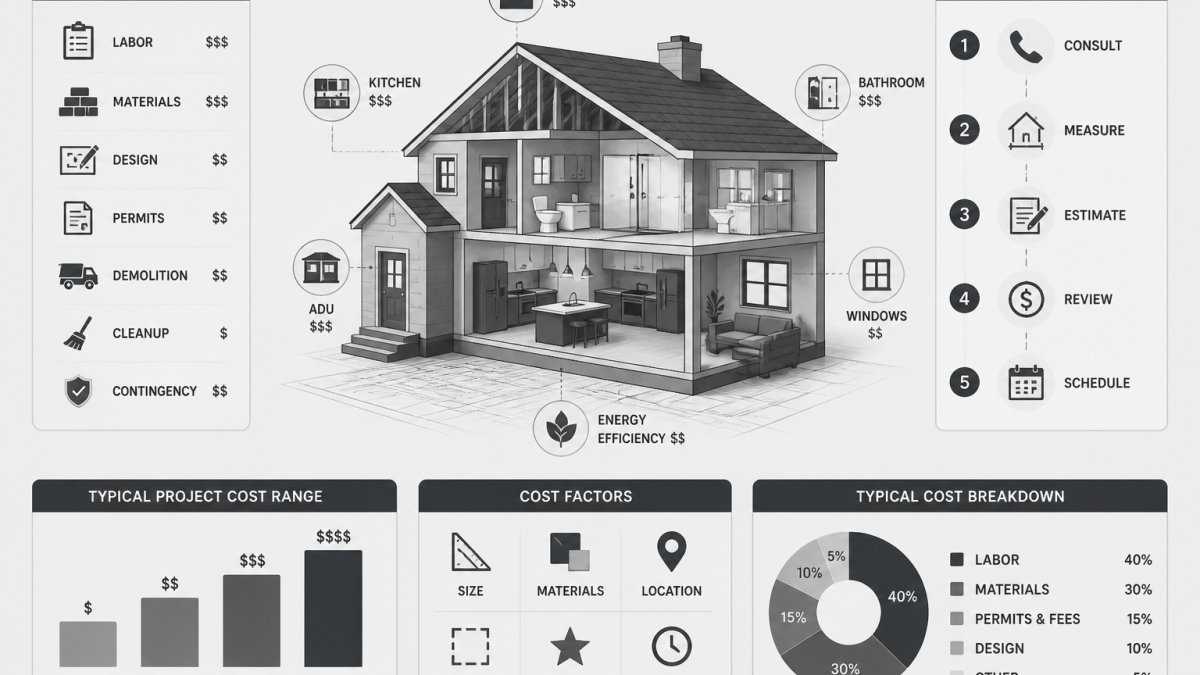
A free home remodeling estimate is a written, itemized projection of what your project will cost, prepared by a licensed contractor after reviewing your space and scope of work. At Times Square Remodeling Inc., we've watched homeowners sign contracts based on a single number scribbled on a business card, then spend the next six months arguing about what that number actually covered. A real estimate has line items, quantities, and a clear scope statement.
The document should list materials by type and quantity, labor hours or crew days, permit fees, and a timeline.
Line Items vs. Lump Sums: What to Look For
A lump sum gives you one price for the whole job. A line-item estimate breaks that price into labor, materials, permits, and contingencies. Line items protect you because you can see exactly where money goes and challenge anything that looks inflated.
| Estimate Type | What It Shows | Best For | Risk Level |
|---|---|---|---|
| Lump sum | One total price | Simple, single-trade jobs | Higher |
| Line item | Cost per task and material | Kitchens, bathrooms, ADUs | Lower |
| Cost-plus | Materials plus labor markup | Projects with unknown scope | Medium |
| Time and materials | Hourly rate plus receipts | Small repairs, punch lists | Variable |
How to Prevent Unexpected Remodeling Costs Before You Sign
Material inflation is the one variable you can partly control. Lock in pricing on major fixtures and finishes early, and confirm how long a quote stays valid. A bid that expires in seven days protects the contractor, not you.
The Home Renovation Budget Template That Keeps Projects on Track
A working home renovation budget template tracks four columns: estimated cost, actual cost, variance, and running total. Fill it in weekly, not monthly. Small overruns compound quietly, and by the time the final invoice arrives, the variance column is the only honest record of what happened.
Use this structure:
- Fixed costs: permits, design fees, demolition, waste removal, installation fees
- Variable costs: fixtures, finishes, appliances, tile, paint, hardware
- Labor: general contractor, subcontractors, specialty trades
- Contingency: held in reserve, released only for documented surprises
- Soft costs: temporary housing, storage, utility changes
How to Size Your Contingency Line
Most practitioners find that a contingency reserve of 10% to 20% of the project total is the working range, with the higher end reserved for older homes or projects that touch plumbing, electrical, or structural systems. The reserve is not a slush fund. It is released only against a written change order or a documented discovery, and any unused balance returns to you at closeout.
Where the Money Actually Goes
Across most residential renovations, labor and materials split roughly in half, though the ratio shifts by trade. Cabinetry, countertops, and tile tend to be material-heavy. Demolition, framing, plumbing rough-in, and electrical rough-in tend to be labor-heavy. Knowing which side of the ratio a line item sits on tells you where to negotiate and where cutting corners creates callbacks.
The True Cost of an Upgrade
An upgrade is rarely the sticker price difference. A larger tile format can require a different substrate, more thinset, and additional labor hours. A heavier countertop can require cabinet reinforcement. A new appliance can require a dedicated circuit. When you evaluate an upgrade, price the full ripple, not just the fixture. That is the number that belongs in the variance column.
Weekly Review Cadence
Set a standing 15-minute review each week with whoever is managing the project. Walk the four columns, flag any variance above a threshold you set in advance, and confirm the next week's scheduled work. A budget that is reviewed only at milestones is a budget that is already behind.
Questions to Ask a General Contractor Before You Commit
The right questions separate a contractor who manages projects from one who manages excuses. Ask about licensing, insurance, and who actually swings the hammer. Then go one layer deeper: the answers only matter if you know how to compare them across bids.
- Are you licensed, and what is your license number?
- Who pulls the permits, and are they in the written contract?
- Will you use your own crew or subcontractors?
- How do you handle hidden damage discovered mid-project?
- What's your change-order process?
- Can you provide references from projects similar to mine?
- What's the payment schedule, and is it tied to milestones?
The Apples-to-Apples Bid Comparison Checklist
Two bids for the same kitchen can differ by tens of thousands of dollars and still both be "correct", because they cover different scopes. Before you compare numbers, normalize the bids against this checklist. If a bid cannot answer a line, that is a gap you will pay for later.
- Scope statement: Does the bid name every room, every surface, and every fixture by model or specification?
- Exclusions: What is explicitly not included? Demolition, dumpster, permit fees, and paint are common exclusions.
- Allowances: Are fixtures and finishes priced as allowances? If so, what happens when you exceed them?
- Permits: Who pulls them, who pays for them, and are inspection re-fees covered?
- Subcontractors: Which trades are subbed out, and are those subs licensed and insured?
- Schedule: Is there a start date, a completion date, and a stated consequence for missing them?
- Payment schedule: What percentage is due at signing, and what milestone triggers each subsequent draw?
- Warranty: What is covered, for how long, and in writing?
- Change-order process: How is added work priced and approved before it starts?
- Cleanup and disposal: Who removes debris, and is the dumpster in the bid?
Red Flags in the Answers
A bid that is dramatically lower than the others is usually missing scope, not offering a deal. A contractor who cannot produce a certificate of insurance on request is a liability you inherit. A payment schedule that front-loads more than a modest deposit puts your money ahead of their work. And a contractor who discourages you from getting a second or third bid is telling you something about how their number compares.
References You Should Actually Call
Ask for three references from projects completed in the last 12 months, and ask each one the same three questions: Did the project finish on the schedule in the contract? Did the final invoice match the original estimate, and if not, why? Would you hire them again? The third answer is the one that matters.
How to Read a Remodeling Project Timeline (And Spot Red Flags)
A remodeling project timeline is a schedule of phases, each with a start date, a duration, and a dependency on the phase before it. The red flags hide in the gaps between phases.
Step-by-Step: How to Get an Accurate Home Remodeling Estimate
Getting an accurate home remodeling estimate follows five repeatable steps. Skip one and the number you receive becomes a guess.
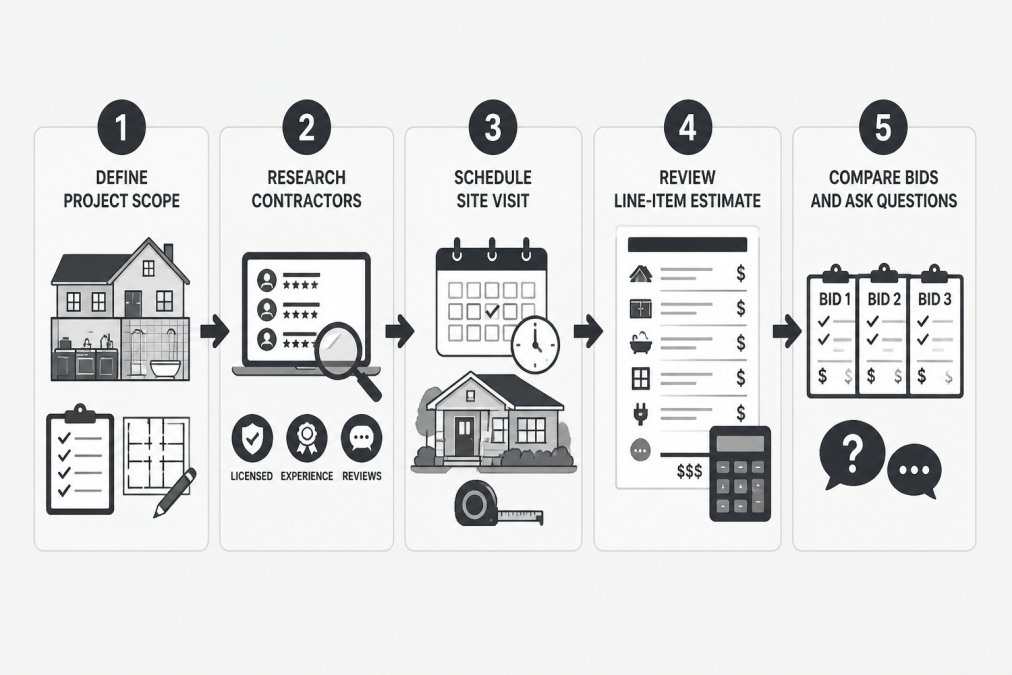
- Define your project scope. Write down what you want changed, room by room, with rough dimensions.
- Research and shortlist contractors. Check licensing, insurance, and references before you call.
- Schedule the site visit. A real estimate requires someone to walk the space.
- Review the line-item estimate. Compare quantities, materials, and labor against your scope.
- Compare bids and ask questions. Differences between bids usually reveal differences in scope, not price.
Conclusion
The gap between a smooth renovation and a stressful one usually comes down to the estimate and the contractor behind it. Times Square Remodeling Inc. brings over 15 years of experience as a California-licensed general contractor, with a focus on energy-efficient upgrades and full-service project management. We handle everything from roofing and kitchen and bathroom remodeling to ADU construction, so you're not coordinating a dozen separate trades.
Frequently Asked Questions
How do I get an accurate estimate for a home remodel?
To get an accurate home remodeling estimate, start by defining your project scope in detail. Then, invite at least three licensed contractors to perform an on-site inspection. A thorough estimate should be based on specific measurements and material selections, not just square footage. Ask for a line-item breakdown that separates labor, materials, permits, and contingency. This approach gives you a realistic budget and helps you compare bids fairly.
What should be included in a professional remodeling estimate?
A professional estimate should include a detailed scope of work, a line-item breakdown of costs for labor and materials, permit fees, and a projected timeline. It should also specify what is not included, such as unforeseen structural repairs or design changes. Look for a clear payment schedule and a contingency line, typically 10-20% of the project cost, to cover surprises. A fixed-price bid offers more cost certainty than a rough estimate.
How can I prevent unexpected costs during a home renovation?
Preventing unexpected costs starts with a detailed contract and a realistic budget. Include a contingency fund of 10-20% for hidden issues like water damage or outdated wiring. Before signing, ask your contractor how they handle change orders and what triggers them. Get everything in writing, including material allowances. Regularly communicate with your project manager and review progress to catch potential overruns early.
What questions should I ask a contractor before getting an estimate?
Ask for their license number, insurance certificates, and a list of recent local references. Inquire about their process for handling change orders and unexpected discoveries. Ask who will be on-site daily and how they communicate progress. Request a sample estimate to see their level of detail. Finally, ask about their warranty on workmanship and how they resolve disputes. Their answers reveal their professionalism and reliability.