 how-to
Can You Stay in House During Mold Remediation?
Table of Contents
- Can You Stay in House During Mold Remediation?
- What Happens During Mold Remediation
- Is It Safe to Sleep in a House with Mold?
- Room-by-Room Decision Guide for Staying or Leaving
- Renters, Shared Buildings, and Contractor Questions
- Frequently Asked Questions
Last Updated: October 5, 2026
Can You Stay in House During Mold Remediation?
The short answer: sometimes, but not always.
At Times Square Remodeling Inc., we have over 15 years of experience as a California-licensed general contractor.
Most guides get this wrong: the decision is not about the mold itself but the work. Remediation stirs up spores, changing the safety math for everyone in the building.
Below, we break down the 10-square-foot rule, when to leave, and how to plan your return.
The 10-Square-Foot Rule
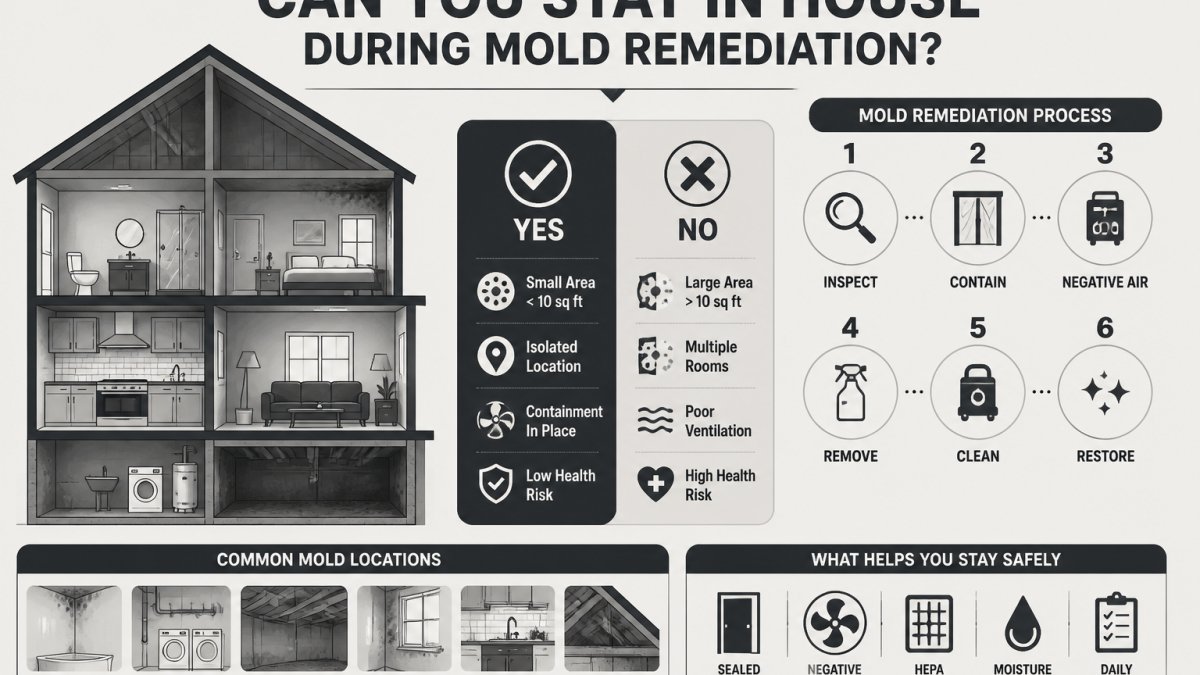
The 10-square-foot rule is a common industry guideline: mold covering less than roughly 10 square feet can often be cleaned without full containment.
Key differences:
- Under 10 square feet: Often a DIY or small crew job. Limited dust and spores.
- Over 10 square feet: Containment, air scrubbers, and possible demolition.
- Hidden mold: Size is unknown until walls or floors are opened.
The U.S. Environmental Protection Agency mold cleanup guidance notes that porous materials with mold growth often cannot be cleaned and must be removed.
If a contractor cannot tell you the size of the affected area before work starts, ask how they will find out.
What Happens During Mold Remediation
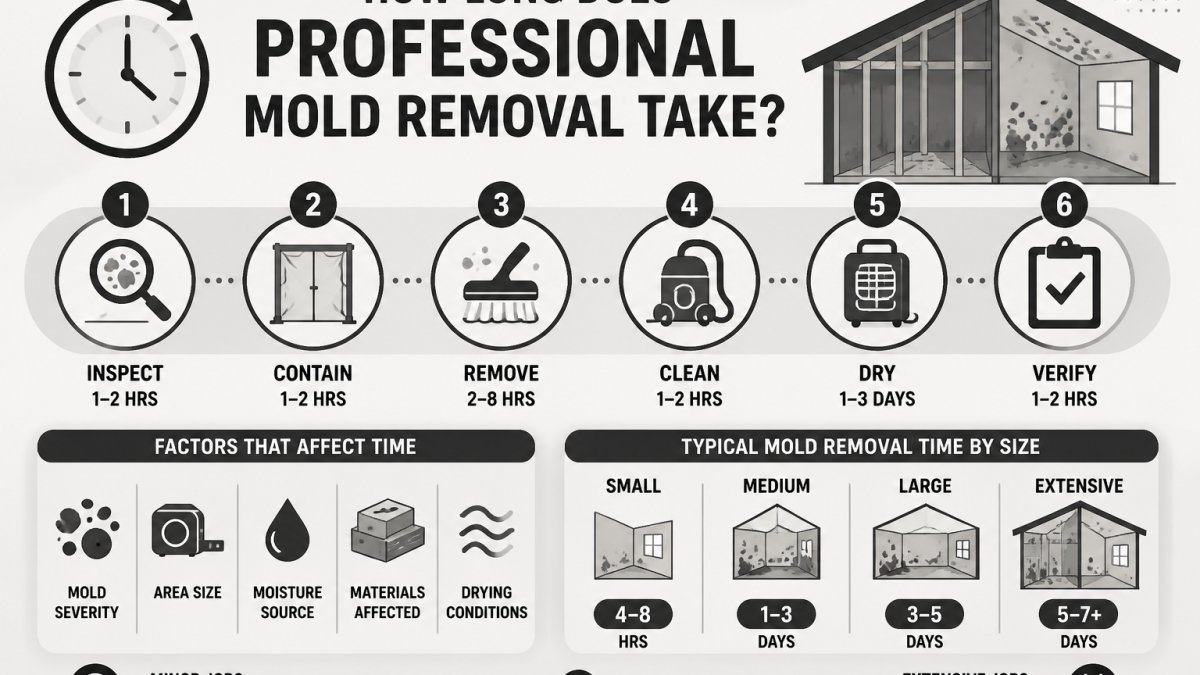
Mold remediation removes mold growth, fixes the moisture source, and cleans the air and surfaces so spores do not spread, it is not just wiping surfaces.
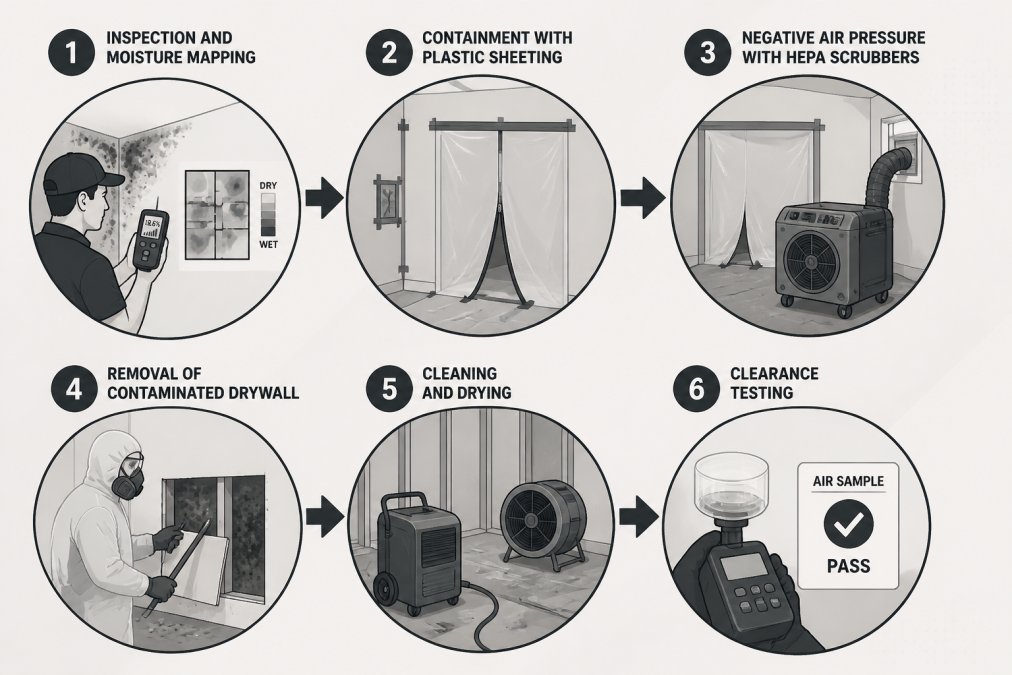
A typical job follows these steps:
- Inspection and moisture mapping. The crew finds the water source and the extent of contamination.
- Containment. Plastic sheeting seals off the work area.
- Air filtration. Negative air pressure and HEPA scrubbers trap airborne spores.
- Removal. Contaminated drywall, insulation, or flooring is cut out and bagged.
- Cleaning. Surfaces are treated and wiped.
- Drying. Fans and dehumidifiers remove remaining moisture.
- Clearance. A post-remediation assessment confirms the area is clean.
The noise, dust, and equipment are the reasons occupancy gets tricky.
Containment and Negative Air Pressure
This is the single most important safety feature of a mold job.
When containment is done well:
- Spores stay inside the work zone.
- Cross-contamination to other rooms drops sharply.
- The HVAC system can be isolated so it does not spread spores.
When done poorly, dust escapes and the whole house is exposed, that is when staying becomes a real health risk.
Leave if any of these apply:
- The affected area is larger than a small patch.
- Walls, ceilings, or floors will be opened.
- The mold is near the HVAC system or in a shared space.
- Anyone in the home has asthma, allergies, or a weakened immune system.
- There are infants, young children, or older adults living there.
Staying is more reasonable when the job is small, fully contained, and no one is sensitive, but keep distance from the work zone and expect noise and equipment.
The Centers for Disease Control and Prevention mold resources recommends that people with mold allergies or lung conditions avoid areas with active mold growth and remediation work.
Is It Safe to Sleep in a House with Mold?
Sleeping in a house with active mold growth or active remediation is not recommended for sensitive occupants, you spend six to eight hours in one closed room breathing the same air all night.
For healthy adults in a small, contained job, sleeping far from the work zone is often fine; for anyone with asthma, allergies, or a compromised immune system, it is not worth the risk.
Watch for these signs that the air quality has dropped:
- A musty smell in the bedroom
- New coughing, sneezing, or itchy eyes in the morning
- Visible dust on surfaces near the work zone
- Worsening symptoms in family members with asthma
If any of these appear, relocate until the job passes clearance.
Room-by-Room Decision Guide for Staying or Leaving
Use this guide room by room. The key questions: is the room inside the containment zone, is anyone in it in a sensitive group, and does it share air with the work area?
| Room | Inside Containment? | Sensitive Occupant? | Recommendation |
|---|---|---|---|
| Work area | Yes | Any | No entry until clearance |
| Adjacent room | No, shared wall | Yes | Relocate temporarily |
| Adjacent room | No, shared wall | No | Stay, keep door closed |
| Bedroom far from work | No | No | Usually safe to sleep |
| Bedroom far from work | No | Yes | Relocate until clearance |
| Shared HVAC zone | Yes | Any | Leave until system is cleaned |
Renters, Shared Buildings, and Contractor Questions
Renters face a different set of rules.
For renters:
- Report the mold in writing and keep a copy.
- Photograph the affected area with dates.
- Ask where you will stay if the unit is not safe during work.
- Check your lease and local tenant rules on relocation.
In shared buildings, mold in one unit can affect neighbors through shared walls and HVAC. Ask the building manager how containment will protect other units.
Before hiring anyone, ask these questions:
- Are you licensed and insured for mold work?
- How will you contain the work area?
- Will you use negative air pressure and HEPA filtration?
- How will you protect the HVAC system?
- What does clearance testing include, and who performs it?
- Can I see the results in writing before I move back in?
For homeowners in Los Angeles County dealing with mold after water damage, FEMA guidance on mold and flood cleanup offers additional safety steps for re-entering a damaged home.
Mold remediation raises hard questions about safety, timing, and who pays. Getting it wrong can mean weeks out of your home or health problems that linger.
Frequently Asked Questions
Can you sleep in a house during mold removal?
It depends on where the work is happening and who is sleeping there. If remediation is confined to a small, sealed area with plastic sheeting and negative air pressure, sleeping in a distant bedroom is often possible. If the affected area is large, the HVAC system is involved, or anyone in the home has asthma, allergies, or a weakened immune system, sleep elsewhere until clearance testing confirms the work zone is clean.
How long should you wait to re-enter your home after mold remediation?
Most crews release the work zone after final cleaning and a post-remediation assessment, which typically happens within 24 to 72 hours of demolition and drying being complete. Do not re-enter until the contractor confirms containment has been removed, surfaces are dry, and any clearance testing has passed. If you relocated, ask for the written clearance result before moving furniture or bedding back into the space.
What happens if you stay in a house with mold?
Staying in a home with active mold growth can mean ongoing exposure to airborne spores, especially in bedrooms and living areas near the affected space. Common complaints include coughing, sneezing, nasal congestion, eye irritation, and worsened asthma symptoms. People with allergies or respiratory conditions may notice symptoms sooner. The longer moisture stays, the more the mold spreads, so the practical answer is to fix the moisture source and start remediation rather than wait it out.
What should I ask a remediation contractor before work begins?
Ask how the work zone will be sealed, whether negative air pressure and HEPA filtration will run for the whole job, and whether the HVAC system will be isolated or protected. Confirm who performs clearance testing and whether it is done by a party independent of the crew doing the removal. Get the scope in writing, including what happens if hidden damage is found behind walls, and ask how daily updates will be shared if you are staying in the home.