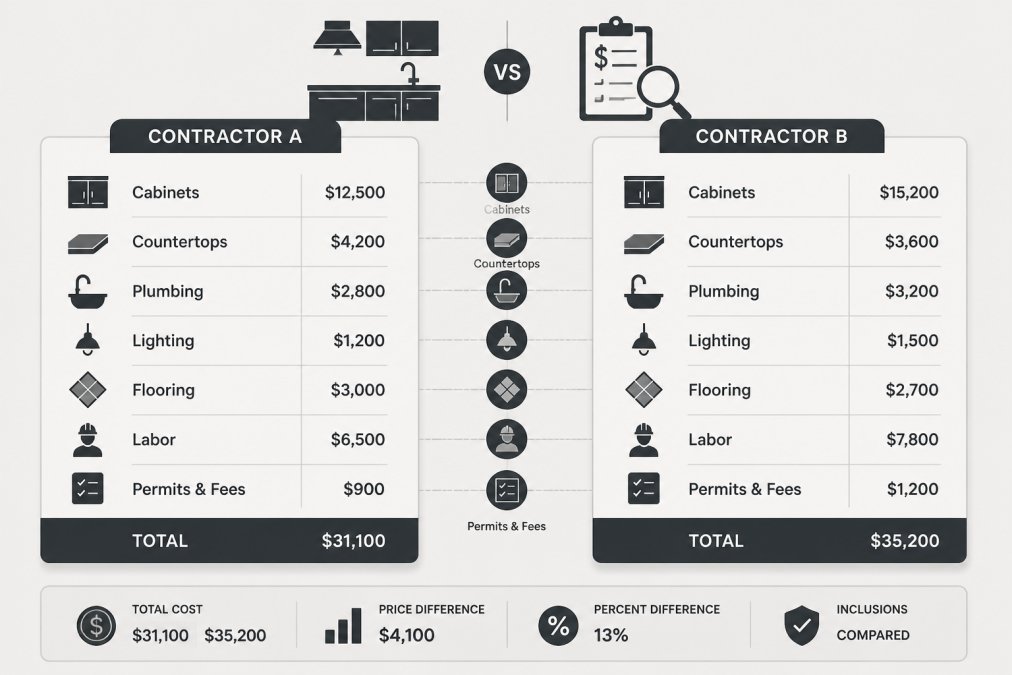
 comparison
Compare Kitchen Remodeling Contractor Quotes: 2026 Guide
Table of Contents
- Why Kitchen Remodeling Quotes Vary So Much
- How to Read a Kitchen Remodel Cost Breakdown
- Questions to Ask Kitchen Remodeling Contractors Before You Compare Bids
- How to Spot a Padded Remodeling Bid
- Understanding the Kitchen Remodel Payment Schedule
- Normalizing Quotes Digitally: A Step-by-Step Comparison Process
- Conclusion
- Frequently Asked Questions
Last Updated: September 10, 2026
Why Kitchen Remodeling Quotes Vary So Much
Two contractors walk the same kitchen and hand you bids that differ by tens of thousands of dollars, which is exactly why you need to compare kitchen remodeling contractor quotes carefully. That gap rarely means one is trying to rob you. When you compare kitchen remodeling contractor quotes side by side, you are usually comparing two different projects that share an address.
At Times Square Remodeling Inc., we have spent more than 15 years as a California-licensed general contractor watching homeowners react to that spread. The variance comes down to three forces: scope, material specifications, and how each contractor handles risk and overhead.
Scope of Work: The Hidden Reason Bids Differ
Scope of work is the written inventory of everything a contractor will and will not do. When one bid includes cabinet removal, drywall repair, and permit filing while another quietly omits them, the lower number is not a better deal. It is a smaller project.
A common mistake is assuming every contractor interprets "kitchen remodel" the same way. One bidder prices a cosmetic refresh, reface cabinets, swap the countertop, paint. Another prices a full gut: relocate plumbing, upgrade electrical, replace subfloor. Different scopes, same label.
Before you compare anything, list every task you expect performed and check it against each bid line by line. Anything missing is a future change order, and change orders are where budgets quietly die.
Material Specifications and Grade Gaps
Material specifications are the exact brands, grades, and dimensions of every product going into your kitchen. This is where the "apples-to-apples" comparison most homeowners think they are doing falls apart.
Countertops alone swing widely: quartz, granite, and butcher block differ in cost and durability. Cabinetry swings wider, plywood versus particleboard boxes, soft-close versus standard hinges, custom versus stock sizing. A bid that says "new cabinets" tells you nothing; one naming the manufacturer, door style, and box construction tells you everything.
The same logic applies to labor. A contractor using a dedicated crew prices differently than one subcontracting every trade. Neither is wrong, but you deserve to know which you are buying.
How to Read a Kitchen Remodel Cost Breakdown
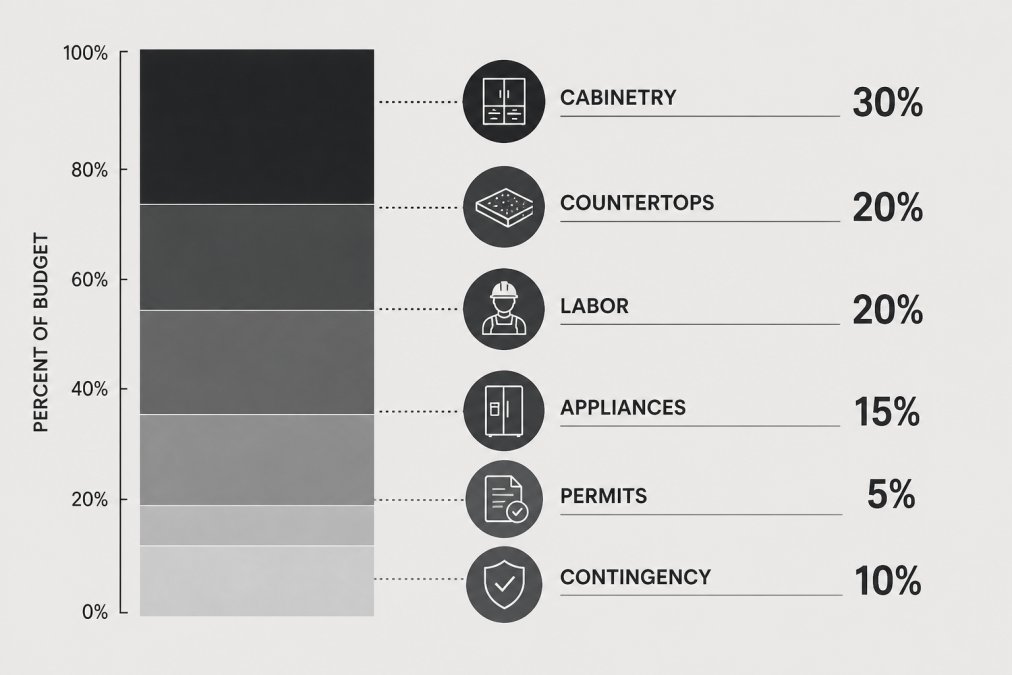
A kitchen remodel cost breakdown is an itemized estimate separating materials, labor, permits, and contingency into distinct lines. If a bid arrives as one lump sum, ask for a line-item estimate before going further.
Here is how the categories typically divide:
- Cabinetry and countertops: usually the largest material line, and the easiest place for a bidder to hide a downgrade
- Labor: demolition, carpentry, plumbing, electrical, tile, and finish work, often split by trade
- Appliances and fixtures: frequently excluded so the bid looks smaller
- Permit fees: varies by jurisdiction and by how much structural or electrical work is involved
- Contingency fund: the line most bids omit entirely, and the one that saves you when hidden damage surfaces
A padded bid is an estimate inflated with unnecessary line items, inflated quantities, or vague allowances designed to look legitimate. Spotting one requires reading quantities, not totals.
Questions to Ask Kitchen Remodeling Contractors Before You Compare Bids
The right questions expose scope gaps and reveal how a contractor handles the unexpected. Ask these before placing any two bids side by side.
On scope and risk:
- Is this a fixed-price contract or time and materials, and why?
- What happens if you find hidden water damage or outdated wiring behind the walls?
- How do you document and price a change order before doing the work?
On credentials:
- What is your license number, and can I verify it with the state licensing board?
- Are you carrying general liability and workers' compensation coverage, and can I see certificates?
- Who are your subcontractors, and are they licensed and insured too?
On schedule and payment:
- What is the project timeline, and what is the project completion date in writing?
- What does the payment schedule look like, and how does it tie to project milestones?
On proof:
- Can I speak with two recent clients and see the finished work?
- What warranty coverage do you provide, and what does it actually cover?
The California Contractors State License Board publishes license verification and consumer guidance that every homeowner should read before signing. Contractors who welcome these questions are usually the ones worth hiring.
How to Spot a Padded Remodeling Bid
A padded bid charges for work you do not need, overstates quantities, or buries profit inside vague allowances. The inflation lives in the details, find it by reading quantities, not totals.
Watch for these signals:
- Round-number allowances. "Allow a set amount for tile" with no square footage or product named is a placeholder, not a price. Ask for the square footage and the specific product.
- Duplicated line items. Demolition listed under two trades, or disposal fees appearing three times.
- Quantities that do not match your kitchen. Ask for square footage on every material line and check it against your own measurements.
- Missing scope priced elsewhere. If a bidder omits permit filing but you know your project needs it, that cost reappears later.
- Pressure to sign fast. Legitimate contractors do not need a same-day decision.
The Line-Item Math That Exposes Padding
Padding hides in quantities, not totals. You need three numbers for every material line: quantity, unit, and unit price. A bid giving only a total for "tile work" gives you nothing to check.
The pattern: a bid lists tile at roughly double your actual floor and wall area. The unit price looks competitive and the total reasonable, but the quantity is wrong and the overage is pure margin. Multiply the inflated square footage by the unit price and you have the padding, in dollars, on one line.
The same math applies to drywall, paint, and flooring. Ask each contractor for the square footage they are pricing on every surface line, then compare it to your own measurements. Ten percent discrepancies are normal waste factor; fifty percent is padding.
Overhead and Profit Are Not Padding
Overhead and profit are not padding. Every contractor carries insurance, vehicles, office costs, and a margin that keeps the business alive. Expect that line, and be suspicious of a bid that hides it.
Overhead covers fixed business costs: insurance, vehicles and fuel, tools, office staff, software, and the owner's time on estimating and project management. Profit is what remains, compensation for risk and tied-up capital.
In residential remodeling, overhead and profit is often applied as a percentage on top of direct costs, sometimes separately to labor and materials, sometimes as one combined line. The percentage varies by contractor size, complexity, and region. The point is not the number, it is whether the bid shows it. A bid that lists overhead and profit is comparable; one that buries it inside material markups is not.
Lowball Bids: The Other Half of the Comparison
A lowball bid is the same problem in reverse: it wins the job by omitting scope, then recovers the difference through change orders once work is underway. The homeowner ends up paying more than the mid-range bid, with less control over the final number.
The tell is not the total, it is the missing line items. Compare a lowball bid against a mid-range bid line by line and you will usually find permit filing, disposal, drywall repair, or a contingency line missing. Add those back at the mid-range bid's prices and the gap narrows or disappears.
What to Do When You Find Padding
Do not accuse. Ask. A specific, documented question about a line item is almost always answered with a correction. "This line shows tile at a quantity that does not match my measurements, can you walk me through it" produces a real adjustment. "Can you do better on price" produces a discount that comes out of somewhere else in the bid.
If a contractor cannot or will not explain a line item, that is your answer. Move to the next bid.
Understanding the Kitchen Remodel Payment Schedule
A kitchen remodel payment schedule ties each payment to a completed phase of work, protecting both sides: you never pay for work not done, and the contractor never funds your project out of pocket. It is also the most negotiable document in the bid package, and the one most homeowners sign without reading closely.
Most schedules follow a draw schedule tied to project milestones:
| Payment Stage | Tied To | Typical Share of Contract |
|---|---|---|
| Deposit | Signed contract, materials ordered | Small initial amount |
| Draw 1 | Demolition and rough framing complete | Early phase |
| Draw 2 | Rough plumbing and electrical inspected | Mid phase |
| Draw 3 | Cabinets set, countertops templated | Late phase |
| Final | Punch list signed off, warranty issued | Remaining balance |
Be cautious with any contractor requesting a large upfront payment before materials are ordered or work begins. A front-loaded schedule removes your leverage if the project stalls.
What the Schedule Actually Protects You From
The payment schedule is your only real enforcement tool once work starts. A contractor paid ahead of progress has no financial reason to finish on time; one paid behind progress has every reason to. That asymmetry is the entire point.
Three mechanisms make a schedule enforceable rather than decorative:
- Inspection-tied draws. Each draw should release only after a named inspection passes, not after a verbal "we're done with rough-in." In most jurisdictions, rough plumbing and rough electrical require a municipal inspection before drywall goes up (hud.gov). Tie the draw to the signed inspection card, not the contractor's word.
- Lien waivers at each draw. Ask for a conditional lien waiver from the general contractor and every subcontractor and supplier before releasing each payment. This prevents a subcontractor you never hired from filing a mechanic's lien against your home because the general contractor did not pay them. Most state statutes allow a homeowner to demand a lien waiver as a condition of payment.
- Retainage. Hold back a percentage of each draw, released only at final punch list sign-off. This is standard in commercial construction and increasingly common in residential remodels. It gives you a pool of money to cover the last five percent of work that contractors are notoriously slow to finish.
How Change Orders Break the Schedule
This is where most kitchen remodel budgets fail. A payment schedule covering only the original scope has no answer for the change order that arrives in week three, when the contractor opens a wall and finds galvanized supply lines or a subfloor wet for a decade.
A change order is a written amendment that adds, removes, or modifies scope, price, or schedule. Without a written change order process in the original contract, you cannot compare what you are charged against what was agreed.
Before signing, ask each contractor to put the following in writing:
- Who can authorize a change order. Only you, in writing. Not a site supervisor, not a subcontractor, not a text message.
- How change orders are priced. Labor rate, material markup, and whether overhead and profit apply to the change. Some contractors charge overhead and profit on top of change order costs; some do not. Get the answer before you need it.
- How change orders affect the schedule. A change order that adds three weeks to the timeline should say so. Otherwise the completion date in your contract becomes meaningless.
- A change order threshold. Many contracts require written change orders above a set dollar amount and allow small adjustments verbally. Know where that line is.
Comparing Payment Schedules Across Bids
When you normalize quotes, put each contractor's payment schedule in the same spreadsheet as their scope and material specs. Look for these differences:
- Deposit size. A deposit that covers only materials ordered is reasonable. A deposit that covers the contractor's first two weeks of labor is not.
- Number of draws. More draws means tighter cash control for you and more administrative work for the contractor. Fewer draws means larger payments and more risk.
- What triggers each draw. "Completion of rough-in" is vague. "Passed rough electrical inspection" is specific. Specific triggers are enforceable; vague ones are not.
- Retainage. A contractor who agrees to retainage is signaling confidence in their own finish work. A contractor who refuses is signaling something else.
A payment schedule is not a formality. It is the contract's enforcement mechanism, and the part of the bid most worth negotiating before you sign.
Normalizing Quotes Digitally: A Step-by-Step Comparison Process
Digital quote normalization converts every bid into one standard format so line items, quantities, and inclusions can be compared directly. It is the step most homeowners skip, and the reason so many comparisons end in confusion.
Here is the process:
- Collect every bid in one place. PDFs, emails, and paper quotes all go into a single folder.
- Build a master scope list. Write down every task your project requires, from demolition through final walkthrough.
- Transpose each bid into one spreadsheet. One column per contractor, one row per scope item, quantities and material specs in the cells.
- Flag every blank cell. A blank means the item is excluded, and excluded items become change orders.
- Normalize material grades. Rewrite "cabinets" as the actual manufacturer, box material, and door style for each bid.
- Calculate the cost baseline. Add the true total for each contractor, including permits and a contingency fund you set yourself.
- Score non-price factors. Licensing and insurance, references and portfolio, project timeline, and warranty coverage.
Tools like HouseGPTs contractor quote comparison automate part of this by flagging missing line items across bids, though you still enter the data yourself. Buildertrend and Houzz Pro generate standardized proposals on the contractor side, which makes your normalization job easier when a bidder uses them.
Negotiation is psychological as much as financial. Contractors respond better to specific, documented questions than to blanket discount requests. Instead of "can you do better on price," ask "this line shows tile at a quantity that does not match my measurements, can you walk me through it." That usually produces a real adjustment.
Conclusion
Comparing kitchen remodeling contractor quotes is not about finding the lowest number. It is about finding the bid that honestly reflects the work your kitchen needs, from scope and material specifications through payment schedule and warranty. Normalize every quote into one format, question every blank cell, and treat contingency as a line you fund rather than one you hope to avoid.
Times Square Remodeling Inc. is a California-licensed general contractor, license #953868, with over 15 years of experience delivering detailed, itemized estimates, transparent change order management, and end-to-end project execution across kitchen and bathroom remodeling, ADU construction, and energy-efficient upgrades. Get started with Times Square Remodeling Inc. and compare a quote built to be read line by line.
Frequently Asked Questions
What is a realistic budget for a kitchen remodel?
A realistic budget depends on scope, materials, and labor in your area. A minor refresh costs far less than a full gut renovation with layout changes. The key is to build a cost baseline from your own line-item estimates, not from national averages. Add a contingency fund of 15 to 20 percent for hidden damage, permit fees, and change orders. Request itemized quotes from at least three licensed contractors so you can compare apples to apples.
How do I know if a contractor's quote is too low?
A lowball estimate usually omits critical line items like permits, demolition, disposal fees, or finish work. It may also list vague allowances that will balloon later. Compare the scope of work line by line against other bids. If one quote is dramatically lower without a clear reason, ask the contractor to explain what is excluded. A padded bid inflates costs; a lowball bid hides them. Both hurt your renovation budget.
What documents should be included in a professional remodeling quote?
A professional quote should include a detailed scope of work, material specifications with brand and model numbers, a line-item estimate, a payment schedule tied to project milestones, a project timeline, permit responsibility, warranty coverage terms, and proof of licensing and insurance. It should also state how change orders are handled and signed. If any of these are missing, ask for them in writing before you compare quotes.
What should I not tell a kitchen remodeling contractor?
Avoid revealing your maximum budget or that you are in a hurry. Contractors who know your ceiling may pad the bid to match it. Also avoid saying you have not gotten other quotes, as this removes competitive pressure. Instead, share your scope of work and material preferences, then let the bids speak. Keep your contingency fund private so you have room to negotiate change orders without losing leverage.
How does the kitchen remodel payment schedule protect me?
A milestone-based draw schedule ties payments to completed work, not to calendar dates. For example, you might pay a deposit at signing, then pay after demolition, after rough-in inspections, after cabinet installation, and a final payment after punch-list completion. Never pay more than 10 percent upfront or pay for work not yet done. This structure protects your home equity and keeps the project on track.