 how-to
How Long Does Professional Mold Removal Take?
Table of Contents
- How Long Does Professional Mold Removal Take? A Realistic Timeline
- The Mold Remediation Timeline, Phase by Phase
- Mold Remediation Drying Time: Why It Outlasts the Removal
- What Makes Professional Mold Removal Take Longer
- Can I Stay in My House During Mold Remediation?
- When Can I Return After Mold Remediation?
- Delays That Stretch the Timeline and How to Prevent Them
- Frequently Asked Questions
Last Updated: October 7, 2026
How Long Does Professional Mold Removal Take? A Realistic Timeline
Professional mold removal usually takes four to ten days from inspection to final clearance, though small jobs can wrap in two to three days and severe contamination can stretch past two weeks. At Times Square Remodeling Inc., we have handled mold cleanup across Los Angeles County, and the honest answer is that no two jobs run on the same clock.
What drives the difference? Moisture, materials, and how far the mold has spread.
Below, we break down the mold remediation timeline phase by phase, explain why drying time often outlasts the removal itself, and show you how to spot the delays that add days to a job.
The Short Answer
Most homes fall into a predictable range:
- Small, contained mold: 2 to 3 days
- Typical bathroom or kitchen mold: 4 to 7 days
- Large or long-running infestation: 10 days to 2 weeks or more
The number you should plan around is the total, not the removal alone.
Why One Number Never Covers Every Job
Mold removal is not a single task. It is a sequence: find the moisture, stop it, contain the area, remove contaminated material, dry the structure, then prove the air is clean.
Each step has its own clock. A one-room job with a slow leak behaves nothing like a basement that has been damp for months.
The Mold Remediation Timeline, Phase by Phase
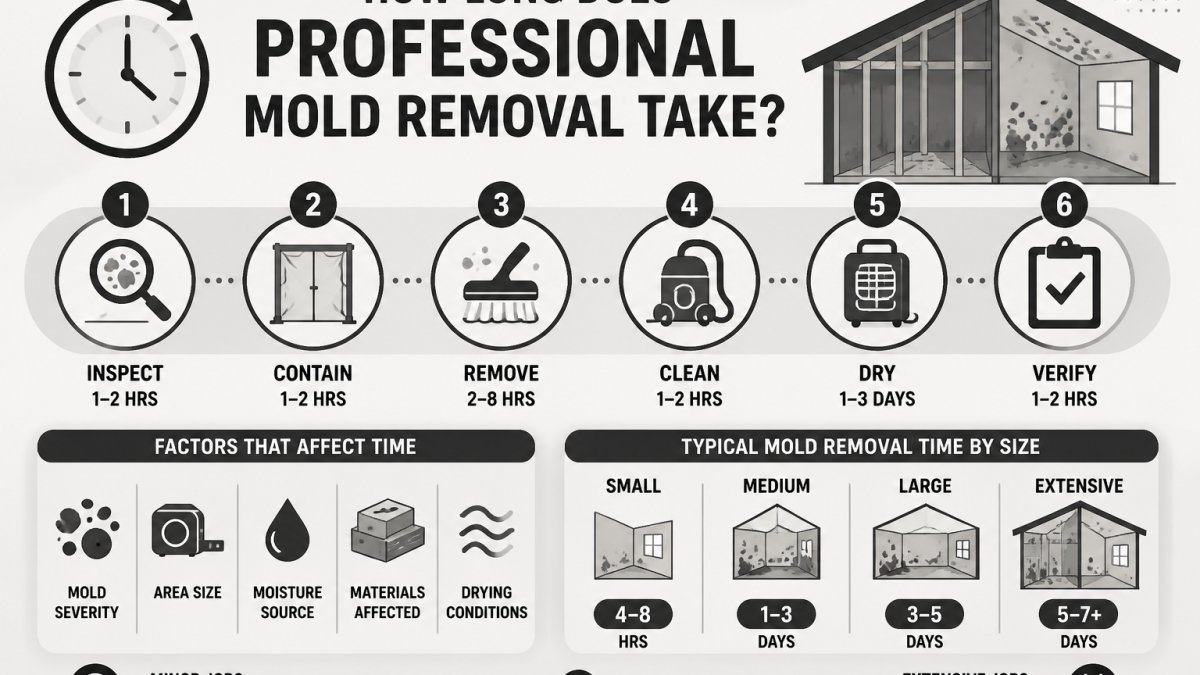
A full mold remediation timeline runs in three phases, and each one has a realistic day range. Here is how the work actually sequences.
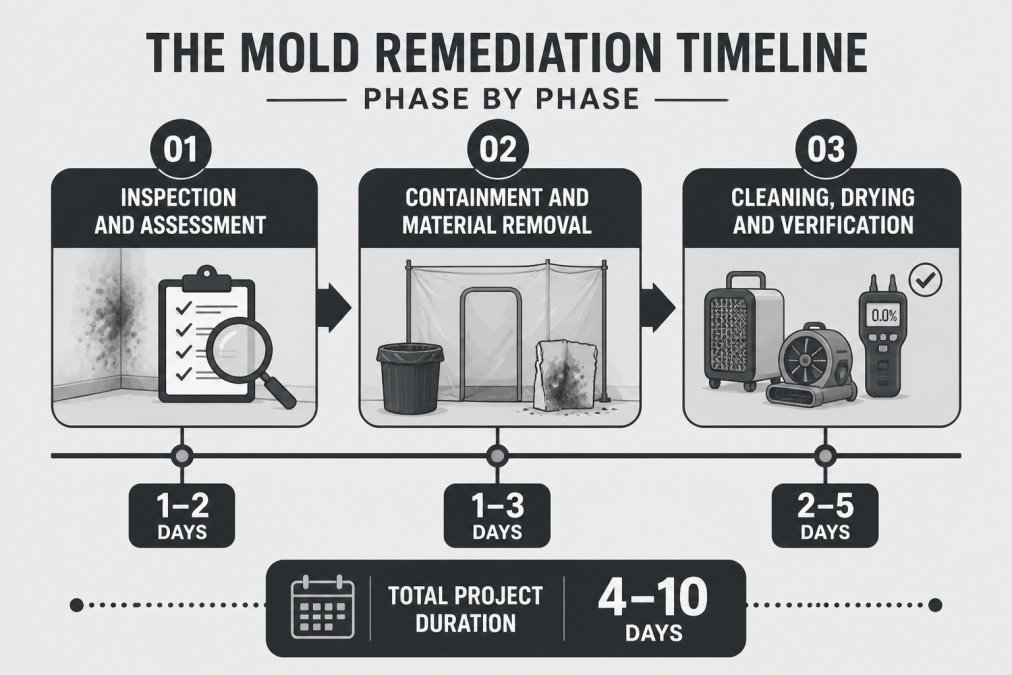
Phase 1: Inspection and Assessment (1 to 2 Days)
Assessment comes first, and it sets the scope for everything after. A technician traces the source of moisture, measures how far mold growth has spread, and checks hidden cavities behind drywall and under flooring.
Expect moisture meters, thermal imaging, and air sampling in some cases. If the source is a leak or water damage, that gets documented too, because mold returns fast when the water source is not fixed.
Phase 2: Containment and Material Removal (1 to 3 Days)
Containment keeps spores from spreading to clean rooms. Crews seal the affected area with plastic sheeting and run air scrubbers with HEPA filters.
Then comes removal. Porous surfaces like drywall, insulation, and carpet usually cannot be cleaned and must be cut out, bagged, and disposed of. Nonporous surfaces such as tile, metal, and glass can often be cleaned and treated with an antimicrobial product.
Phase 3: Cleaning, Drying, and Verification (2 to 5 Days)
This is the longest phase, and the one most homeowners underestimate.
After removal, the structure must be dried completely. Air movers and dehumidifiers run continuously, and the target is full dryness, not "dry to the touch." Once drying is confirmed, a post-remediation verification check, often with air sampling, confirms the work is complete.
Mold Remediation Drying Time: Why It Outlasts the Removal
Mold remediation drying time typically runs two to five days, and it is separate from the time spent removing mold. This is the distinction most guides skip.
Removal is physical work with a visible finish line. Drying depends on how much moisture is trapped in the framing, subfloor, and wall cavities.
A common mistake is rushing this phase. If the structure is not fully dry, mold colonies can return within days of the crew leaving. A EPA guide to mold cleanup and moisture control makes the point plainly: fix the water problem first, or the mold comes back.
What Makes Professional Mold Removal Take Longer
Three variables decide whether a job finishes in three days or drags past two weeks: the size of the affected area, the type of surface, and how long the moisture has been present. Most guides stop there. The more useful answer is what those variables look like in real projects, so you can map your own situation onto a realistic range.
Scenario Timelines by Project Size and Material
These ranges assume the moisture source is found and repaired before remediation begins. If it is not, add days to every scenario below.
| Scenario | Typical Affected Area | Dominant Materials | Realistic Total Timeline |
|---|---|---|---|
| Small bathroom, surface mold on tile and grout | Under 10 sq ft | Nonporous tile, sealed grout | 2 to 3 days |
| Single room with mold on drywall and baseboards | 10 to 100 sq ft | Porous drywall, semi-porous framing | 4 to 7 days |
| Finished basement, damp for weeks | 100 to 300 sq ft | Drywall, carpet, subfloor, framing | 7 to 12 days |
| Widespread contamination across multiple rooms or HVAC | 300+ sq ft | Mixed porous and semi-porous throughout | 10 days to 2 weeks or more |
A small bathroom with mold only on tile is the fastest job in remediation. The surface is nonporous, so it can be cleaned and treated rather than removed, and there is little trapped moisture to dry out.
A finished basement is where timelines stretch. Carpet and pad come out, drywall comes out, and the subfloor and framing underneath hold moisture that has been accumulating for weeks. Drying alone can run five to seven days in a basement because cool, still air slows evaporation.
Widespread contamination, especially when mold has entered an HVAC system, adds containment complexity on top of everything else. Ductwork has to be sealed and cleaned separately, and the system cannot run normally during remediation, which slows drying in the rest of the home.
Porous vs. Nonporous Surfaces
| Surface Type | Examples | Typical Action | Time Impact |
|---|---|---|---|
| Porous | Drywall, insulation, carpet | Cut out and dispose | Adds removal days |
| Semi-porous | Wood framing, subfloor | Clean, treat, dry | Adds drying days |
| Nonporous | Tile, metal, glass | Clean and treat | Fastest to finish |
Porous materials almost always get removed rather than cleaned. That single fact often explains a longer timeline than a homeowner expected. Semi-porous materials are the middle case: they can sometimes be saved, but only if drying is thorough, and that drying is what extends the schedule.
Can I Stay in My House During Mold Remediation?
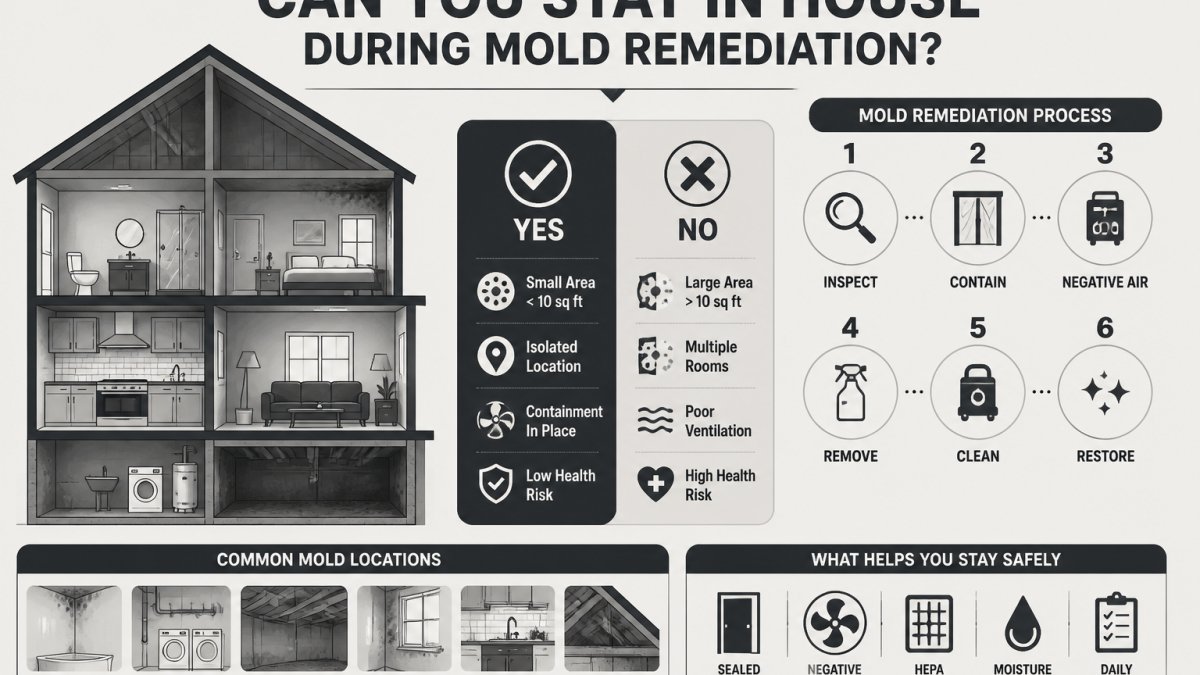
In many cases, yes, but it depends on the scope and your health. Small, contained jobs in a single sealed room often allow you to stay if you avoid the work zone.
Larger jobs, or any situation involving extensive spore release, usually call for temporary relocation. People with allergies, asthma, or weakened immune systems should treat this more cautiously, since mold spores are known allergens and irritants.
Ask your contractor directly whether the containment plan supports staying home. A clear answer is a good sign.
When Can I Return After Mold Remediation?
You can usually return once the work area has passed post-remediation verification and the structure is fully dry. That is the real signal, not the day the crew packs up.
Verification often includes a visual inspection plus air sampling to confirm spore levels are back to normal. If sampling is used, you may wait a day or two for lab results before clearance.
Delays That Stretch the Timeline and How to Prevent Them
Most blown timelines trace back to a handful of preventable problems. The key is understanding why each one adds days, not just that it does.
Hidden Moisture Behind Finished Surfaces
Mold visible on a wall is often the smallest part of the problem. Moisture wicks sideways through drywall and framing, so the affected area behind the surface can be several times larger than what you can see. When a crew opens the wall and finds more, the scope is revised and the timeline extends.
Prevention: Ask for moisture mapping with thermal imaging during the assessment phase, before any removal begins. A thorough assessment costs a little more time up front and saves days later.
Recurring or Unfixed Leaks
If the water source is still active, remediation is a temporary fix. Mold returns within days of the crew leaving, and the job has to be redone. This is the single most common reason a project that should have taken four days turns into a repeat visit.
Prevention: Have the leak repaired and confirmed dry before remediation starts. A EPA guide to mold cleanup and moisture control makes the point plainly: fix the water problem first, or the mold comes back.
Inaccessible Cavities
Mold inside wall cavities, under flooring, or above ceilings is slower to reach and slower to dry. Access has to be created, containment has to be maintained around the opening, and the cavity has to be dried before it can be closed.
Prevention: Ask during the assessment whether cavities will be inspected. If the answer is no, get a second opinion.
Failed Moisture Checks
Drying is not finished when surfaces feel dry. Moisture meters have to read within normal range for the material and the ambient conditions. If a check fails, air movers and dehumidifiers run longer, and the verification step is pushed back.
Prevention: Ask what the target moisture reading is for your materials and how it will be confirmed. A contractor who can answer that specifically is tracking the right thing.
Lab Turnaround for Clearance Testing
Post-remediation verification often includes air sampling, and samples go to a lab. Turnaround is typically one to two business days. If sampling is scheduled late in the project, those days sit idle at the end.
Prevention: Ask for verification to be scheduled as soon as drying is confirmed, not after the crew has packed up.
Insurance Approval Delays
If the claim is being filed, approval and scope agreement can add days before work starts. Documentation gaps are the usual cause.
Prevention: Photograph everything before removal begins, keep a written log of dates and conversations, and submit the assessment report with the claim.
A contractor who explains these risks before starting is one who has done the work many times. At Times Square Remodeling Inc., we walk homeowners through each phase so there are no surprises about scope or schedule.
Frequently Asked Questions
Can I stay in my house during mold removal?
It depends on the size and location of the contamination. For a small, contained area like a single bathroom, you can often stay home if the work area is sealed off with plastic sheeting and negative air pressure. For larger infestations, or if mold is in a bedroom or HVAC system, the EPA recommends relocating until cleanup finishes. People with asthma, allergies, or weakened immune systems should leave regardless of project size.
How long does mold removal take for a small area?
A small area, roughly under 10 square feet, typically takes one to two days for removal. If the source was a slow leak and the surrounding materials stayed dry, drying adds another one to two days. Total timeline for a small bathroom or closet is usually three to five days from inspection to clearance.
How long does a house need to dry after mold removal?
Drying usually takes 48 to 72 hours with professional air movers and dehumidifiers running continuously. Thick materials like hardwood, drywall backing, and subflooring can take three to five days. Drying time is separate from removal time, so a job that takes two days to remove mold may still need three more days of drying before verification.
When can I return to a room after mold remediation?
You can return once the work area passes post-remediation verification, which usually means an independent inspector confirms no visible mold, normal moisture readings, and acceptable spore counts. This typically happens two to five days after removal ends. Do not return based on appearance alone; moisture hidden behind drywall can restart mold growth within 24 to 48 hours.