 blog
blog
Times Square Remodeling: What Homeowners Should Know
Table of Contents
- What Times Square Remodeling Actually Means for Homeowners
- How to Prevent Unexpected Remodeling Costs
- Questions to Ask a Remodeling Contractor Before You Hire
- Home Renovation Contract Checklist
- Remodeling Project Timeline: What a Realistic Schedule Looks Like
- How to Compare Remodeling Contractor Estimates Side by Side
- Conclusion: Choosing a Times Square Remodeling Approach That Protects You
- Frequently Asked Questions
Last Updated: October 14, 2026
What Times Square Remodeling Actually Means for Homeowners
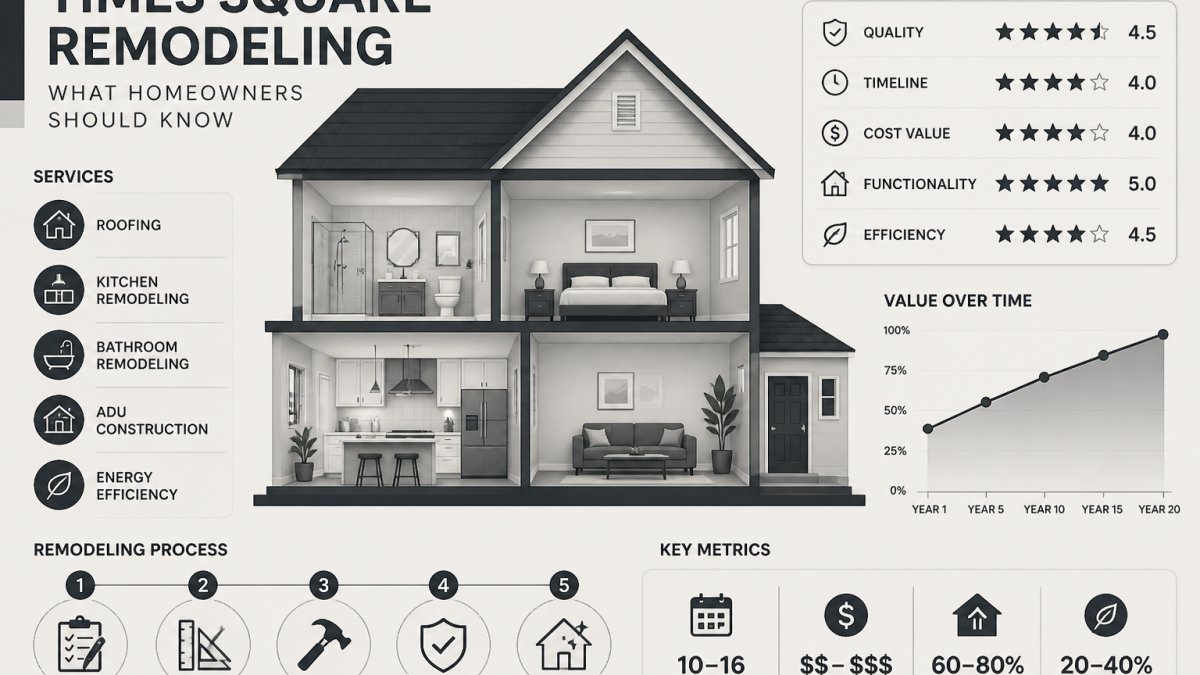
Times Square remodeling is the phrase many homeowners use when searching for a remodeling contractor, and it usually means one of two things: they have seen our name, Times Square Remodeling Inc., or they want a full-service renovation team handling everything from roofing to kitchens.
Times Square Remodeling Inc. is a Los Angeles-based general contractor, not a business in New York. Homeowners searching for times square remodeling are typically looking for a licensed, full-service contractor who can manage a kitchen, bathroom, or whole-home renovation from design through final walkthrough.
A common mistake is assuming a contractor's name tells you what they do. What matters is the license, the scope of work, and the contract.
How to Prevent Unexpected Remodeling Costs
Unexpected costs come from three places: incomplete scopes, hidden damage found after demolition, and change orders never priced in advance. Homeowners who plan for all three rarely get surprised.
We recommend a contingency line item covering unknowns a contractor cannot see until walls are open, such as outdated wiring, water damage behind tile, or framing that does not meet current code.
Build a Contingency Line Item Before You Sign
A contingency line item is money set aside in the contract to cover unknowns discovered during construction. It is protection, not padding; homeowners who skip it make rushed decisions when a problem surfaces.
Here is how we structure it:
- Set the contingency before signing. Agree on the amount and how it will be drawn down.
- Require written approval for every change. No verbal approvals, ever.
- Price changes before work resumes. A change order should state the cost and time impact.
- Keep a running log. Track every change so the final bill matches the paperwork.
For guidance on what a written contract should include, the California Contractors State License Board publishes plain-language advice for homeowners hiring a contractor.
Questions to Ask a Remodeling Contractor Before You Hire
The right questions reveal whether a contractor is organized, insured, and honest. Ask them in person before you sign anything.
Start with these:
- Are you licensed, and what is your license number?
- Can I see your certificate of insurance for general liability and workers' compensation?
- Who will be on site daily, and who is my main point of contact?
- How do you handle change orders and unexpected discoveries?
License, Insurance, and Change-Order Questions
License and insurance questions are non-negotiable. A licensed contractor carries a verifiable state license number, and insurance protects you if a worker is injured or property is damaged.
Change-order questions matter just as much. A contractor who cannot explain their change-order process in plain language does not have one.
We keep this simple at Times Square Remodeling Inc.: every change is documented, priced, and approved in writing before work continues.
Home Renovation Contract Checklist
A home renovation contract defines scope, price, timeline, and dispute handling. Read every line before signing, and never sign a contract with blank spaces.
Use this checklist:
- Contractor's full legal name, license number, and business address
- Detailed scope of work, room by room
- Materials and finishes listed by brand and model where possible
- Total price and payment schedule tied to milestones
The Federal Trade Commission's guidance on home improvement scams explains the warning signs of contractors who pressure homeowners into signing quickly or demand large upfront payments.
Remodeling Project Timeline: What a Realistic Schedule Looks Like
A realistic remodeling project timeline depends on scope, permits, and material lead times. A bathroom moves faster than a kitchen, and a whole-home renovation takes longest. Homeowners who understand the phases stay calmer when one runs long.
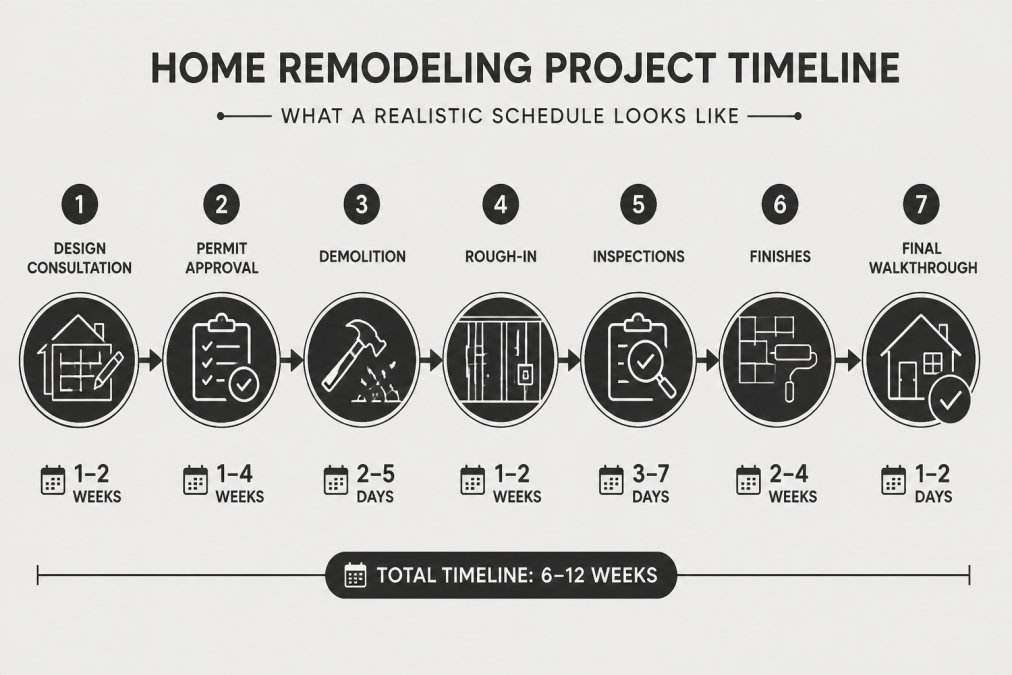
The Phases, In Order
Most residential renovations move through the same sequence, and skipping or compressing a phase creates rework:
- Design and scope lock. Finalize tile, fixtures, cabinets, and finishes before demolition, not during it. Late selections stall schedules more often than labor shortages.
- Permit application and review. Permit review is the largest schedule variable and least under a contractor's control. Timelines vary by jurisdiction and scope complexity, so build slack here rather than assuming a fixed number of days.
- Demolition and disposal. In a dense area, debris hauling, dumpster placement, and building access rules can add days a suburban project never sees.
- Rough-in and inspections. Framing, electrical, plumbing, and mechanical rough-in must pass inspection before walls close. Each trade inspection is a gate, so a failed inspection resets the clock.
- Insulation, drywall, and finishes. The longest visible stretch, and the one homeowners judge the project by. Cabinets, countertops, tile, paint, and trim all sequence here.
- Final inspection and walkthrough. The punch list is generated at the walkthrough, and the project is not complete until every item is closed.
What Actually Causes Delays
Most delays come from four sources, only one of them the contractor's fault:
- Permit review. Outside the contractor's control. The fix is to submit a complete, accurate application the first time.
- Material backorders. Cabinets, windows, and specialty tile can carry long lead times. Ordering before demolition starts is the standard mitigation.
- Change orders. Every approved change adds cost and time. A change-order process that prices time impact, not just money, keeps the schedule honest.
- Hidden conditions. Outdated wiring, water damage, or non-compliant framing found after walls open. This is what the contingency line item exists to absorb.
Planning for Disruption in a Dense Area
This is the part most remodeling guides skip, and it determines whether a project feels manageable or miserable. In a dense urban setting, the constraints are about access, neighbors, and daily life.
- Building access and staging. Where will materials be staged? Is there a freight elevator, a service entrance, or a loading zone with time restrictions? Confirm this before the contract is signed, not on demolition day.
- Noise and work-hour rules. Many buildings and municipalities restrict construction noise to specific hours. A contractor who does not know the building's rules will get the project shut down for a day.
- Elevator and hallway protection. Common areas usually need protection, and elevator reservations may be required for material delivery. These are scheduling items, not afterthoughts.
- Temporary loss of a kitchen or bathroom. If the only bathroom is being renovated, plan for a temporary solution. If the kitchen is out of service, budget for meals and a temporary setup.
Ask your contractor to walk the building with you before signing and write the access, noise, and staging plan into the contract.
The U.S. Department of Energy's home improvement resources covers how energy-efficient upgrades like insulation, windows, and HVAC can be sequenced into a renovation to reduce long-term utility costs, and those upgrades are easiest to fold in during the rough-in phase, before walls close.
How to Compare Remodeling Contractor Estimates Side by Side
Estimates are not comparable until you normalize them. Two contractors can quote the same kitchen and land far apart because one left out demolition, permits, or finish materials.
| Category | What to Check | Why It Matters |
|---|---|---|
| Scope detail | Room-by-room list of work | Reveals what was left out |
| Materials | Brand, model, finish specified | Prevents substitution |
| Permits | Who pulls them and pays | Avoids surprise fees |
| Timeline | Start and completion dates | Shows realism |
| Payment schedule | Tied to milestones, not dates | Protects your cash |
| Change orders | Written process stated | Prevents runaway costs |
| Warranty | Length and coverage terms | Signals confidence |
| Exclusions | What is explicitly not included | Prevents disputes later |
The lowest bid is often the least complete bid. A contractor who leaves out demolition and permit costs will look cheaper on paper and cost more by the end. Compare the categories, not the totals.
Verify Before You Compare
An estimate is only as good as the contractor behind it. Before weighing two numbers, confirm both contractors are legitimate. This is the step most homeowners skip, and the one that matters most.
- License. Ask for the license number and verify it directly with the state licensing board. A license number that cannot be verified is a red flag, not a clerical error.
- Insurance. Request a certificate of insurance for general liability and workers' compensation. Call the insurer to confirm the policy is active, certificates can be altered.
- Business identity. Confirm the legal business name and address match the contract. A contractor who operates under a different name than the one on the license is a risk.
- References. Ask for references from projects similar in scope to yours, and actually call them. Ask what went wrong, not just what went right.
The Federal Trade Commission's guidance on home improvement scams explains the warning signs of contractors who pressure homeowners into signing quickly or demand large upfront payments. The California Contractors State License Board publishes plain-language advice for homeowners hiring a contractor, including how to check a license and what a contract must contain.
Red Flags in an Estimate
Some patterns show up again and again in estimates that turn into disputes:
- A total price with no line-item breakdown.
- A payment schedule that front-loads most of the money before work begins.
- No stated start or completion date.
- No mention of permits or who is responsible for them.
Conclusion: Choosing a Times Square Remodeling Approach That Protects You
The homeowners who come out of a renovation happy planned for the unknowns. They set a contingency, asked hard questions, and got everything in writing.
If you want a contractor who handles the full scope, from roofing and kitchen and bathroom remodeling to ADU construction and energy-efficient upgrades, Times Square Remodeling Inc. is built for exactly that. We are a California-licensed general contractor with more than 15 years of experience, and we manage projects end to end so you are not coordinating multiple trades yourself.
Frequently Asked Questions
What services does Times Square Remodeling Inc. offer?
Times Square Remodeling Inc. is a California-licensed general contractor that handles kitchen remodeling, bathroom remodeling, ADU construction, roofing, and energy-efficient upgrades such as solar and insulation. The company has over 15 years of experience and holds license #953868. Because they manage multiple trades under one license, homeowners can avoid coordinating separate specialists for structural work, finishes, and energy improvements on a single project.
How do I verify a California general contractor's license before hiring?
Ask for the license number and check it through the California Contractors State License Board (CSLB) website. Confirm the license is active, the classification matches your project type, and the business name matches what appears on your contract. Also request a certificate of insurance for general liability and workers' compensation. A legitimate contractor will provide these without hesitation. Times Square Remodeling Inc. holds license #953868, which you can verify the same way.
What should a remodeling contract include to protect me from surprise costs?
A solid home renovation contract checklist includes: a detailed scope of work with specific materials and finishes, a payment schedule tied to milestones rather than calendar dates, a written change-order process with signed approval before any extra work begins, a contingency allowance for hidden conditions, a start and completion date, and a warranty statement. Vague line items like 'miscellaneous' or 'labor' without detail are a warning sign. Get everything in writing before work starts.
How long does a typical kitchen and bathroom remodeling project take?
A remodeling project timeline varies by scope. Ask your contractor for a phase-by-phase schedule in writing so you can plan around the disruption.