 how-to
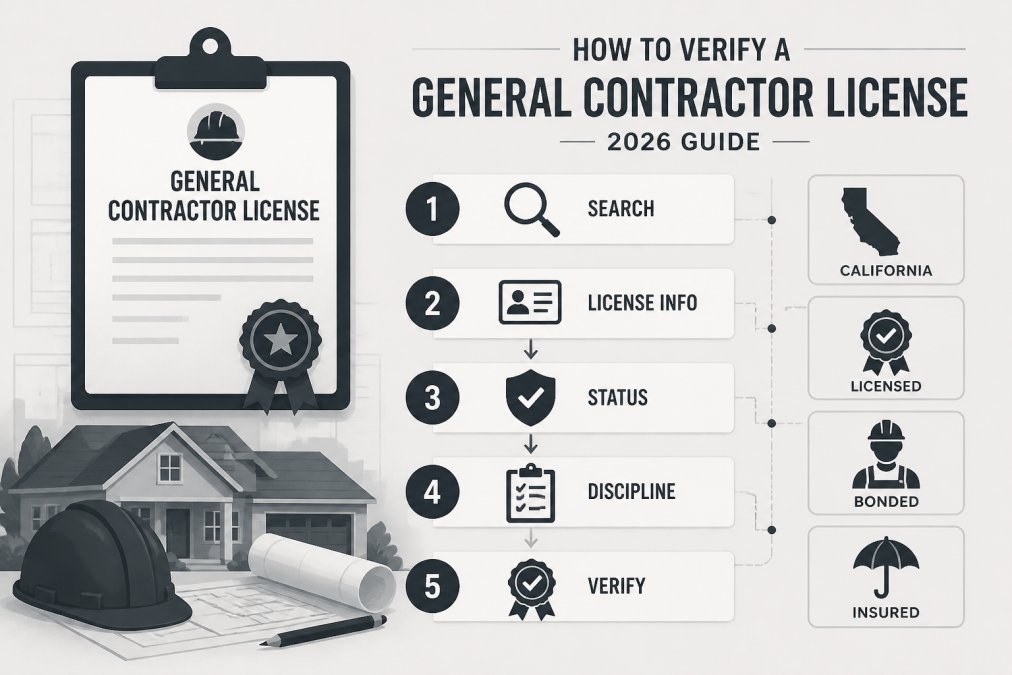
How to Verify a General Contractor License (2026 Guide)
Table of Contents
- What You Need Before Starting a License Verification
- How to Run a CSLB License Check in Three Steps
- How to Check if a Contractor is Insured and Bonded
- Red Flags of Fake or Expired Contractor Licenses
- Consequences of Hiring an Unlicensed Contractor
- Your Next Step After a Successful License Check
- Frequently Asked Questions
Last Updated: September 8, 2026
Verifying a contractor's credentials before signing an agreement is the single most effective way to protect your home and your budget. A general contractor license check confirms that the individual or company bidding on your project is legally authorized to perform construction work in your state and has met minimum competency standards.
The process takes less than five minutes using the public database maintained by your state's licensing board. In California, that means the Contractors State License Board, or CSLB. Below, we'll walk through exactly how to verify a general contractor license, what the status codes mean, and the additional checks that separate a legitimate professional from a costly mistake.
What You Need Before Starting a License Verification
Before you open the search portal, gather the basic information you will need for an accurate license lookup. A contractor license verification requires at least one of the following: the license number printed on their vehicle or marketing materials, the full legal business name as registered with the state, or the name of the qualifying individual.
Having the license number is the fastest path. Every state issues a unique number to each licensed entity, and searching by this identifier eliminates confusion caused by similarly named businesses. If you only have a business name, the database may return multiple entities, so verify that the address and the qualifying agent match the person you are speaking with.
You should also confirm which classification type applies to your project. A contractor license is issued for specific trade specialties such as general building, residential construction, or commercial contractor work (cslb.ca.gov). Hiring a specialist licensed for a different classification than your project requires can void your homeowners insurance coverage if something goes wrong.
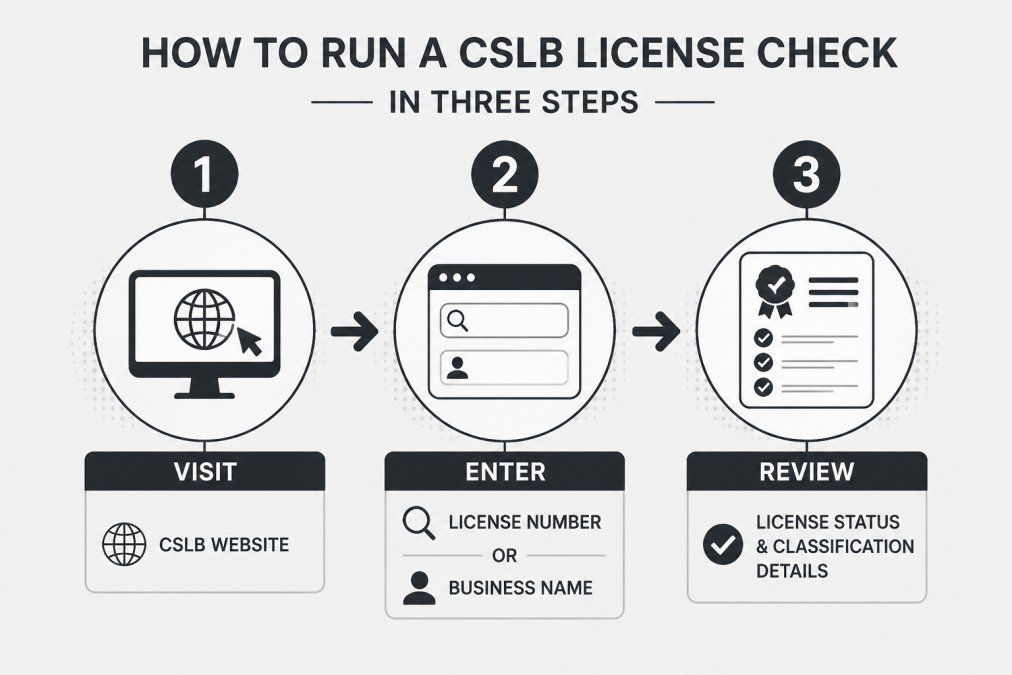
How to Run a CSLB License Check in Three Steps
The California license lookup process is straightforward, but knowing where to look and what to examine makes the difference between a quick confirmation and a missed red flag. The CSLB maintains a public verification portal that operates as the authoritative record for contractor registration and license status in the state.
Step 1: Use the CSLB Website Search Tool
Open the official CSLB website and navigate to the license verification section. The state's CSLB license search portal is the only authoritative source for license status, so avoid third-party directories that may display outdated information. The portal is free and accessible from any mobile device, which makes it easy to run a check while you are standing in your driveway talking to a contractor.
Step 2: Search by License Number or Business Name
Enter the license number exactly as it appears on the contractor's documentation, including any leading letters. If searching by business name, use the legal registered name rather than a trade name or "doing business as" alias. The query will return a list of matching entities, so confirm you are reviewing the correct one by checking the registered address and the qualifying agent listed on the record.
Step 3: Review License Status and Classification
Once you locate the record, examine three fields closely: the license status, the classification type, and the expiration date. An active license means the contractor is currently in good standing and legally permitted to operate. The classification must match the scope of your project, and the expiration date should be in the future. The CSLB also lists any disciplinary action or enforcement history on the public record, which is worth reading carefully before you proceed.
How to Check if a Contractor is Insured and Bonded
A contractor license proves competency, but it does not guarantee that you are financially protected on the job. You must separately verify insurance coverage and bond status, because these protections cover different risks and are not interchangeable. This is the step most homeowners skip, and the one that matters most if a worker is injured or your property is damaged.
What Each Policy Actually Covers
Workers' compensation insurance protects you from liability if a worker is injured on your property (dir.ca.gov). General liability insurance covers damage to your home caused by the contractor's work. The contractor bond, required by the CSLB for licensure, provides a fund that homeowners can draw from if the contractor fails to complete the project or violates the terms of their license.
A common mistake is accepting a photocopy of an insurance certificate without verifying it. Policies lapse, and a certificate that was valid last month may be canceled today. A five-minute phone call to the insurance agency listed on the certificate confirms that the policy number is current and the coverage limits match what your project requires.
The Mobile-First Verification Workflow
Most state portals and insurance verification lines are clunky desktop interfaces, but you can run a full check while standing on the job site using just your smartphone. Here is the workflow that takes less than ten minutes:
- Ask for the certificate of insurance (COI) and the bond rider. Legitimate contractors carry digital copies on their phones. If they cannot produce them on the spot, that is a red flag.
- Call the insurance agency directly. Do not call the number printed on the certificate, scammers sometimes list a fake agency or a friend's phone number. Look up the agency's official phone number via a web search and call that number instead.
- Confirm three things with the agent: the policy is currently active, the named insured matches the contractor's legal business name, and the coverage dates extend past your projected project completion date.
- Verify the bond separately. The bond is not the same as insurance. Ask for the surety company name and the bond number, then call the surety to confirm the bond is active and has not been exhausted by prior claims.
What to Do When the Check Fails
If the insurance policy has lapsed or the bond is inactive, do not proceed with the project. A contractor who lets coverage lapse mid-project is a financial risk. If the contractor claims the lapse was an administrative error, ask them to provide a new COI with a current effective date before any work begins. Do not accept a promise to "get it sorted out", the coverage must be active before the first worker steps on your property.
Why This Matters More Than the License Check
The license check confirms the contractor passed a background check and met competency standards. The insurance and bond check confirms you will not be left holding the bag if something goes wrong. A licensed contractor with lapsed insurance is just as dangerous as an unlicensed one, because the financial protection you rely on is not in place. Make this check part of your standard due diligence.
Red Flags of Fake or Expired Contractor Licenses
Knowing what a valid record looks like is only half the equation. You also need to recognize the warning signs that indicate a contractor is operating without legitimate credentials or with an expired license. The most dangerous scenario is not the contractor who has no license, it is the one who shows you a forged document or uses a license number that belongs to someone else.
Spotting a Forged License Document
A printed license card or a PDF on a phone screen is not proof of anything. Documents can be forged, altered, or simply outdated. When a contractor shows you their license, look for these details:
- The license number format. Each state uses a distinct format. In California, CSLB license numbers are typically seven digits with a letter prefix (for example, "A" for general engineering, "B" for general building, "C" for specialty trades). If the number does not match the expected format for your state, it is likely fabricated.
- The qualifying individual's name. The license is issued to a specific person or business entity. If the name on the license does not match the name of the person you are speaking with, ask why. A contractor cannot legally operate under someone else's license.
- The issue and expiration dates. A license that expired last month is not valid, even if the contractor says they are "renewing." The state database will show the current status, and an expired license means the contractor is not legally permitted to work.
- The physical card quality. State-issued license cards have security features like holograms, microprinting, or watermarks. A flimsy card with blurry text is a forgery.
The 'Borrowed' License Scam
A growing problem is the contractor who uses a license number that belongs to a legitimate, licensed professional, often a former employer or a relative. The license number checks out in the state database, but the person you are hiring is not the qualifying individual. This is why the license check alone is not enough. You must confirm that the person you are speaking with is the qualifying agent listed on the license record.
Ask for a photo ID and compare it to the name on the license record. If the contractor says they are "working under" someone else's license, that is a violation in most states. The licensed contractor is responsible for the work, but the person doing the work may not be covered by the same insurance and bond.
Behavioral Red Flags That Accompany Fake Licenses
Contractors who fabricate licenses often exhibit the same behavioral patterns. They pressure you to sign quickly, demand cash payments, or offer a significant discount for paying upfront. They avoid putting their license number on written estimates or contracts. They may give you a business card with a license number but no physical address. These behaviors are not proof of fraud on their own, but when combined with a document that does not pass scrutiny, they are strong indicators that you should walk away.
The Definitive Test: The State Database Always Wins
No matter how convincing a printed document looks, the state database is the only authoritative source. If the license number returns no results, the license is either fake, expired, or issued under a different number. If the status shows "suspended" or "expired," the contractor is not legally permitted to work. If the record lists a disciplinary action, read the details carefully. A single five-minute search can prevent a dispute that takes years and thousands of dollars to resolve.
Consequences of Hiring an Unlicensed Contractor
The risks of hiring an unlicensed contractor extend far beyond the quality of the workmanship. When you hire someone without a valid contractor license, you lose access to the consumer protection mechanisms that the state provides, including the ability to file a complaint with the CSLB and draw on the contractor bond for financial recovery.
Unlicensed contractors also typically operate without workers' compensation insurance. If a worker falls from a ladder on your property and you hired an unlicensed operator, you may be personally responsible for their medical bills. Homeowners insurance policies frequently exclude coverage for injuries involving unlicensed contractors, which leaves you exposed to significant financial liability.
There is also the matter of permit requirements. A licensed contractor pulls the necessary permits for structural work, which triggers inspections that confirm the work meets building codes. An unlicensed contractor often skips this step entirely, which means your renovation may not comply with local codes. When you eventually sell the home, the unpermitted work can surface during the buyer's inspection and derail the sale or reduce the property value.
Your Next Step After a Successful License Check
Once the license check comes back clean and you have confirmed insurance and bond coverage, you still need to protect yourself with a written contract that spells out the scope of work, the payment schedule, and the timeline. A valid contractor license is the entry ticket, not the guarantee of a smooth project. The contract is where you lock in the terms that prevent disputes.
When you are ready to move forward, choose a contractor who makes verification effortless. Times Square Remodeling Inc. holds California contractor license #953868, and we publish our credentials openly because we know the check should be easy for you. With over 15 years of experience in roofing, we have built our reputation on professional project execution and clear communication at every stage.
Get started with Times Square Remodeling Inc. and request your consultation to discuss your project with a team that welcomes your due diligence.
Frequently Asked Questions
How can I verify a general contractor's license in California?
Use the CSLB license check tool on the official Contractors State License Board website. Enter the contractor's license number or business name to see the license status, classification, and expiration date. Confirm the license is active and matches the work you need, such as the appropriate classification for roofing.
What information do I need to check a contractor's license?
The contractor's license number is the most direct search criteria for a CSLB license check. If you only have the business name, the search tool can find the license associated with it. Having the legal business entity name helps confirm you are looking at the correct contractor and not a similarly named company.
What should I do if a contractor's license is expired or inactive?
Stop all work immediately. An expired or inactive license means the contractor is not legally authorized to perform work in California. Hiring them exposes you to liability and financial risk. Do not make any further payments and contact the CSLB to understand your options for recourse.
Does checking a contractor's insurance provide full protection?
No. While confirming insurance coverage is a critical step, it is not the only one. You should also verify the contractor's license status, check for a valid contractor bond, and confirm they pull the necessary permits for your project. This comprehensive approach protects you from financial loss and poor workmanship.