 how-to
How to Manage Major Renovation Stress: A 2026 Guide
Table of Contents
- Set a Realistic Renovation Budget and Timeline
- How to Prevent Unexpected Remodeling Costs
- How to Communicate with General Contractors
- Renovation Timeline Expectations and How to Handle Delays
- Living Through a Renovation Without Losing Your Mind
- Manage Conflict with Your Partner During a Remodel
- Recognize Renovation Burnout and Post-Renovation Blues
- Frequently Asked Questions
Last Updated: September 15, 2026
Set a Realistic Renovation Budget and Timeline
Renovation stress starts when the number in your head and the number on the contractor's estimate don't match. At Times Square Remodeling Inc., the difference comes down to two things: a realistic budget and a timeline built with slack.
A renovation budget is a written plan that assigns every dollar to a specific scope item before work begins, plus a reserve for what nobody can see yet (How To Avoid a Home Improvement Scam). The reserve is not optional. Walls hide things.
Most homeowners plan for visible work: cabinets, tile, fixtures, paint. Few plan for what happens when the wall opens up. Treating the first estimate as the final number is a common mistake, it never is.
A realistic timeline follows the same logic. Renovations run on sequences, not wishes: permits, inspections, and materials take time. Build in buffer at every phase.
How to Prevent Unexpected Remodeling Costs
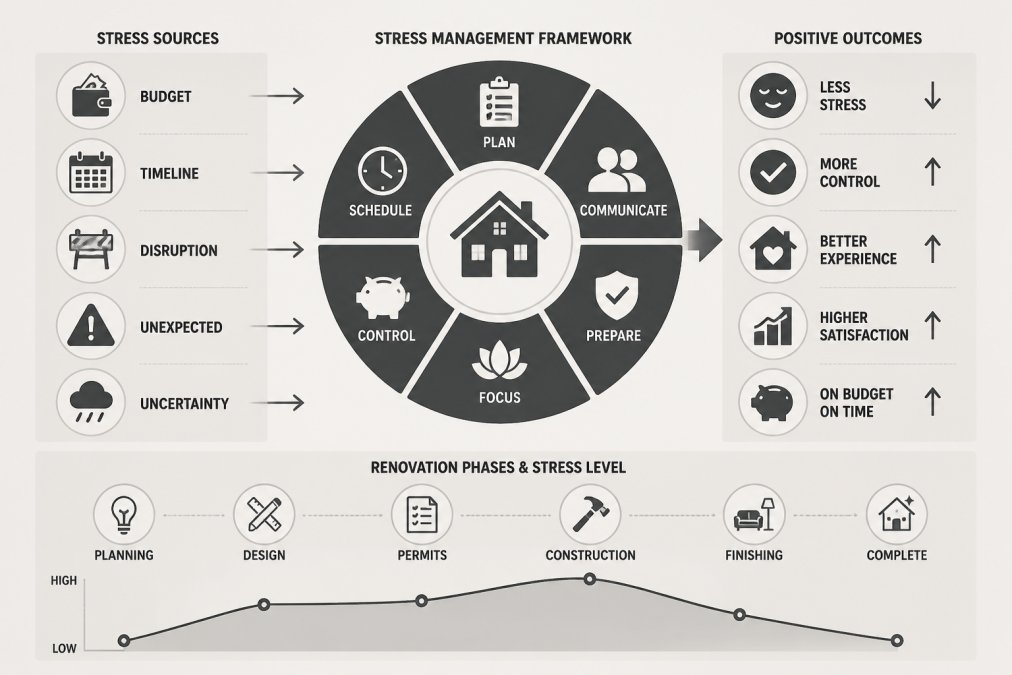
Unexpected costs are the biggest driver of renovation stress, arriving in three flavors: hidden conditions, scope creep, and indecision. Each is manageable if you plan before the first hammer swings.
Hidden conditions are what walls, floors, and ceilings reveal once open: old wiring, water damage, missing insulation, framing that doesn't match plans. Nobody can predict these, which is why a contingency exists.
Scope creep is quieter, the "while we're in here, let's also..." conversation. It feels harmless in the moment, but it isn't harmless to your budget or schedule.
Indecision costs more than most homeowners realize. Every week a selection sits unmade, the build phase stalls, and tradespeople reschedule. Delays compound.
Build a Budget Contingency That Actually Works
A working contingency is a separate line item, not a vague hope. Set it aside before you sign anything and treat it as untouchable until a genuine surprise appears. Spend it on upgrades and you no longer have a contingency, just a larger project with the same risk.
Track every change order in writing. A change order is any alteration to the original scope, and it should state what changes, what it costs, and how it affects the schedule (Buyer’s Remorse: The FTC’s Cooling-Off Rule May Help). Verbal agreements are how budgets die.
How to Communicate with General Contractors
Clear contractor communication is the cheapest stress reduction available on any remodel. It prevents most disputes.
Set a communication rhythm on day one. Agree on how often you'll talk, through what channel, and who the point of contact is on both sides. A weekly walkthrough plus a written summary covers nearly everything.
Put decisions in writing. Texts and email threads count, but a shared document is better. When a question arises about why a wall was framed a certain way, the answer should be findable, not remembered.
Questions to Ask Before Work Begins
Ask these before signing, not after:
- Who is my day-to-day contact, and how quickly do they respond?
- How do you handle change orders, and what's the approval process?
- What's your plan if we discover hidden damage behind a wall?
- Which items are allowances, and what happens if I go over?
- How will you protect floors, furniture, and the rest of the house?
- What does the payment schedule look like, tied to which milestones?
The answers tell you more than the estimate does. Vague answers to specific questions are a warning sign.
Renovation Timeline Expectations and How to Handle Delays
A typical kitchen and bathroom renovation moves through predictable phases, and knowing them removes anxiety. Timelines vary with scope, permitting, and material lead times, but the sequence rarely changes.
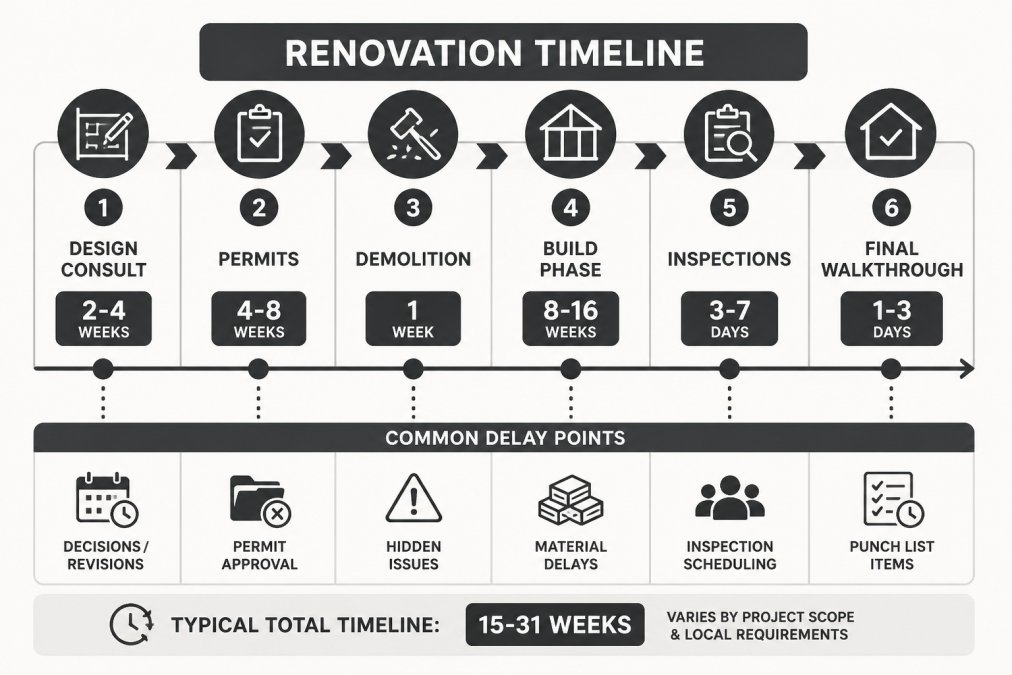
Design and selection take longer than expected, because every finish, fixture, and layout decision must be made before it can be ordered. Permitting adds its own stretch depending on scope and jurisdiction. Demolition is fast; the build phase is where the calendar lives.
Delays come from four places: permit backlogs, material lead times, inspection scheduling, and mid-build changes. You control the last one directly. Every decision you finalize early is a delay you never have.
Living Through a Renovation Without Losing Your Mind
Living in a construction zone is its own category of renovation stress, and most guides skip it. Planning advice stops the day demolition starts, precisely when the daily grind begins. What follows is the practical survival layer.
Build a Temporary Kitchen That Actually Functions
A microwave on a folding table is a countdown to takeout fatigue. Before demolition, identify a room with a sink, a counter, and two working outlets, a laundry room, basement corner, or dining room with a utility sink nearby. Move the refrigerator there or buy a compact one. A single induction burner, toaster oven, and slow cooker cover most meals without tripping a breaker.
Wash dishes in a plastic tub you can dump outside or in a utility sink. Stock paper plates, disposable cutlery, and a fold-away dish rack. Keep a box of the spices and utensils you use daily, not the whole drawer.
Contain Dust Like a Job Site, Not a Home
Drywall dust travels through the entire house, not just the work zone. Ask your contractor to install zippered plastic barriers at every doorway to the work area, a zipper door lets you pass through without breaking the seal. Run a box fan with a furnace filter taped to the back in the work zone, and change your HVAC filter every two weeks during heavy dust phases.
Seal return vents near the work area with plastic and painter's tape. Cover furniture in adjacent rooms with plastic drop cloths, not sheets, fabric lets fine dust pass through. Expect to dust horizontal surfaces daily; that's the baseline, not a containment failure.
Protect Sleep, Pets, and Kids
Noise starts early. Crews often arrive between 7 and 8 a.m., and the first hour is loudest, compressors, saws, deliveries (nonoise.org). If you work from home or have a baby, ask your contractor which days will be loudest and plan around them. A white noise machine and earplugs are not luxuries.
Pets are the most overlooked casualty of a renovation. Doors get left open, crews come and go, and a stressed animal can bolt. Board pets during demolition week if you can; if not, keep them in a closed room far from the work zone with a sign telling crews not to enter. Tell every crew member on day one that a pet lives in the house. Maintaining this level of vigilance throughout the house helps prevent the chaos of a bathroom renovation stress from overwhelming both your pets and your peace of mind.
For young children, treat the work zone as off-limits with the same seriousness as a swimming pool. Nails, screws, and small tools end up on the floor. Walk the site each evening and pick up anything sharp or small.
Set a Daily and Weekly Rhythm
A predictable rhythm reduces the feeling that your home has been hijacked.
Manage Decision Fatigue Before It Manages You
Manage Conflict with Your Partner During a Remodel
Name the Real Flashpoints Before They Happen
Divide Decisions by Domain, Not by Vote
Scripts for the Three Conversations You Will Actually Have
Protect the Relationship Outside the Project
Recognize Renovation Burnout and Post-Renovation Blues
Frequently Asked Questions
Is it normal to feel overwhelmed during a house renovation?
Yes. Renovation stress affects most homeowners because the project disrupts routines, demands constant decisions, and involves significant money. Acknowledging that anxiety is a normal response, not a personal failing, helps you address it. Break the project into weekly milestones, schedule one decision-free day per week, and step away from the site regularly. If the stress becomes constant, talk to your contractor about adjusting the schedule or hiring more of the project management work.
How do I prevent unexpected remodeling costs?
Build a budget contingency of 15 to 20 percent on top of your estimated total. Get a fixed-scope contract that lists what happens when hidden damage appears. Ask your contractor to flag potential change orders before work begins. Request weekly written updates so surprises surface early. When you prevent unexpected remodeling costs this way, you reduce the financial shock that drives most renovation stress.
What is the best way to communicate with contractors to reduce project anxiety?
Set a standing weekly check-in by phone or in person. Keep one shared document for decisions, change orders, and questions. Confirm every verbal agreement in writing the same day. Ask your contractor how they prefer to receive urgent messages versus routine updates. Clear expectations about response times cut down on the uncertainty that fuels renovation stress, especially during the build phase.
How do you handle unexpected delays during a major home improvement project?
Expect delays from permits, inspections, and material lead times. Ask your contractor for a schedule with buffer weeks built in. When a delay hits, request a revised timeline in writing and ask what work can proceed in parallel. Use the extra time to finalize design choices so the build phase does not stall. Knowing that renovation timeline expectations include slack prevents panic when dates shift.