 listicle
Best Sustainable Materials for Modern Kitchen Countertops
Table of Contents
- Quick Comparison: Sustainable Countertop Materials at a Glance
- Non-Toxic Kitchen Countertop Materials for a Healthier Home
- Eco-Friendly Kitchen Countertop Pros and Cons
- Regional Sourcing and the Carbon Footprint of Countertops
- Sustainable Countertop Installation Best Practices
- End-of-Life Recyclability and the Circular Economy
- Conclusion
- Frequently Asked Questions
Last Updated: September 22, 2026
Quick Comparison: Sustainable Countertop Materials at a Glance
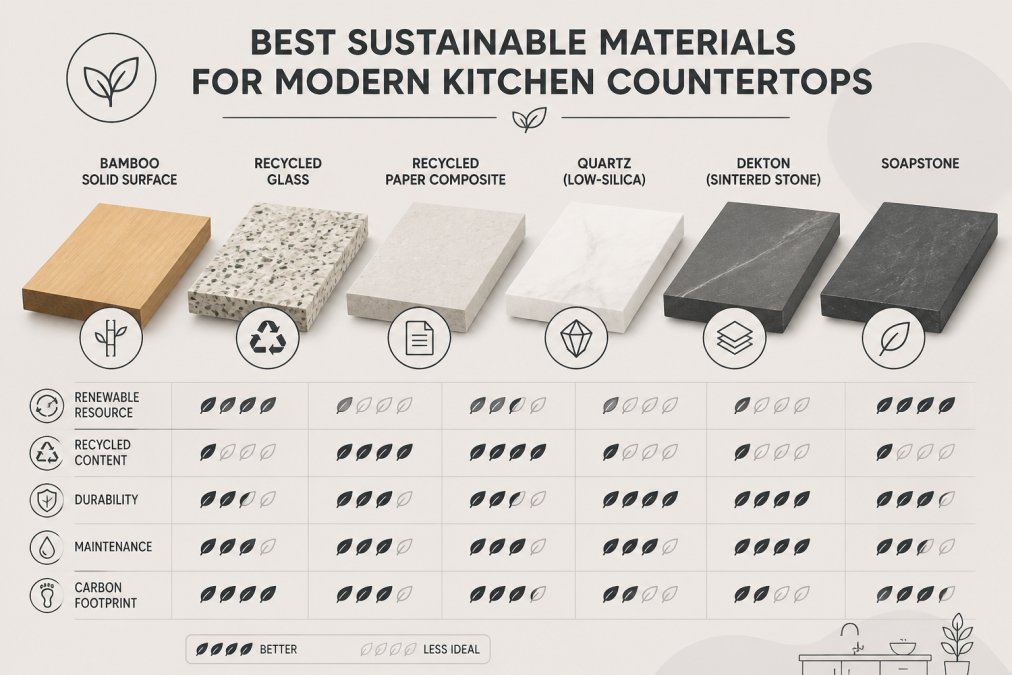
The best sustainable materials for modern kitchen countertops balance recycled content, durability, and maintenance needs. The trade-offs below decide most projects.
| Material | Durability | Heat Resistance | Maintenance | Recycled Content |
|---|---|---|---|---|
| Recycled glass | High | High | Low | Very high |
| Sintered stone | Very high | Very high | Very low | Mineral-based |
| Solid surface | Medium | Low | Medium | High |
| Reclaimed wood | Medium | Low | High | Salvaged |
| Bamboo | Medium | Low | High | Renewable |
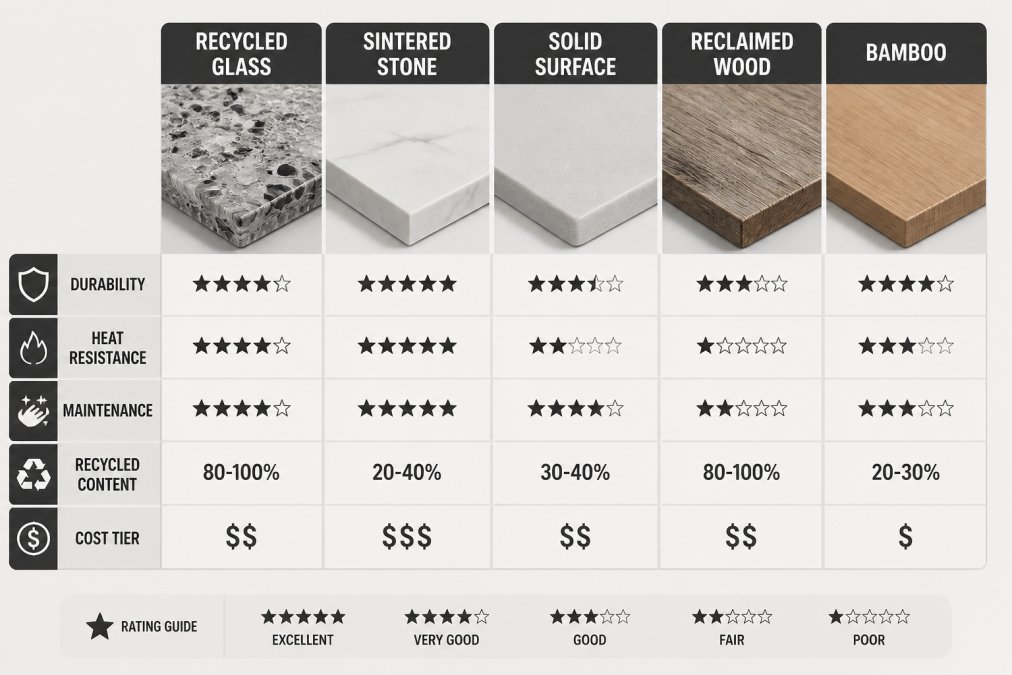
Recycled glass and sintered stone lead on performance. Wood and bamboo win on warmth and renewable sourcing, but demand more care.
Non-Toxic Kitchen Countertop Materials for a Healthier Home
Non-toxic kitchen countertop materials are surfaces manufactured without petroleum-based resins, formaldehyde adhesives, or high-VOC finishes that release chemicals into indoor air. The EPA's indoor air quality guidance identifies volatile organic compounds as a common source of indoor pollution, which is why the binder matters as much as the stone.
Materials worth shortlisting:
- Recycled glass surfaces use cement and non-toxic pigments rather than petrochemical resin
- Sintered stone is pressed from natural minerals with no resins or petroleum derivatives
- Paper composite brands such as Richlite and PaperStone rely on FSC-certified paper and non-petroleum binders
- Bamboo slabs bonded with formaldehyde-free adhesives
Low-VOC Finishes and Indoor Air Quality
Low-VOC finishes matter most on wood and paper-based counters, where the sealant touches food and air. Reclaimed wood tops finished with food-safe, low-VOC oils avoid the off-gassing that solvent-heavy lacquers produce. Ask your fabricator for the safety data sheet before installation, not after. Homeowners with chemical sensitivity should treat this as a specification, not a preference.
Eco-Friendly Kitchen Countertop Pros and Cons
Eco-friendly kitchen countertop pros and cons come down to one trade-off: greener materials often ask for more care. But "more care" is vague, and vague advice is what makes homeowners pick the wrong slab. The useful version is a decision matrix that weighs sustainability against the performance metrics that actually matter day to day, heat resistance, porosity, scratch resistance, and the realistic maintenance cadence.
Performance Reality Check by Material
| Material | Heat Resistance | Porosity | Scratch Resistance | Realistic Maintenance Cadence |
|---|---|---|---|---|
| Recycled glass | High, tolerates hot pots with a trivet | Non-porous | Moderate, can chip at edges | Wipe daily; reseal not required |
| Sintered stone | Very high, rated for direct heat contact | Non-porous | Very high | Damp cloth; no sealing |
| Solid surface | Low, scorches under hot pans | Non-porous | Low, sands out scratches | Periodic buffing; avoid heat |
| Reclaimed wood | Low, requires trivets | Porous | Low, dents and patinas | Re-oil every 1-3 months |
| Bamboo | Low, requires trivets | Porous | Moderate | Re-oil every 2-4 months |
The Trade-Offs Nobody Puts in the Brochure
Recycled glass resists heat and stains but can etch if acidic spills, citrus, vinegar, wine, sit overnight. It is also heavy, so cabinet reinforcement may be needed on a long run.
Sintered stone shrugs off heat and stains, but its hardness means only a professional fabricator with diamond tooling can cut it. Field cuts are not an option, so templating accuracy matters more than with any other surface.
Solid surface is the easiest to repair, scratches sand out, but it scorches under a hot pan and shows every knife mark.
A Common Mistake: Judging on Looks Alone
In practice, the busiest kitchens should prioritize a non-porous surface near the range and reserve wood for islands and prep zones. Mixing materials is not a compromise, it is the correct specification. A sintered stone perimeter with a reclaimed wood island gives you heat resistance where you sear and warmth where you gather.
Skipping the sealant on a porous wood or bamboo top lets water wick into the grain. The result is swelling, dark staining, and a counter that cannot be sanded back to flat.
Maintenance-Specific Eco Products That Actually Work
Most guides stop at "oil it." Here is what to actually keep under the sink:
- For wood and bamboo: food-safe, plant-based penetrating oils (linseed, tung, or a blended butcher-block oil) rather than petroleum-based sealers. Reapply thin coats; wipe off the excess or it turns gummy.
- For recycled glass and sintered stone: pH-neutral stone soap. Avoid acidic cleaners, they are the single most common cause of dulling on glass surfaces.
- For solid surface: a mild abrasive cream cleanser for scuffs, followed by a non-abrasive polish. Never use ammonia-based glass cleaner; it clouds the finish over time.
- For all surfaces: microfiber cloths over paper towels. Paper towels leave lint in porous grain and micro-scratch polished surfaces.
Regional Sourcing and the Carbon Footprint of Countertops
Carbon footprint tracks how far a slab travels and how much energy its manufacture consumes. A counter quarried overseas and shipped across an ocean carries more embodied carbon than one produced closer to the job site. Regional sourcing shortens that distance and supports local fabricators.
Ask three questions before you buy:
- Where was the raw material extracted or diverted?
- Where was the slab manufactured?
- How far does it travel to reach your kitchen?
Sustainable Countertop Installation Best Practices
Sustainable countertop installation best practices protect both the material and the indoor air during the remodel. But the details that decide whether a slab survives its first year are in the sequencing and substrate, not the marketing. Proper structural support ensures long-term stability for these surfaces, much like how the thoughtful selection of sustainable kitchen gadgets helps maintain the overall efficiency and environmental integrity of your culinary workspace.
Substrate and Support
Brittle surfaces, sintered stone and recycled glass, need a flat, fully supported substrate. Plywood is preferred over particleboard because it resists moisture swell. On a long unsupported span, add a subtop or steel reinforcement; a slab that flexes will crack at the seam or the sink cutout.
Sequencing That Prevents Re-Cuts
Install the counter after cabinets are level and plumbing rough-ins are final, or you risk re-cutting a slab. The order that works:
- Cabinets set, shimmed, and screwed to the wall
- Plumbing and electrical rough-ins inspected
- Laser template taken on site
- Fabrication and edge profiling
- Dry-fit, then final set with seams aligned to cabinet stiles
- Sink and faucet set, then silicone cure
Air Quality During Fabrication
Cutting should happen outside or with dust extraction. Silica dust from stone fabrication is a documented health hazard, and the same dust settles into a home's HVAC if cutting happens indoors. Ask your fabricator where the cuts will be made and whether they use wet-cutting or a vacuum shroud. For a full-service remodel, one licensed contractor handling demolition, cabinetry, and counter templating avoids the finger-pointing that stalls a project.
Sourcing and Installation Are the Same Conversation
A slab that travels across an ocean carries more embodied carbon than one produced closer to the job site, but the installation decision affects that footprint too. Ordering the slab after templating reduces waste from over-ordering. Asking the fabricator to return or reuse offcuts keeps remnants out of the landfill. And choosing a fabricator within the same region as the quarry or manufacturer shortens the last leg of the trip, which is often the longest.
Ask three questions before the slab is cut:
- Where was the raw material extracted or diverted?
- Where was the slab manufactured?
- How far does it travel to reach your kitchen?
Templating should happen after cabinets are set and secured, never from a drawing. A laser template catches the out-of-square walls common in older homes and prevents a slab from arriving too short.
Installation is not a separate phase from sustainability. Substrate prep, cutout sealing, dust control, and offcut handling are where a green material either stays green or becomes landfill.
End-of-Life Recyclability and the Circular Economy
End-of-life recyclability is where most countertop guides stop short. Solid surface materials can be reclaimed and reprocessed at the end of their service life, which keeps them in the circular economy instead of a landfill. Sintered stone and recycled glass are durable enough to outlast several kitchen refreshes, so their longevity itself reduces waste.
Conclusion
Choosing countertops that hold up to daily cooking while reducing environmental impact takes more than a green label. Times Square Remodeling Inc. is a California-licensed general contractor (License #953868) with over 15 years of experience installing kitchen and bathroom surfaces, and we handle templating, fabrication coordination, and installation end to end. Our team specializes in energy-efficient home upgrades and comprehensive remodeling, so the counter, cabinetry, and ventilation work as one system.
Frequently Asked Questions
What is the most environmentally friendly kitchen countertop?
Recycled glass surfaces like IceStone score highest because they divert landfill waste and carry Cradle to Cradle certification. PaperStone and Richlite use recycled paper with low-emission binders. Reclaimed wood avoids harvesting new trees entirely. For overall environmental impact, prioritize materials with verified recycled content, low-VOC binders, and end-of-life recyclability.
Are recycled glass countertops durable for daily kitchen use?
Yes. IceStone recycled glass surfaces are highly durable and heat resistant, and the non-porous composition means no sealing is required. The main drawback is sensitivity to acidic etching if spills like lemon juice or vinegar are left sitting. Wipe acidic spills promptly and the surface holds up well for years of daily cooking.
How do sustainable countertops compare to granite in maintenance?
Granite requires periodic sealing because it is porous. Most sustainable options perform differently: sintered stone and recycled glass are non-porous and need no sealing, bamboo and reclaimed wood require regular oiling, and solid surface materials can be sanded and repaired. Maintenance depends on the material family rather than whether it is eco-friendly.
Are bamboo countertops a viable sustainable choice for modern kitchens?
Bamboo is harvested every 5 to 6 years, making it one of the fastest-renewing countertop resources. It works well for islands and prep areas and often costs less than stone. The trade-off is maintenance: bamboo needs regular oiling to prevent water damage, and it is softer than sintered stone or recycled glass, so it scratches more easily.