 comparison
Bathroom Remodeling Near Me: How to Choose a Contractor
Table of Contents
- Bathroom Remodeling Near Me: What the Search Really Means
- How to Vet Bathroom Remodeling Contractors Before You Hire
- What a Bathroom Remodel Estimate Should Include
- Bathroom Remodel Timeline: What to Expect Week by Week
- Your Bathroom Remodel Checklist: From First Call to Final Walkthrough
- Red Flags and Trust Signals When Comparing Local Remodelers
- Conclusion: Choosing a Bathroom Remodeling Partner You Can Trust
- Frequently Asked Questions
Last Updated: October 9, 2026
Bathroom Remodeling Near Me: What the Search Really Means
When you type "bathroom remodeling near me" into a search bar, you are not just looking for a list of companies. You are looking for a partner you can trust inside your home.
The phrase "bathroom remodeling near me" is a signal of intent. It means you are ready to move from dreaming to planning. You want to know about service availability in your ZIP code and how to find a local company that understands your neighborhood.
This guide is designed to help you navigate that search. We will cover how to vet bathroom remodeling contractors, what a realistic timeline looks like, and how to compare quotes.
How to Vet Bathroom Remodeling Contractors Before You Hire
The most important part of your project happens before any demolition starts. Vetting a contractor is the step where you separate professional remodelers from those who might leave you with a half-finished bathroom. You need to look beyond a pretty website and check the hard facts.
A common mistake is hiring based on price alone. The lowest bid often leads to cutting corners or surprise costs later. Instead, look for a contractor who is transparent about their process and credentials.
License, Insurance, and Bond Verification
In California, a general contractor must be licensed by the Contractors State License Board (CSLB). You can verify a license number on the California Contractors State License Board website. This is non-negotiable. If a contractor cannot provide a license number, do not let them work on your home.
Insurance is the next hurdle. Ask for a certificate of insurance for general liability and workers' compensation. If a worker gets injured on your property and the contractor does not have insurance, you could be held liable. A professional company will provide these documents without hesitation.
Questions That Reveal How a Contractor Actually Works
Once the paperwork checks out, ask questions that dig into their daily operations. You want to know who will be in your home and how they handle problems.
- Who will be the main point of contact? Will it be the owner or a project manager?
- Do you use in-house employees or subcontractors?
- How do you handle hidden damage, like mold or rotted framing, once walls are open?
- What is your policy on change orders?
The answers to these questions tell you more about a company than their portfolio. A contractor who has clear answers is likely organized and reliable.
What a Bathroom Remodel Estimate Should Include
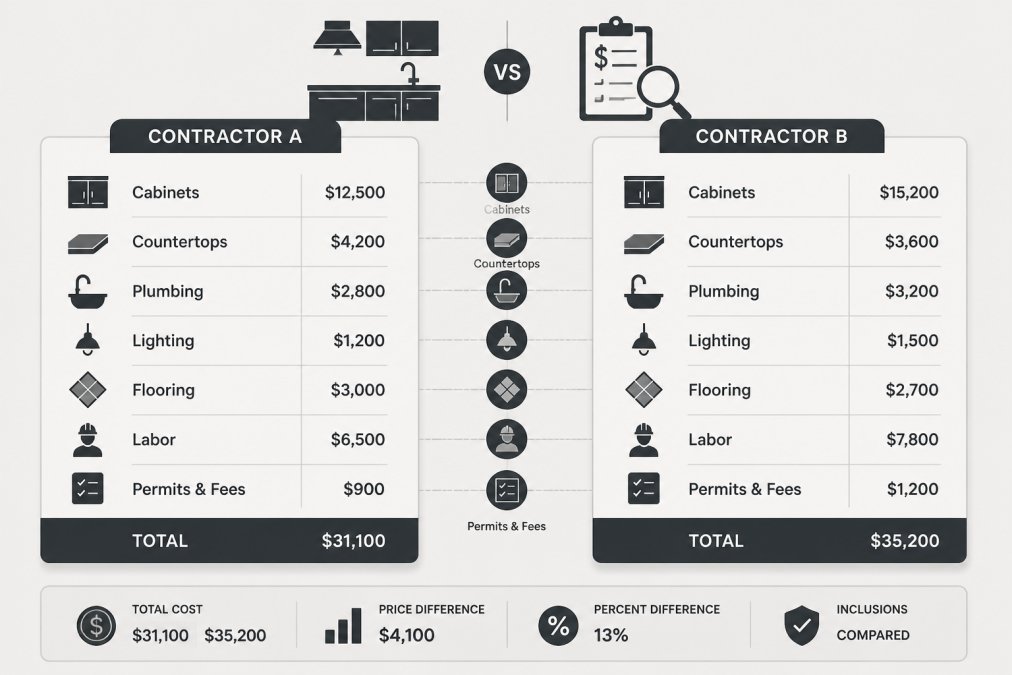
A bathroom remodel estimate is more than a single number at the bottom of a page. It should be a detailed breakdown of the project. If you receive a one-page quote with a lump sum, ask for an itemized version.
A proper estimate separates labor from materials. It lists specific fixtures, tile, and vanity models. This prevents confusion later when you expect a certain brand of faucet but receive a generic alternative. The estimate should also outline what is not included, such as moving plumbing lines or replacing subflooring.
What Actually Drives the Cost
Most practitioners find the final number is shaped less by the tile you pick than by what is behind the wall. The biggest cost drivers are:
- Layout changes. Moving a toilet, sink, or shower drain means relocating supply lines and waste pipes, which is the single most expensive change you can request.
- Hidden damage. Rotted subfloor, mold, or outdated wiring discovered after demolition is the most common reason a project goes over budget.
- Wet-area waterproofing. A bonded waterproofing membrane behind tile is a small line item that prevents five-figure water damage later. Never let a bidder skip it to look cheaper.
- Fixture and finish tier. A stock vanity and ceramic tile sit at one end; a custom vanity and natural stone sit at the other. The labor to install them is often similar.
- Permits and inspections. Work that moves plumbing or electrical generally requires a permit and inspection, which adds both a fee and time.
Estimate vs. Quote: Know Which You Have
| Document | What It Means | Your Risk |
|---|---|---|
| Estimate | Projected cost based on assumed conditions | Number can rise if conditions change |
| Fixed quote | Locked price for a defined scope | Price holds unless you change the scope |
| Time-and-materials | You pay for actual hours and materials | Cost is open-ended |
Ask for a line-item breakdown for these categories:
| Category | What to Look For |
|---|---|
| Demolition | Hauling away old materials, protecting floors |
| Plumbing | Moving pipes, new valve installation, permits |
| Electrical | New outlets, GFCI protection, lighting circuits |
| Tile & Flooring | Waterproofing membrane, tile setting, grout |
| Fixtures | Vanity, sink, faucet, toilet, shower trim |
| Labor | Daily rates or project-based fees |
If an estimate lacks detail, it is a sign the contractor may not have a firm grasp on the scope of work. A detailed estimate protects both you and the contractor from misunderstandings.
Bathroom Remodel Timeline: What to Expect Week by Week
A standard bathroom remodel typically takes two to three weeks for a simple update, while a full gut renovation can take four to six weeks.
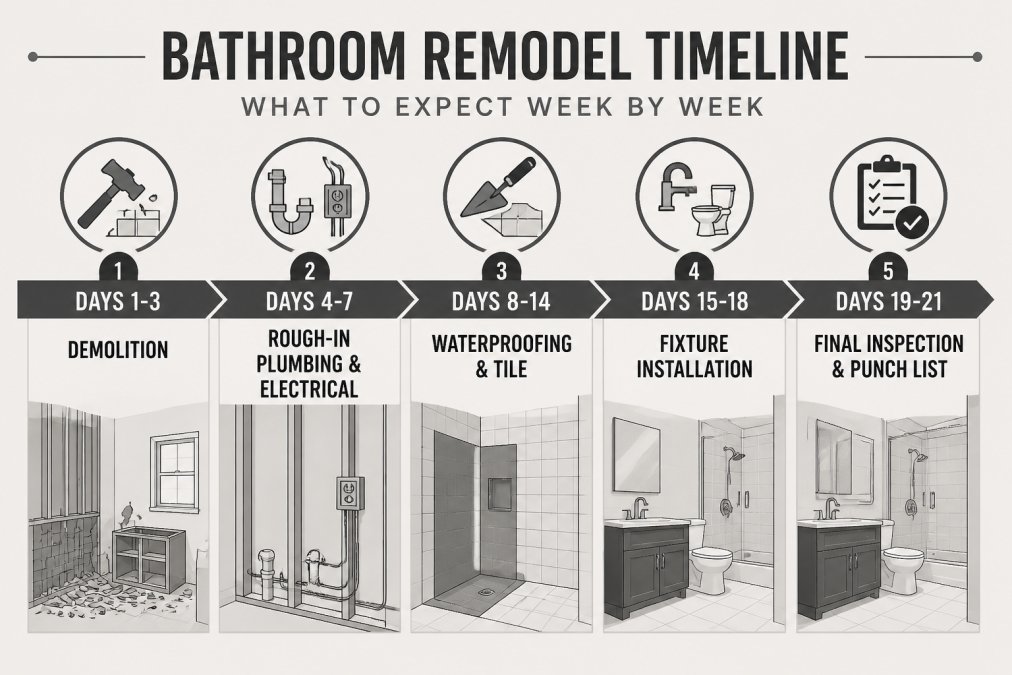
Week one is usually the most disruptive. It involves demolition and rough-in work. You will hear noise and have workers in and out of your home.
Week two focuses on waterproofing and tile. This is where the bathroom starts to look like a bathroom again. The walls are closed up, and the tile is installed. This phase requires precision to prevent water damage later.
Week three is for finishing touches. The vanity, toilet, and shower fixtures go in. Paint and trim are completed. The final walkthrough happens at the end of this week.
Your Bathroom Remodel Checklist: From First Call to Final Walkthrough
Staying organized keeps the project on track. Use this checklist to manage the process from your first search to the final inspection.
Before Work Begins
- Verify contractor license and insurance.
- Confirm the project timeline and start date.
- Finalize material selections (tile, vanity, fixtures).
- Clear personal items from the bathroom and adjacent areas.
- Confirm the payment schedule.
During and After Construction
- Review work at the end of each week with the project manager.
- Approve any change orders in writing before work continues.
- Conduct a final walkthrough to check for leaks, alignment, and paint quality.
- Obtain a lien waiver from the contractor to ensure all subs are paid.
- Keep all warranty documents for fixtures and labor.
Red Flags and Trust Signals When Comparing Local Remodelers
When comparing local remodelers, look for patterns of behavior. Trust signals include a physical local address, a professional website with real project photos, and a list of references you can call. A contractor who is active in the community and has a long history in the area is often a safer bet.
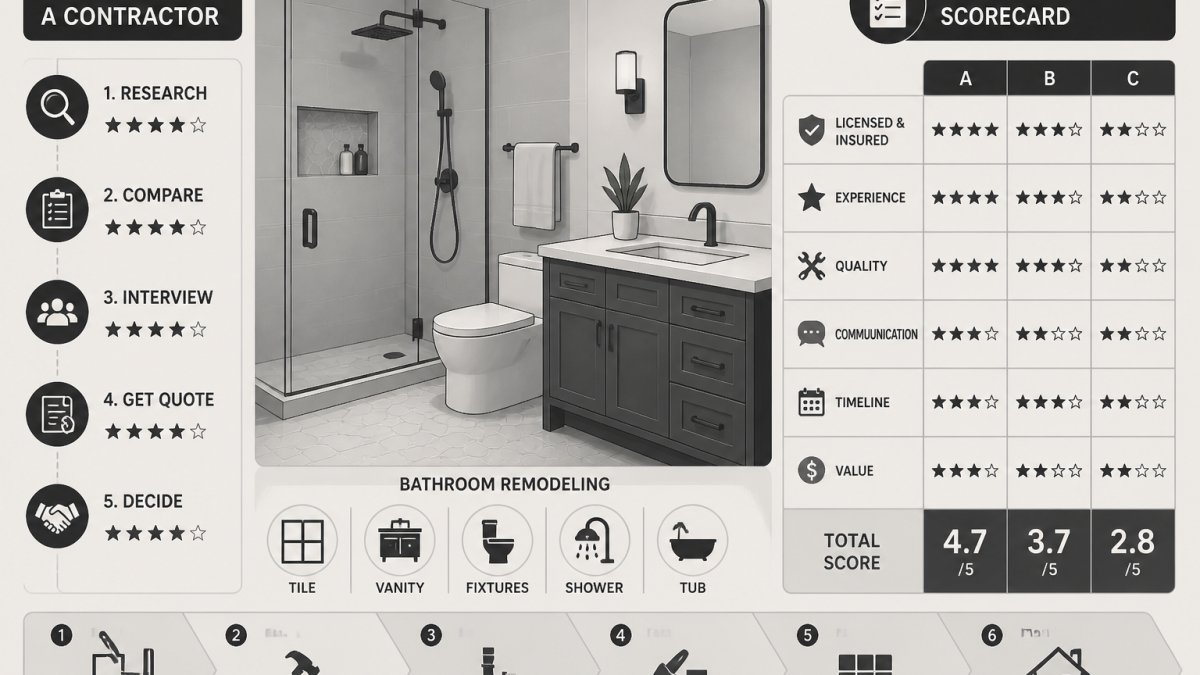
But ratings alone will not tell you who to hire. The most useful comparison is a side-by-side scorecard built on criteria that actually predict a good outcome. Score each bidder on the same list:
| Criterion | What a Strong Answer Looks Like |
|---|---|
| Licensing | Verifiable license number you can look up yourself |
| Insurance | Certificate of insurance for general liability and workers' comp |
| Written scope | Itemized, with inclusions and exclusions spelled out |
| Payment schedule | Tied to milestones, not a large upfront deposit |
| Change orders | Written and signed before extra work proceeds |
| Warranty | Separate workmanship and product warranties, in writing |
| Permits | Contractor pulls them and schedules inspections |
| References | Recent local projects you can actually call |
Warranty, Permits, and Post-Project Support
These three items separate a professional from a handyman. Ask each bidder to put their workmanship warranty in writing and tell you how long it lasts. Product warranties come from the manufacturer, but the labor to replace a failed fixture usually comes from the installer, so confirm who covers what. On permits, the contractor should pull them and arrange inspections; if a bidder suggests skipping the permit to save time, walk away. Finally, ask what happens after the final walkthrough. A company that offers a defined callback window for punch-list items is telling you they plan to stand behind the work.
Accessibility and Aging-in-Place Trade-Offs
If anyone in the home plans to age in place, compare how each bidder handles accessibility. A curbless walk-in shower with a linear drain removes the step-over hazard, but it requires more framing and waterproofing work than a standard pan.
Red flags are equally telling. Be wary of contractors who ask for large cash deposits, refuse to put agreements in writing, or cannot provide a certificate of insurance.
The Federal Trade Commission offers consumer guidance on home improvement scams. It advises homeowners to get multiple bids and never pay in full upfront. Taking the time to compare providers using a consistent set of criteria will help you find a reliable partner.
Conclusion: Choosing a Bathroom Remodeling Partner You Can Trust
Finding the right contractor for your bathroom renovation requires patience and diligence. You are not just buying a service; you are inviting someone into your home to create a space you will use every day. The process can feel overwhelming, but breaking it down into verification, estimation, and comparison makes it manageable.
At Times Square Remodeling Inc., we understand the concerns homeowners have about budget and timelines. We are a California-licensed general contractor (License #953868) with over 15 years of experience. We specialize in comprehensive remodeling services, including bathroom and kitchen updates, and we are dedicated to professional project execution. If you are ready to start your project, contact us to discuss how we can help you achieve your goals.
Frequently Asked Questions
What should I look for when choosing a bathroom remodeling contractor?
Start with licensing and insurance. In California, verify the contractor holds an active license through the Contractors State License Board and carries both general liability and workers' compensation coverage. Ask for the license number and look it up yourself. Then check project photos from similar bathrooms, read customer reviews on multiple platforms, and request at least three references from jobs completed in the past year. A contractor who hesitates to provide any of this is not worth your time.
How long does a typical bathroom remodel take?
A standard full bathroom remodel runs three to five weeks from demolition to final walkthrough. A cosmetic refresh, such as new fixtures and paint without moving plumbing, can finish in one to two weeks. Projects involving layout changes, structural work, or custom tile take longer. Ask your contractor for a written schedule broken down by phase, and confirm how they handle delays from material backorders or hidden damage discovered during demolition.
What is included in a bathroom remodel estimate?
A complete estimate breaks costs into labor, materials, permits, and contingency. It should list specific line items: demolition, plumbing rough-in, electrical work, waterproofing, tile, vanity, fixtures, and painting. Vague lump-sum quotes make it impossible to compare bids or spot where corners are being cut. Ask whether the estimate includes permit fees, dumpster rental, and site protection. Request a written scope of work that states exactly what is and is not covered.
Do bathroom remodeling contractors handle permits?
A licensed general contractor typically pulls permits on your behalf, and the cost is either included in the estimate or listed as a separate line item. Permits are usually required when you move plumbing, add electrical circuits, or change the layout. Cosmetic updates like swapping a faucet or repainting may not need one. Confirm who files the permit and who schedules inspections before work begins. An unpermitted remodel can create problems when you sell the home.
How can I compare bathroom remodeling estimates fairly?
Line up each bid against the same scope of work. If one contractor includes tile waterproofing and another omits it, the cheaper quote is not actually cheaper. Compare material brands and grades, labor breakdowns, permit handling, and warranty terms side by side. Ask each contractor to explain anything that differs. A bid that is significantly lower than the others usually means something was left out, not that you found a bargain.