 ultimate-guide
Is Mold Remediation Covered by Homeowners Insurance?
Table of Contents
- Is Mold Remediation Covered by Homeowners Insurance?
- Covered Perils vs. Gradual Damage: What Your Policy Actually Says
- How to File a Mold Insurance Claim: A Step-by-Step Process
- Signs of Hidden Water Damage You Should Never Ignore
- Mold Remediation Cost vs. Your Policy Limits
- Mold Endorsements and Sub-Limits: When Standard Coverage Falls Short
- Conclusion
- Frequently Asked Questions
Last Updated: October 2, 2026
Is Mold Remediation Covered by Homeowners Insurance?
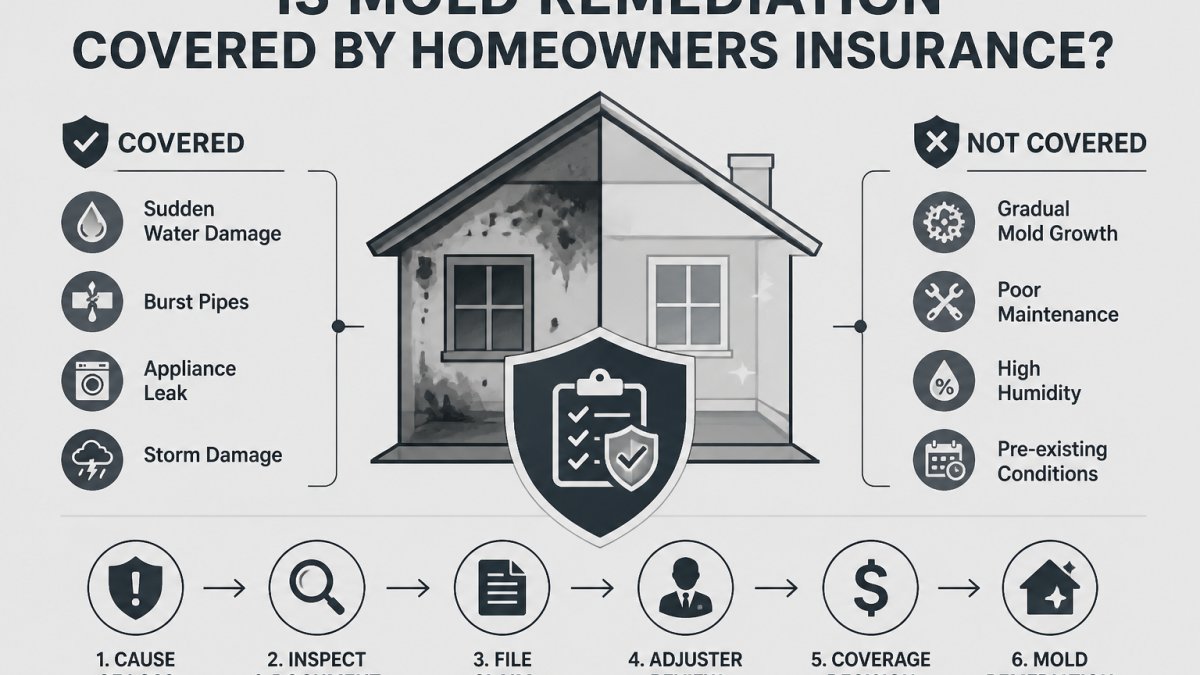
The short answer to "is mold remediation covered by homeowners insurance" is: sometimes, and far less often than they expect. A standard homeowners insurance policy generally covers mold remediation only when the mold traces back to a covered peril, such as a burst pipe or a sudden appliance failure. When mold grows because of long-term moisture, a slow roof leak, or skipped maintenance, the claim usually gets denied. This guide from Times Square Remodeling Inc. walks through exactly where that line falls, how to file a mold insurance claim, and what to do when your policy limits fall short of the actual cleanup.
The confusion is understandable. Mold is a fungus and bacteria problem, but insurers treat it as a cause-and-effect problem. They do not ask "is there mold?" They ask "what caused the moisture, and is that cause covered?" Get that distinction wrong and you will spend weeks arguing with an insurance adjuster instead of drying out your house.
Below, we break down the sudden-versus-gradual rule, the step-by-step claims process, and the endorsements that close the gap.
Covered Perils vs. Gradual Damage: What Your Policy Actually Says
A covered peril is a specific, named event your policy agrees to pay for, such as fire, windstorm, hail, or a sudden pipe burst. Mold itself is rarely a named peril.
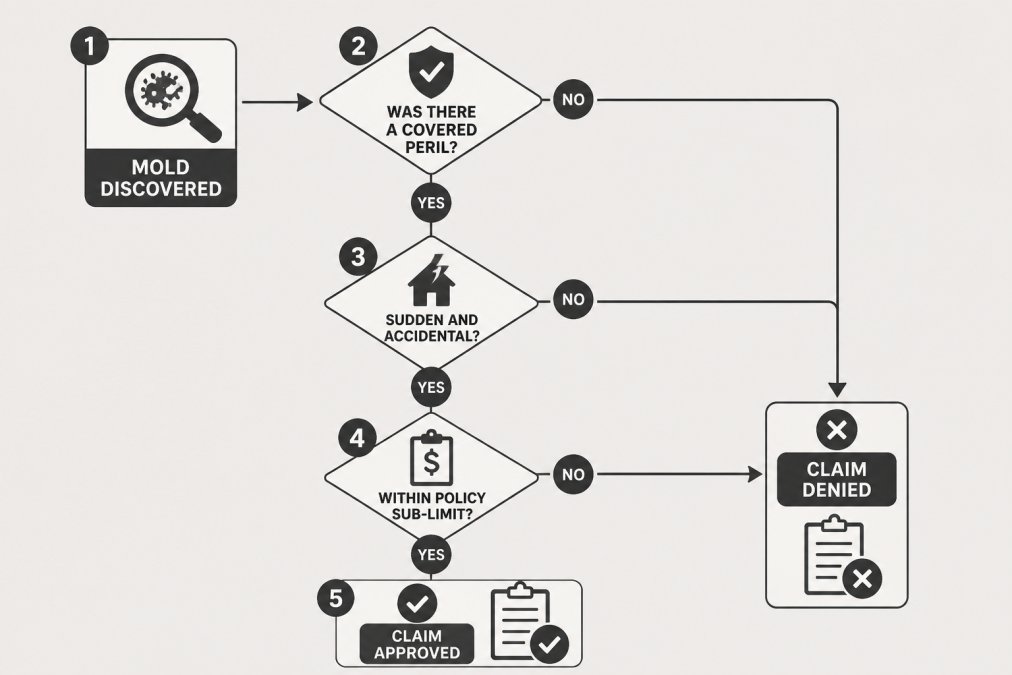
The word "promptly" carries real weight. Insurers expect mitigation to begin quickly, and delays give an adjuster grounds to argue the mold became a maintenance issue rather than a covered loss.
Why Gradual Water Damage Gets Denied
Gradual water damage is the single most common reason mold claims fail. A slow drip under a sink, a roof leak that has been staining the ceiling for months, or condensation that has been feeding a bathroom wall for a year all point to a problem the homeowner had time to notice.
Policies typically exclude maintenance neglect, and that exclusion is broad. If the moisture built up over weeks or months, the insurer will classify the mold as preventable and deny the water damage claim outright.
How to File a Mold Insurance Claim: A Step-by-Step Process
Filing correctly protects your property damage claim from the start. The order of operations matters more than most homeowners realize, because a single misstep, like throwing out damaged materials before an inspection, can sink an otherwise valid claim. But the steps themselves are only half the story. What separates an approved mold claim from a denied one is the evidence file you build for the adjuster.
The Seven Steps, In Order
- Stop the water source. Shut off the supply, fix the leak, or tarp the roof. Ongoing moisture turns a covered event into a maintenance dispute.
- Document everything before you clean. Photograph the mold, the moisture source, and any damaged belongings. Keep receipts for anything you discard.
- Report the claim immediately. Call your insurer the same day you discover the damage and get a claim number.
- Schedule the adjuster inspection. The insurance adjuster will verify the cause and confirm whether a covered peril applies.
- Get professional mold testing. A written report from a qualified mold testing provider establishes the scope and the affected area.
- Keep all remediation invoices. Every dollar you spend on professional removal is evidence for your claim.
- Track your deductible and sub-limit. Know what you pay out of pocket before the insurer pays anything.
What the Adjuster Is Actually Looking For
Most guides stop at the checklist. The part that decides your claim is the claims adjustment process itself, and it runs on documentation, not on how bad the mold looks. A licensed adjuster is building a file that answers four questions: What was the cause of loss? When did it happen? Was it sudden? Did the homeowner mitigate promptly?
Your job is to hand them answers in writing. That means:
- A dated cause-of-loss narrative. Write down the date you discovered the moisture, the date you discovered the mold, and the specific event that let water in. A burst supply line on a Tuesday is a clean story. "It's been damp for a while" is not.
- A plumber's or contractor's written diagnosis. If a licensed plumber confirms a failed fitting or a ruptured hose, that report converts your version of events into a third-party finding. Adjusters weight third-party findings heavily.
- Moisture readings and a scope of work. A mold testing or restoration provider's report with moisture meter readings, affected square footage, and a remediation protocol gives the adjuster something to price. Without it, the adjuster estimates low.
- A mitigation timeline. Receipts from a water extraction company, a dehumidifier rental, or a tarp purchase all prove you acted fast. This is the single strongest rebuttal to a "gradual damage" denial.
- Photos with timestamps. Before-and-after photos of the moisture source, the mold, and the removed materials. Metadata timestamps carry more weight than undated phone shots.
If the Claim Is Denied
A denial is not always final. Most policies include an appraisal clause and a formal appeals process, and state departments of insurance publish consumer complaint procedures. The two most common reversal paths are (1) producing a licensed contractor's report that contradicts the adjuster's cause-of-loss finding, and (2) invoking the appraisal clause to have a neutral umpire set the loss amount.
Signs of Hidden Water Damage You Should Never Ignore
Signs of hidden water damage usually show up long before visible mold does, and catching them early is what keeps a small repair from becoming a full remediation project.
Watch for a musty, earthy smell in a room that has no obvious moisture, paint that bubbles or peels on a wall or ceiling, soft or spongy spots in drywall and flooring, and a persistent uptick in allergy symptoms indoors.
Indoor air quality is often the first thing to suffer. If a room smells damp and you cannot find the source, moisture is almost certainly present behind a surface.
Mold Remediation Cost vs. Your Policy Limits
Here is the part that surprises homeowners most: even an approved claim rarely covers the full bill. Standard policies cap mold coverage with a sub-limit, a ceiling that sits far below your overall dwelling coverage. A policy with substantial structural damage coverage may still cap mold cleanup at a small fraction of that amount.
What Sub-Limits Typically Look Like
Most standard homeowners policies set the mold sub-limit at a specific figure. The exact figure lives on your policy declarations page, usually under a heading like "Additional Coverages" or "Limited Mold Coverage." Find it before you file, not after.
What Remediation Actually Costs
Remediation costs scale with the affected area, whether the mold reached the structure, and how much material must be removed. Industry cost guides commonly place the ranges this way:
- Small, contained growth (on a paintable surface).
- Mid-size jobs (a wall cavity, a bathroom, a section of ceiling).
- Large or structural jobs (mold through drywall, insulation, subfloor, or framing across multiple rooms).
Those are remediation figures only. Reconstruction, drywall replacement, painting, and flooring are separate line items and can double the total. That is why a sub-limit can be exhausted by a single mid-size job once rebuild costs land.
The Math That Decides Your Out-of-Pocket
Run the numbers before you authorize work. If your sub-limit, deductible, and the remediation plus rebuild come in at certain figures, you are looking at a specific amount out of pocket. That gap is the number that matters, not the deductible alone.
| Scenario | Typical Coverage Outcome | What You Pay |
|---|---|---|
| Mold after a burst pipe, reported fast | Covered, within sub-limit | Deductible plus anything above the cap |
| Mold from a slow roof leak | Usually denied | Full remediation cost |
| Mold after a sewer backup | Covered only with backup endorsement | Deductible plus overage |
| Long-term bathroom condensation | Denied as maintenance neglect | Full remediation cost |
Health-Related Claims Are a Different Policy
One distinction that trips up homeowners: property damage from mold is handled by your homeowners policy, but health or medical claims related to mold exposure are almost never covered there. Those fall under health insurance, and most health plans treat mold-related respiratory complaints as a pre-existing or environmental condition rather than a covered illness. If your concern is medical, call your health insurer, not your homeowners carrier.
Mold Endorsements and Sub-Limits: When Standard Coverage Falls Short
A mold endorsement is an add-on that raises your mold coverage above the standard sub-limit, and for homeowners in older housing stock it is often the difference between a manageable claim and a financial hit.
Coverage also varies by state, because insurance is regulated at the state level. Some states require insurers to offer mold endorsements or set minimum coverage thresholds; others leave it entirely to the market.
California Department of Insurance consumer resources on homeowners coverage
The same logic applies to sewer backup and roof leak damage, which frequently require their own endorsements.
Conclusion
Mold claims fail for one reason more than any other: the moisture was gradual, and gradual damage is excluded. If you are staring at mold right now, the priority is stopping the water, documenting everything, and getting a professional assessment before you file. Times Square Remodeling Inc. is a California-licensed general contractor (License #953868) with over 15 years of experience in restoration and remodeling, handling water damage repair, mold remediation, and the reconstruction that follows.
Frequently Asked Questions
Does homeowners insurance cover mold caused by a leaky pipe?
It depends on whether the leak was sudden or gradual. If a pipe bursts unexpectedly and you file a water damage claim promptly, mold remediation coverage is often included because the pipe burst qualifies as a covered peril. However, if the pipe has been dripping slowly for months and you did not address it, the insurer will likely classify the mold as resulting from maintenance neglect and deny the claim. Document everything and report the damage as soon as you discover it.
How expensive is mold remediation, and will my policy limits cover it?
Mold remediation cost varies widely based on the affected area, the type of mold, and whether structural damage is involved. Many standard homeowners insurance policies cap mold coverage at a sub-limit, which varies depending on your insurer and policy tier. If the remediation cost exceeds that sub-limit, you pay the difference out of pocket. Review your declarations page to confirm your specific mold coverage limit before filing a claim.
Will filing a mold claim cause my insurance premiums to increase?
Filing a mold claim can affect your premium, though the impact varies by insurer and your claims history. A single claim related to a covered peril like a pipe burst may have a modest effect. Multiple claims or claims stemming from maintenance neglect could lead to a larger increase or even non-renewal. Ask your insurance adjuster whether the claim is likely to be surcharged before you file, and weigh that against the remediation cost.
What steps should I take immediately after discovering mold?
First, stop the moisture source if possible. Then document everything with photos and notes before any cleanup. Contact a licensed mold testing professional to assess the extent, and notify your insurance company promptly. Keep all receipts for emergency mitigation like drying or temporary repairs. Do not disturb the mold beyond what is necessary to prevent spread, and do not hire a remediation contractor before your insurance adjuster has inspected the damage.