 how-to
Cost of Professional Home Air Sealing Services
Table of Contents
- What Professional Home Air Sealing Services Include
- Home Air Sealing Cost: What Drives the Price
- Professional Air Leak Detection: The First Step in Any Quote
- How to Read an Air Sealing Contractor Quote
- Attic Air Sealing Cost: Why the Attic Often Costs More
- Rebates, Incentives, and Payback for Air Sealing
- DIY vs. Professional Air Sealing: When to Hire Out
- Frequently Asked Questions
Last Updated: October 17, 2026
What Professional Home Air Sealing Services Include
Professional home air sealing is the targeted closure of gaps, cracks, and penetrations in a building's envelope to reduce uncontrolled air movement between conditioned and unconditioned spaces. At Times Square Remodeling Inc., we treat it as diagnostic work first and sealant work second, because sealing the wrong gaps wastes money and can create new problems.
Scope of Work: Attic, Crawlspace, and Living Areas
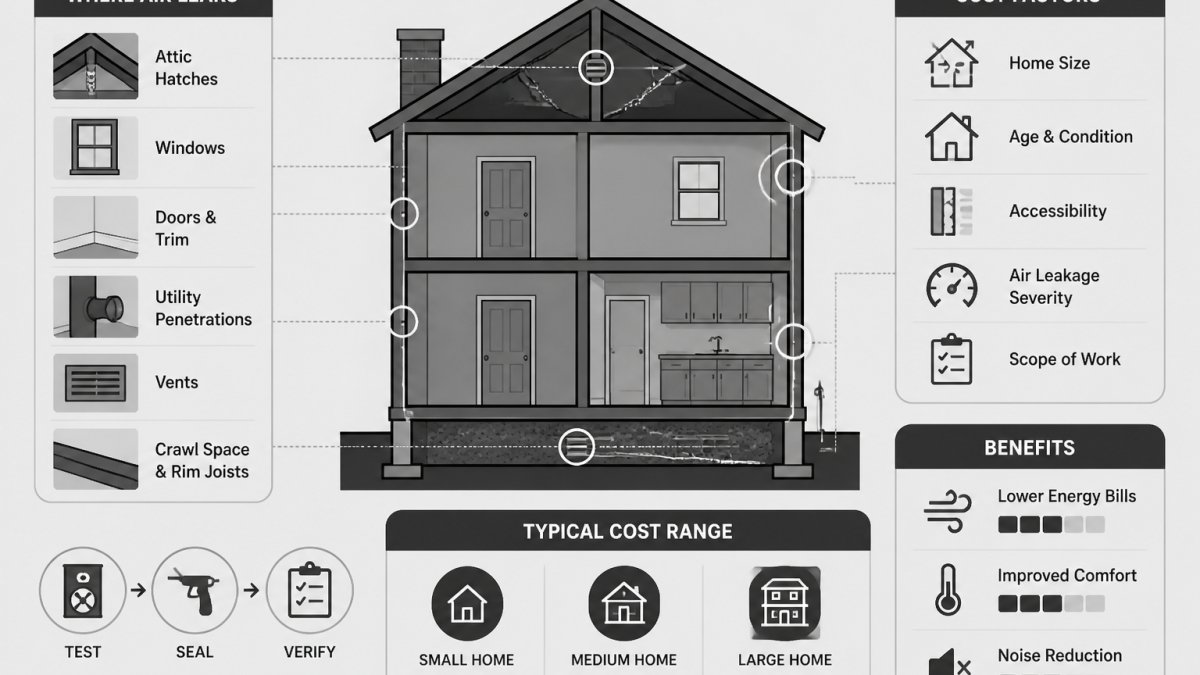
A standard job covers three zones. In the attic, crews seal the boundary between the house and the attic: top plates, recessed light housings rated for contact, wiring and plumbing penetrations, and the attic hatch. In the crawlspace, the focus shifts to the rim joist, sill plate, and any open chases running up into the living space. Inside the home, weatherstripping on doors and sealing around windows, outlets, and baseboards round out the work.
What Is Excluded from a Standard Air Sealing Job
Most quotes do not include insulation replacement, duct sealing, window replacement, or mold remediation. Those are separate line items. Ask specifically whether your contractor includes combustion safety testing, because a tighter house changes how gas appliances vent. That test is not optional in our view.
Home Air Sealing Cost: What Drives the Price
No single figure fits every house, and any contractor who quotes one over the phone is guessing.
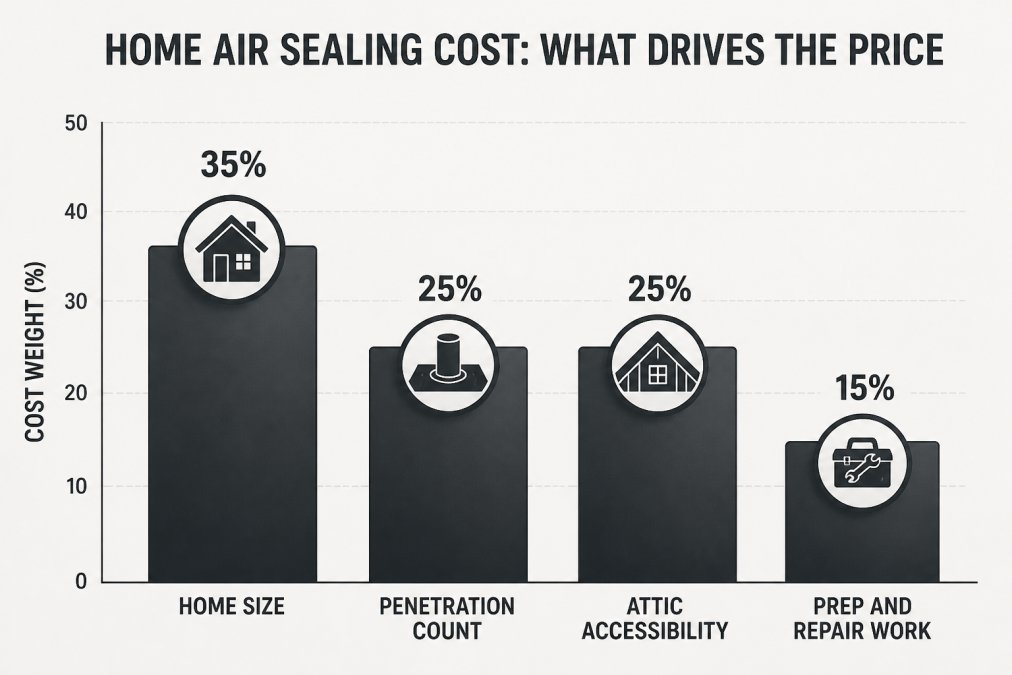
A 1,200-square-foot ranch with an open, walkable attic is a fundamentally different job from a 3,000-square-foot two-story with a low-pitch roof and blown insulation covering every top plate. The second house can take two to three times the labor.
A Transparent Price Range for Air Sealing Alone
Most published figures blend air sealing with insulation, which makes them useless for comparing bids. Separated out, professional air sealing alone typically falls into three bands, based on project scope rather than home size alone:
| Project Band | Typical Scope | Typical Price Range (USD) |
|---|---|---|
| Focused sealing | Attic top plates, accessible penetrations, weatherstripping on 2-3 doors, outlet gaskets | $400-$900 |
| Whole-house sealing | Attic plus crawlspace rim joist and chases, all accessible penetrations, door and window weatherstripping | $900-$1,800 |
| Sealing with diagnostic testing | Pre- and post-work blower-door testing, thermal imaging, combustion safety check, full scope above | $1,200-$2,500 |
These ranges assume a single-story home under 2,500 square feet with an accessible attic and no major prep work. Add 25-50% for a two-story home with a low-pitch roof, blown insulation over the top plates, or knob-and-tube wiring that requires special handling. Homes with finished attic spaces or no crawlspace access can push higher still.
Line-Item Estimate: How a Real Quote Breaks Down
A defensible quote separates each cost component. Here is how a typical whole-house air sealing estimate is structured, using the mid-band above as an example:
| Line Item | What It Covers | Typical Share of Total |
|---|---|---|
| Diagnostic testing | Baseline blower-door test, thermal imaging, smoke tracing | 15-25% |
| Labor | Crew hours for sealing, prep, and restoration | 45-60% |
| Materials | Caulk, spray foam, weatherstripping, backer rod, gaskets | 10-15% |
| Access and prep | Moving insulation, protecting finished surfaces, restoring insulation | 10-20% |
| Combustion safety check | Testing gas appliances after sealing | 5-10% |
| Post-work verification | Final blower-door test and written report | Included in testing line |
Labor is the largest cost component in nearly every quote. Materials, meaning caulk, spray foam, weatherstripping, and backer rod, are inexpensive relative to the hours required to install them correctly. That ratio explains why two bids for the same house can differ sharply: one contractor priced the diagnostic work and prep, the other priced only the sealing.
What Changes the Number Most
- Attic accessibility. A walkable attic with a full-size access hatch is the cheapest configuration. A low-pitch roof with blown insulation over every top plate can double labor.
- Penetration count. Each recessed light, plumbing stack, electrical run, and fan opening is a separate sealing point. A home with 40 penetrations is a different job than one with 12.
- Testing included or not. A quote without a baseline blower-door test is not comparable to one with it, because you cannot verify the result.
- Bundled insulation. Adding attic insulation to an air sealing job typically adds $1,000-$3,000 depending on square footage and R-value target, and is usually quoted as a separate line.
Professional Air Leak Detection: The First Step in Any Quote
Professional air leak detection is the measurement process that finds where a house leaks before anyone opens a tube of caulk. The standard tool is a blower-door test, which depressurizes the home and quantifies total leakage.
The result is expressed as an air leakage rate, often in air changes per hour at a set pressure differential, written as ACHnat when normalized to natural conditions. That number matters more than any visual inspection.
The sequence that produces a defensible quote looks like this:
- Baseline blower-door test with the house closed up
- Thermal imaging and smoke tracing to locate leak paths
- Written scope listing each leak location and the sealing method
- Post-work blower-door test to verify the reduction
- Combustion safety check on any gas-fired appliance
U.S. Department of Energy guidance on blower door testing explains how the test is run and what the readings mean. A contractor who skips the baseline test cannot prove the job worked, and you have no way to check the claim.
How to Read an Air Sealing Contractor Quote
A usable quote separates labor from materials, names each sealing location, and states the target leakage reduction. Anything less is a number on a page.
Here is the structure we would insist on seeing:
| Quote Element | What It Should Say | Red Flag If Missing |
|---|---|---|
| Diagnostic testing | Pre- and post-work blower-door readings | Only one test, or none |
| Scope by location | Attic, crawlspace, and living area listed separately | "Whole house" with no detail |
| Materials | Product type per location | Lump-sum materials line |
| Labor hours | Estimated crew hours | No hours stated |
| Exclusions | Insulation, ducts, windows called out | Silent on exclusions |
| Combustion safety | Test on gas appliances | Not mentioned |
| Warranty | Workmanship term in writing | Verbal only |
Get multiple bids, and compare them line by line rather than on the bottom number. A low bid that omits testing and combustion safety is not a bargain; it is an incomplete job.
Attic Air Sealing Cost: Why the Attic Often Costs More
Attic air sealing cost runs higher than most homeowners expect, and the reason is access, not materials. The attic is where the largest leaks concentrate: top plates, ceiling penetrations for lights and fans, and the plumbing and electrical openings that punch through the ceiling plane.
Working safely in an attic means navigating joists under insulation, managing heat, and often moving blown insulation aside and restoring it afterward. That prep and restoration is real labor.
The payoff justifies the cost. Sealing attic bypasses is the single highest-use step in most weatherization projects because it stops stack-effect leakage, the phenomenon where warm air escapes upward and pulls cold air in below.
Rebates, Incentives, and Payback for Air Sealing
Incentive programs change constantly, and eligibility depends on your utility, your income, and the specific measures installed. Rather than quote figures that may be stale, we tell homeowners to check two sources directly: their utility's current rebate page and the Database of State Incentives for Renewables and Efficiency, which tracks federal, state, and utility programs.
How Air Sealing Incentives Usually Work
Most residential efficiency incentives fall into three structures, and knowing which one applies to your project determines what you can claim:
- Prescriptive rebates. A fixed dollar amount per measure, such as a set rebate for attic air sealing when paired with a blower-door test. These are the easiest to claim but often require the work to be performed by a participating contractor.
- Performance-based incentives. A payment tied to measured leakage reduction, usually verified by pre- and post-work blower-door testing. These reward thorough work but require documentation the contractor must provide.
- Tax credits. Federal and state credits may apply to qualifying efficiency upgrades. Eligibility rules, caps, and expiration dates change, so verify the current program terms before assuming a credit applies.
Eligibility Details Homeowners Miss
A common pattern is that air sealing alone qualifies for a smaller incentive than air sealing bundled with insulation. Many programs require a home energy assessment first, and some require the assessment to be performed by a certified auditor. Contractor credentials matter too: programs frequently require participating contractors to hold specific certifications or to be listed on a utility's approved contractor roster.
Before signing a contract, ask the contractor three questions:
- Is this program's incentive available for air sealing alone, or only when bundled with insulation?
- Does the program require a pre-work energy assessment, and who must perform it?
- What documentation will you provide so I can claim the incentive, blower-door reports, invoices, and contractor certification numbers?
Payback and Cost-Effectiveness
Payback works differently than most home upgrades. Air sealing is inexpensive relative to HVAC replacement or solar, and its savings show up immediately on heating and cooling bills. Many homeowners find the work pays back faster than larger efficiency projects, though the exact period depends on climate, current leakage, and energy prices.
A home energy assessment is the right starting point. Many utilities offer one at low or no cost, and the report gives you the leakage baseline you need to evaluate any bid, and often the documentation required to claim an incentive.
DIY vs. Professional Air Sealing: When to Hire Out
Hiring out makes sense the moment the work moves into the attic or crawlspace, involves combustion appliances, or requires a blower door to find the leaks. Three reasons stand out.
EPA guidance on indoor air quality and home sealing covers ventilation and combustion safety considerations that matter once a house is tightened.
At Times Square Remodeling Inc., we handle air sealing as part of broader energy-efficient upgrade work, backed by more than 15 years of licensed contracting experience.
A tighter house saves money only when the work is scoped and verified correctly.
Frequently Asked Questions
How much does professional home air sealing cost?
The cost of professional home air sealing services varies based on home size, the number of leaks, attic and crawlspace accessibility, and local labor rates. Most contractors provide a quote after a professional air leak detection assessment. Pricing is typically itemized by area and scope, so ask for a written estimate that separates labor and materials. For a precise figure, request a free inspection from a licensed contractor who can evaluate your specific home.
Is professional air sealing worth the cost?
Air sealing can lower heating and cooling costs by reducing air infiltration, and many homeowners see a payback period of a few years. The cost-effectiveness depends on your home's current air leakage rate, local energy prices, and available utility rebates. A blower-door test before and after work verifies the improvement. For older homes with obvious drafts, air sealing is often one of the most cost-effective energy efficiency upgrades.
How do contractors find air leaks in a house?
Contractors use professional air leak detection methods, including a blower-door test that depressurizes the home and measures air changes per hour (ACHnat). They also use infrared cameras and smoke pencils to locate leaks around top plates, plumbing penetrations, electrical penetrations, and rim joists. This assessment informs the air sealing contractor quote by identifying exactly where work is needed.
Should a home be air sealed before adding insulation?
Yes, air sealing should always come before attic insulation. Sealing air leaks first prevents conditioned air from escaping through gaps and ensures the insulation performs as intended. If you insulate over leaks, you trap air movement and reduce energy savings. A professional energy audit can determine the right sequence and help you budget for both attic air sealing cost and insulation installation together.