 listicle
Best Los Angeles General Contractor Services: 2026 Guide
Table of Contents
- Quick Comparison: Top Los Angeles General Contractor Services
- How We Evaluated the Best General Contractor Services
- 1. Times Square Remodeling Inc.: Best for Energy-Efficient Upgrades
- 2. Century Pro Builders: Best for High-Rated Residential Renovation
- 3. MATT Construction: Best for Large-Scale Commercial Projects
- 4. HITT Contracting: Best for Corporate Interior Build-Outs
- 5. Sweeten: Best Free Contractor Matching Service
- 6. ECOSMART DEVELOPMENT & CONSTRUCTION INC: Best for Sustainable Design-Build
- How to Interview a General Contractor
- California Contractor License Check and ADU Regulations
- Frequently Asked Questions
Last Updated: September 21, 2026
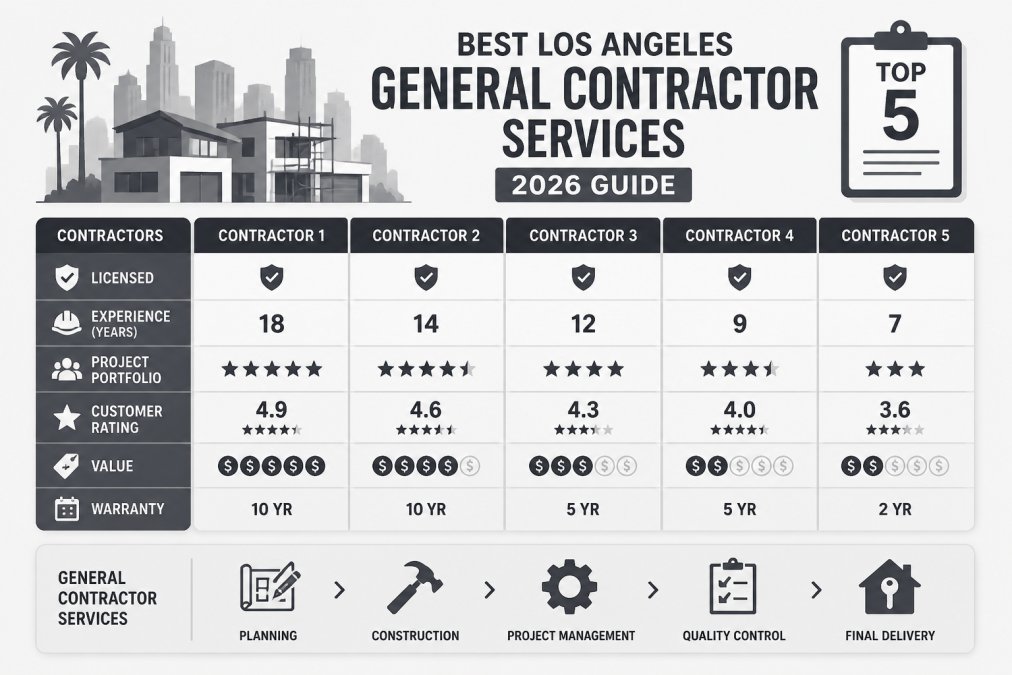
Quick Comparison: Top Los Angeles General Contractor Services
At Times Square Remodeling Inc., we've spent more than 15 years in this market, and the pattern is consistent: companies that finish on time and on budget have verifiable licenses, clear scopes, and real project management systems.
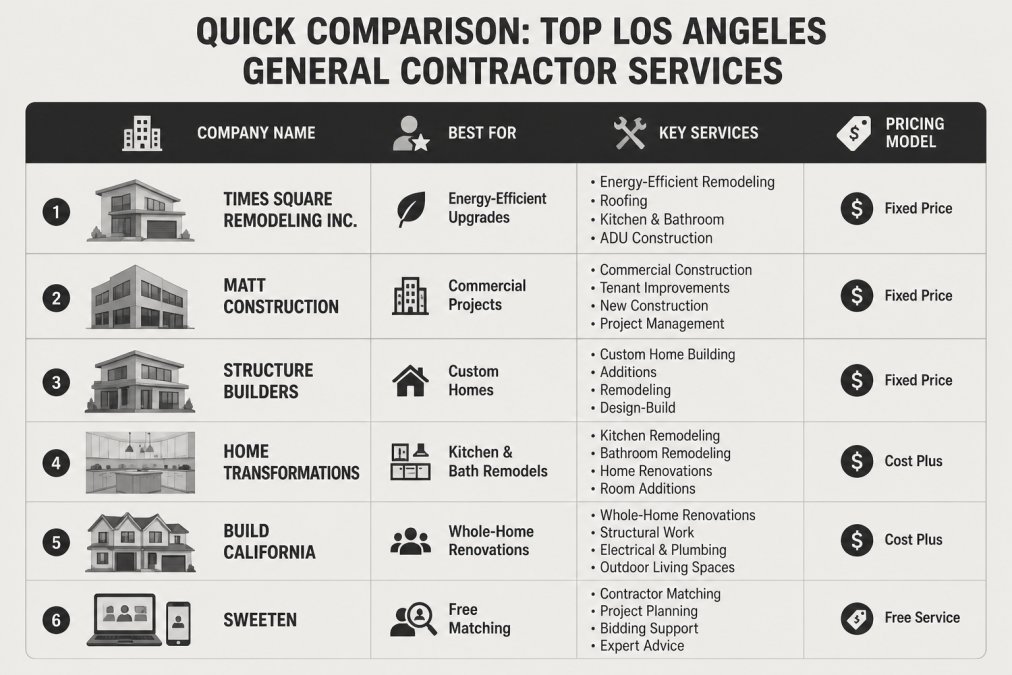
| Company | Best For | Key Services | Pricing Model |
|---|---|---|---|
| Times Square Remodeling Inc. | Energy-efficient upgrades | Roofing, kitchen/bath remodel, ADU, HVAC | Contact for quote |
| Century Pro Builders | High-rated residential renovation | Full-service residential remodel | Project-based |
| MATT Construction | Large-scale commercial projects | Commercial building, structural engineering | Contract-based |
| HITT Contracting | Corporate interior build-outs | Interior build-outs, service work | Contract-based |
| Sweeten | Free contractor matching | Vetted contractor referrals | Free to homeowners |
| ECOSMART Development & Construction | Sustainable design-build | Energy-efficient upgrades, modern build | Project-based |
How We Evaluated the Best General Contractor Services
We scored each firm on licensing and insurance verification, depth of service range, project management capability, and how clearly they communicate scope and timeline. License status came first because it is the single most important filter: the Contractors State License Board license check tool lets any homeowner confirm a contractor's license number, classification, and complaint history before signing anything.
1. Times Square Remodeling Inc.: Best for Energy-Efficient Upgrades
Times Square Remodeling Inc. is a licensed contractor for homeowners seeking renovation and energy upgrades. The firm holds California general contractor license #953868 and brings more than 15 years of hands-on experience to projects.
Services, Pros, and Cons
The service range is broad: roofing, kitchen and bathroom remodeling, ADU construction, and energy-efficient improvements such as HVAC, solar, and insulation. Our team manages the whole scope.
Pros:
- California licensed general contractor with a verifiable license number
- 15+ years of experience across remodeling and roofing
- Specializes in energy-efficient home upgrades
- Handles ADU construction and full kitchen and bathroom remodels under one contract
Cons:
- Pricing is quoted per project, so you'll need a consultation to get a number
2. Century Pro Builders: Best for High-Rated Residential Renovation
Century Pro Builders is a residential general contractor known for full-service home remodeling and custom home construction, managing projects from design through completion for homeowners who want a single point of contact.
3. MATT Construction: Best for Large-Scale Commercial Projects
MATT Construction handles large-scale commercial and institutional development, including complex structural engineering and sustainable building practices. This is not a residential firm; its reputation rests on integrity and craftsmanship at scale. Complex structural integrity remains a necessity for residential projects that require the same level of technical oversight found in commercial development, making hiring engineering firms a critical step for homeowners managing significant renovations.
4. HITT Contracting: Best for Corporate Interior Build-Outs
HITT Contracting runs a national operation with a local office focused on interior build-outs and service work for corporate clients. The firm has a track record with Fortune 500 companies and uses formal project management systems, which shows in how tightly its schedules and change orders are controlled.
5. Sweeten: Best Free Contractor Matching Service
Sweeten is not a contractor. It is a free matching platform that connects homeowners with vetted, licensed general contractors and helps them compare bids, removing the first hurdle for anyone who has no idea where to start.
6. ECOSMART DEVELOPMENT & CONSTRUCTION INC: Best for Sustainable Design-Build
ECOSMART Development & Construction focuses on energy-efficient construction and modern design-build services. The firm earns high customer satisfaction marks and specializes in modern, efficient building standards, making it a reasonable fit for homeowners who want sustainability baked into the design from day one.
How to Interview a General Contractor
Most homeowners treat the contractor interview as a vibe check. It should be a structured screening. The questions below separate a licensed, accountable builder from a crew that disappears mid-project, and the answers you should treat as disqualifying.
The 10 questions that actually matter
- What is your license number, and what classification does it carry? Write it down and verify it yourself before signing. A general building contractor holds a B classification, covering most residential and light commercial work; a specialty license limits the contractor to a single trade.
- Who is my single point of contact, and who is on site each day? The answer should be a named person, not "our team." If the owner sells the job and a different crew shows up, you have lost accountability.
- How do you price change orders? Ask for the written mechanism, hourly rate plus materials markup, or a fixed-price addendum. "We'll work it out" is not a mechanism.
- What is the payment schedule, and how much is due at signing? A common pattern is a deposit tied to mobilization, then progress payments tied to completed milestones. Be cautious of any schedule that front-loads most of the money before work begins.
- Who pulls the permits? The licensed contractor should pull them under their own license. If a homeowner is asked to pull an owner-builder permit for work the contractor is doing, that shifts legal liability onto you.
- Can you provide a certificate of insurance for general liability and workers' compensation? Ask for it directly from the insurer or broker, not a photocopy.
- How many projects are you running right now? A contractor juggling too many jobs is the most common cause of stalled schedules.
- What is your subcontractor vetting process? Ask whether subs are licensed and insured, and whether lien waivers are collected at each payment.
- What does your written contract include? Scope, payment schedule, timeline, change-order process, and a dispute-resolution clause. Everything in writing before work starts.
- Can you provide three recent references for projects similar to mine? Then call them and ask specifically about schedule, budget, and how the contractor handled problems.
Red flags that should end the conversation
- A request for a large cash deposit or payment made out to an individual rather than the licensed business entity.
- No written contract, or a contract that omits scope, payment schedule, or change-order terms.
- Pressure to sign the same day, or a "today-only" discount.
- A license number that does not match the name on the contract.
- Reluctance to provide a certificate of insurance.
- A request that you pull the permit as an owner-builder.
- No physical business address or a phone number that only goes to voicemail.
The Federal Trade Commission guidance on hiring contractors recommends getting everything in writing and never paying the full amount upfront. Treat that as the floor, not the ceiling.
A quick due-diligence checklist
Before you sign, confirm all of the following:
- License number verified on the state board site, active status, correct classification, no unresolved complaints.
- Certificate of insurance on file for general liability and workers' compensation.
- Written contract with scope, payment schedule, timeline, and change-order terms.
- Three recent references contacted, with at least one project similar in size and type.
- Permit responsibility confirmed in writing (contractor pulls, not homeowner).
- Payment schedule tied to milestones, not calendar dates.
If any item on that list is missing, you are not ready to sign.
California Contractor License Check and ADU Regulations
Two things trip up more homeowners here than any other part of a construction project: verifying the contractor's license properly, and navigating ADU permitting. Both are worth slowing down for.
How to run a real license check
A license check takes about two minutes and can save a five-figure mistake. Here is the process:
- Get the license number in writing from the contractor, not just the business name. The number is the only identifier that cannot be faked by a similar-sounding company name.
- Look it up on the Contractors State License Board license check tool. Confirm the license is active, not expired or suspended.
- Check the classification code. A B classification (General Building Contractor) covers most residential and light commercial work. A C-class specialty license limits the contractor to that single trade, a C-39 roofing license does not authorize a full kitchen remodel.
- Read the complaint and disciplinary history. The board publishes formal actions. A single resolved complaint is not automatically disqualifying, but a pattern of unresolved complaints or a suspended license is.
- Confirm the name on the license matches the name on your contract. If they differ, ask why in writing.
- Ask for a certificate of insurance for both general liability and workers' compensation, sent directly from the insurer or broker.
ADU permitting: what actually governs your project
State law has changed repeatedly to make accessory dwelling units easier to build, but state rules set a floor, local permitting still governs the details. The items that most often determine whether an ADU gets approved as designed are:
- Setbacks. Rear and side yard requirements vary by lot and zone. Confirm the current requirement for your parcel before you design anything.
- Height and story limits. Detached and attached ADUs are treated differently, and the limits depend on how close the unit sits to the primary residence.
- Parking. Many jurisdictions have reduced or eliminated parking requirements for ADUs near transit, but the exemption depends on the parcel's location and existing parking.
- Owner-occupancy. Rules on whether the owner must live on site have shifted in recent years. Confirm the current requirement rather than relying on an older article.
- Fire and life safety. Detached units may trigger additional requirements for egress, sprinklers, or separation from the primary structure.
Why this matters for your contract
Permit responsibility should be spelled out in writing. The licensed contractor should pull permits under their own license and coordinate inspections. If a homeowner is asked to pull an owner-builder permit for work the contractor is performing, that shifts legal liability onto the homeowner, including warranty and worker-safety exposure.
Frequently Asked Questions
How do I verify a general contractor's license in California?
To perform a California contractor license check, visit the Contractors State License Board (CSLB) website. You can search by license number, business name, or personnel name. The database shows license status, classification, expiration date, and any disciplinary actions. Always confirm the license is active and covers your project type before signing a contract. A legitimate general contractor will readily provide their license number, like Times Square Remodeling Inc.'s #953868.
What should I look for when hiring a general contractor for a home remodel?
Look for a valid CSLB license, active insurance (general liability and workers' compensation), and a physical business address. Check online reviews and ask for references from similar projects completed in the last year. Request a detailed written contract outlining the scope of work, payment schedule, and timeline. A qualified general contractor will also help with building permits and coordinate subcontractors for electrical, plumbing, and HVAC work.
How much does a general contractor charge for residential projects?
General contractor pricing depends on project scope, materials, labor, and location. Most contractors use a project-based model or a cost-plus fee. For an accurate estimate, request a detailed quote after a site inspection. Times Square Remodeling Inc. provides transparent, itemized proposals so you understand costs before work begins. Contact them directly for a quote tailored to your kitchen, bathroom, or ADU project.
What is the difference between a general contractor and a specialty contractor?
A general contractor manages the entire construction project, from permits and scheduling to hiring and supervising subcontractors. They handle multiple trades and ensure work meets building codes. A specialty contractor is licensed for a specific trade, like electrical, plumbing, or roofing. For a major renovation or ADU construction, you need a general contractor to coordinate all specialty work and keep the project on budget and on schedule.
How long does a typical kitchen or bathroom remodel take?
A bathroom remodel typically takes 3 to 6 weeks, while a kitchen remodel can take 6 to 12 weeks, depending on complexity, material lead times, and permit approvals. Structural repairs or custom cabinetry can extend the timeline. A professional general contractor provides a detailed schedule upfront and manages subcontractors to avoid delays. Times Square Remodeling Inc. uses project management tools to keep you informed at every stage.